Muere la escritora Doris Lessing
La ganadora del Premio Nobel en 2007 fallece a los 94 años

La escritora Doris Lessing ha fallecido a los 94 años. Recibió el Nobel de Literatura en 2007 por una obta que “supo capturar lo esencial y la épica de la experiencia femenina, que con escepticismo, fuego y poder visionario ha sometido a una civilización dividida al escrutinio”. Una narradora, poeta, ensayista e intelectual comprometida con la vida y la literatura en una búsqueda encadenada a través de una obra con una estética que bien podría ser clásica o de fragmentación posmoderna.
Autora de más de medio centenar de libros, Lessing, nacida en 1919 en Kermanshah, Persia (actual Irán), practicó casi todos los géneros literarios, desde los 15 años. Es conocida por El cuaderno dorado (1962), obra cumbre de la literatura feminista y de la narrativa fragmentaria postmoderna. Lessing fue galardonada con numerosos premios, entre ellos el Nobel de Literatura en 2007 y el Príncipe de Asturias (2001).
África, Inglaterra, la mujer, las dudas existenciales y las contradicciones del ser humano tienen un papel esencial en su escritura. Calificada como una escritora feminista y militante de izquierdas, Lessing trascendió las etiquetas al hacer visible temas y problemáticas que tocan a todos los individuos al margen de géneros, ideologías y lugares.
Nació en Irán en 1919, cuando todavía era Persia y bajo el nombre de Doris May Tayler. Pasó su infancia y juventud en Rhodesia (ahora Zimbabue). Allí empezó a leer libros que su madre le compraba por catálogo. Se independizó a los 15 años y empezó a publicar cuentos en revistas sudafricanas. A los 31 años se fue a Londres, con su tercer hijo y su primera novela. Dejó atrás dos ex maridos y dos hijos. Autora de libros como Instrucciones para un descenso al infierno, Memorias de una superviviente, Canta la hierba o La buena terrorista, es una apasionada luchadora por la libertad, comprometida con las causas del Tercer Mundo. Militó en el partido comunista británico, pero lo dejó decepcionada por el estalinismo.
Bibliografía
Canta la hierba, 1950
Éste era el país del Viejo Jefe, 1951
Martha Quest, 1952
Cinco novelas cortas, 1953
Un casamiento convencional, 1954
La costumbre de amar, 1957
Al final de la tormenta, 1958
Catorce poemas, 1959
En busca de un inglés, 1961
El cuaderno dorado, 1962
Un hombre y dos mujeres, 1963
Cuentos africanos, 1965
Cerco de tierra, 1965
Gatos muy distinguidos, 1967
La ciudad de las cuatro puertas, 1969
Instrucciones para un viaje al infierno, 1971
Historia de un hombre no casado, 1972
Memorias de una superviviente, 1974
A small personal voice, 1974
Shikasta, 1979
Los matrimonios entre las zonas tres, cuatro y cinco, 1980
Diario de una buena vecina, 1983
Si la vejez pudiera, 1984 (con el pseudónimo de Jane Somers)
Los diarios de Jane Somers, 1984 (con el pseudónimo de Jane Somers)
La buena terrorista, 1985
El viento se llevará nuestras palabras, 1987
El quinto hijo, 1988
Historias de Londres, 1992
Risa africana, 1992
Dentro de mí, 1994
De nuevo el amor, 1996
Un paseo por la sombra, 1997
Mara y Dann, 1999
Ben en el mundo, 2000
El día en que murió Stalin: la mujer, 2001
El sueño más dulce, 2002
Las abuelas, 2003
Historia del general Dann y de la hija de Mara, de Griot y del perro de las nieves, 2006
La grieta, 2007
Made in England, 2008
Doris Lessing dies aged 94
- Share 6671
- theguardian.com, Sunday 17 November 2013 13.57 GMT
- Jump to comments (55)
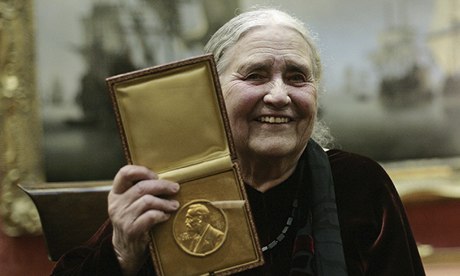
Doris Lessing, the Nobel prize-winning author of The Golden Notebook and The Grass is Singing, among more than 50 other novels ranging from political to science fiction, has died at her London home aged 94.
The biographer Michael Holroyd, her friend and executor, called her contribution to literature “outstandingly rich and innovative”.
He said: “Her themes have been universal and international. They ranged from the problems of post-colonial Africa to the politics of nuclear power, the emergence of a new woman’s voice and the spiritual dimensions of 20th-century civilisation. Few writers have as broad a range of subject and sympathy.
“She is one of those rare writers whose work crosses frontiers, and her impressively large output constitutes a chronicle of our time. She has enlarged the territory both of the novel and of our consciousness.”
Nick Pearson, her editor at HarperCollins/4th Estate, said : “I adored her.”
He added: “When I took over looking after her books she had a fairly formidable reputation, and the first time I went to meet her I was terrified, but she was always completely charming to me. She was always more interested in talking about the other writers on our list, what the young writers were working on – and reading – than in talking about her own books.”
Her last novel, although several earlier books have since been re-released as e-books, was Albert and Emily, in 2008.
Pearson said: “That was a very interesting book for her, revisiting the early life of her mother and her father and how they had been touched by the first world war. At the time she said to me ‘this is my last book’, and we accepted that. She was already at a great age, and I could see she was tired.”
The publisher’s UK chief executive, Charlie Redmayne, added: “Doris Lessing was one of the great writers of our age. She was a compelling storyteller with a fierce intellect and a warm heart who was not afraid to fight for what she believed in. It was an honour for HarperCollins to publish her.”
Twitter reacted quickly to the news, a shock to many despite her great age. The author and critic Lisa Jardine described it as “a huge loss”, and the agent Carole Blake called her an “amazing writer and woman”. The writer Bidisha tweeted: “Doris Lessing: prolific multi-genre genius dies in sleep after writing world-changing novels and winning Nobel. Not bad at all.”
Born in Iran, brought up in the African bush in Zimbabwe – where her 1950 first novel, The Grass Is Singing, was set – Lessing had been a London resident for more than half a century. In 2007 she travelled back to West Hampstead, north London, by taxi, carrying heavy bags of shopping, to find the doorstep besieged by reporters and camera crews. “Oh Christ,” she said, on learning that their excitement was because at 88 she had just become the oldest author to win the Nobel prize in literature. Only the 11th woman to win the honour, she had beaten that year’s favourite, the American author Philip Roth.
Pausing rather crossly on her front path, she said “one can get more excited”, and went on to observe that since she had already won all the other prizes in Europe, this was “a royal flush”.
Later she remarked: “I’m 88 years old and they can’t give the Nobel to someone who’s dead, so I think they were probably thinking they’d probably better give it to me now before I’ve popped off.”
Pearson, her editor at the time of the award, recalled the doorstep moment vividly: “That was what she was like. That was vintage Doris.”
The citation from the Swedish Academy called her “that epicist of the female experience, who with scepticism, fire and visionary power has subjected a divided civilisation to scrutiny”.
Her 1962 novel The Golden Notebook was described as “a feminist bible”, and her fellow laureate J M Coetzee called her “one of the great visionary novelists of our time”.
Doris Lessing
-
 17 Nov 2013: Oldest winner of the Nobel prize for literature, she was seen as a prophet, visionary and pioneer of the feminist movement
-
 Gallery (9 pictures), 17 Nov 2013:Author and Nobel laureate for literature Doris Lessing has died aged 94. Her body of work delved into human relations and inspired a generation of feminist writers
-
 17 Nov 2013: Lisa Allardice on the writer Doris Lessing best known for The Golden Notebook
-
17 Nov 2013: Tributes pour in for Nobel prize-winning author of over 50 novels including The Golden Notebook 57 comments
-
6 Nov 2013:The novelist talks to Laura Barnett about the death of feminism, her first novel and the worst thing anyone ever said about her53 comments
-
 22 Jul 2013:A journey through six ‘zones’ on the way to a threatened planet, this novel challenges SF’s usual aversion to spiritual speculation30 comments
-
1 Mar 2013: From experimental theatre to reading projects for young offenders, the double award covers more than just books
-
11 Feb 2013: As readers pointed out, my last list was rather skewed to a male-dominated tradition. Here is an alternative perspective 129 comments
-

 21 Jan 2013: Damon Wise: Flawed and wilfully odd, Anne Fontaine’s fascinating film examines the middle-aged female psyche in a sympathetic way 6 comments
-
5 Jul 2012:The Testament of Jessie Lamb author Jane Rogers lists her favourite great books where the safe, happy world as we know it comes to grief56 comments
-
8 Jun 2012: From Evelyn Waugh to Doris Lessing 2 comments
-
 6 Apr 2012:Lessing’s radical exploration of communism, female liberation, motherhood and mental breakdown was hailed as the ‘feminist bible’ and reviled as ‘castrating’. Four generations of writers – Diana Athill, Margaret Drabble, Rachel Cusk and Natalie Hanman– reflect on what it means to them57 comments
-
27 Jan 2012: Drugged visions from the opium eater, Harry Potter’s horrors sent by Voldemort … and other things that go bump in the night
-
19 Oct 2011:Originally published in the Guardian on 19 October 1984: Anita Brookner, a Cambridge University art historian, was the surprise winner of the £15,000 Booker Prize for fiction last night
-
 8 Mar 2011:Nobel prize-winning novelist, celebrated for writing a pioneering work of female emancipation
17 November 2013 Last updated at 15:32 GMT
Share this page
Doris Lessing, Nobel Prize-winning author, dies aged 94

Nick Higham looks back at the life of novelist Doris Lessing
Related Stories
British Nobel Prize-winning author Doris Lessing has died aged 94.
A statement from her publisher, Harper Collins, said she “passed away peacefully at her London home in the early hours of this morning”.
Her best-known works include The Golden Notebook, Memoirs of a Survivor and The Summer Before the Dark.
She became the oldest winner of the Nobel Prize for Literature when in 2007 she won the award for her life’s work aged 88.
Jonathan Clowes, her long-time friend and agent, said she was “a wonderful writer with a fascinating and original mind”.
“Start Quote
A compelling storyteller with a fierce intellect and a warm heart”
Charlie Redmayne Harper Collins UK
“It was a privilege to work for her and we shall miss her immensely.”
“Doris Lessing was a one of the great writers of our age,” said Charlie Redmayne, CEO of Harper Collins UK.
“She was a compelling storyteller with a fierce intellect and a warm heart who was not afraid to fight for what she believed in.”
The author is survived by her daughter Jean and granddaughters Anna and Susannah
Born in what is now Iran, she moved to Southern Rhodesia – now Zimbabwe – as a child before settling in England in 1949.
Her debut novel The Grass is Singing was published in 1950 and she made her breakthrough with The Golden Notebook in 1962.
On winning the Nobel Prize, the Swedish Academy described Lessing as an “epicist of the female experience, who with scepticism, fire and visionary power has subjected a divided civilisation to scrutiny”.

After learning she had won the award, she said she was “very glad” but recalled that in the 1960s she had been told the Nobel Prize committee did not like her and she would never win one.
“So now they’ve decided they’re going to give it to me. So why? I mean, why do they like me any better now than they did then?” she said.
The Swedish Academy said the Golden Notebook was seen as “a pioneering work” that “belongs to the handful of books that informed the 20th Century view of the male-female relationship”.
As an author, though, Lessing distanced herself from the feminist movement.
The content of her other novels ranged from semi-autobiographical African experiences to social and political struggle, psychological thrillers and science fiction.
She had two children with her first husband, Frank Wisdom, whom she married in 1939. But she left the family home and the couple divorced in 1943.
She then married and had a son with the German communist Gottfried Lessing in 1945.
They divorced in 1949 and she moved to England with her son Peter.
Tributes have been paid to Lessing by her fellow authors, with Professor Lisa Jardine remembering her as “one of our very greatest writers”.
What are your memories of Doris Lessing? You can send your comments using the form below.
Doris Lessing: a model for every writer coming from the back of beyond
-

-
- The Guardian, Monday 18 November 2013
- Jump to comments (44)

Wonderful Doris Lessing has died. You never expect such rock-solid features of the literary landscape to simply vanish. It’s a shock.
I first encountered Lessing on a park bench in Paris in 1963. I was a student, living on baguettes, oranges and cheese, as one did, and suffering from a stomach ailment, as one did. My pal Alison Cunningham and I had been barred from our hostel during the day, so Alison was soothing my prostrate self by reading from The Golden Notebook, which was all the rage among such as us. Who knew we were reading a book that was soon to become iconic?
Just as we were getting to a crucial moment in the life of Anna Wulf, along came a policeman to tell us that lying down on park benches was against the law, so we decamped for a bistro and another interesting washroom experience. (Footnote: this was before second-wave feminism. It was before widespread birth control. It was before mini-skirts. So Anna Wulf was a considerable eye-opener: she was doing things and thinking things that had not been much discussed at the Toronto dinner tables of our adolescence, and therefore seemed pretty daring.)
The other woman we were sneakily reading in 1963 was Simone de Beauvoir, but the childhoods of little-girl colonials such as ourselves lacked starched petticoats and were not very French. We had more in common with a remote-places-of-the-Empire parvenue such as Doris Lessing: born in Iran in 1919, growing up on a bush farm in Rhodesia (now Zimbabwe); then, after two failed marriages, running away to England with scant prospects, which was where we colonials with scant prospects ran away to then.
Some of Lessing’s energy may have come from her outland origins: when the wheel spins, it’s on the edges that the sparks fly. Her upbringing also gave her an insight into the viewpoints and plights of people unlike herself. And if you know you will never really fit in – that you will always be “not really English” – you have less to lose. Doris did everything with all her heart, all her soul, and all her might. She was sometimes temporarily wrong, as in the matter of Stalinist communism, but she never hedged her bets or pulled her punches. She went for broke.
If there were a Mount Rushmore of 20th-century authors, Doris Lessing would most certainly be carved upon it. Like Adrienne Rich, she was pivotal, situated at the moment when the gates of the gender disparity castle were giving way, and women were faced with increased freedoms and choices, as well as increased challenges.
She was political in the most basic sense, recognising the manifestations of power in its many forms. She was spiritual as well, exploring the limits and pitfalls that came with being human, especially after she became an adherent of Sufism. As a writer she was inventive and brave, branching out into science fiction in her Canopus In Argos series at a time when it was a dodgy thing for a “mainline” novelist to do. She was also very down-to-earth, having famously remarked “Oh Christ!” when informed in 2007 that she had won the Nobel prize. She was only the eleventh woman to do so, and never expected it; a lack of expectation that was in itself a kind of artistic freedom, for if you don’t think of yourself as an august personage, you don’t have to behave yourself. You can still kick up your heels and push the limits, and that was what interested Doris Lessing, always. Her celebrated experiment with a pseudonym as a demonstration of the hurdles facing unknown writers being just one example. (Her “Jane Somers” novels were reviewed as pale imitations of Doris Lessing, which must have been a little daunting for her.)
I never met Simone de Beauvoir – that would have been, in my youth, a terrifying prospect – but I did meet Doris Lessing, several times. These meetings took place in literary contexts, and she was everything a younger female writer might hope for: kind, helpful, interested, and with a special understanding of the position of writers from elsewhere within England.
As we age, we face a choice of caricatures; for women writers vis à vis younger ones, it’s Cruella De Vil versus Glinda the Good. I encountered my share of Cruellas along the way, but Doris Lessing was one of the Glindas. In that respect, she was an estimable model. And she was a model also for every writer coming from the back of beyond, demonstrating – as she so signally did – that you can be a nobody from nowhere, but, with talent, courage, perseverance through hard times, and a dollop of luck, you can scale the topmost storyheights.
• This article was corrected on Sunday 17 November 2013 because it gave the name of the main character in The Golden Notebook as Martha Quest instead of Anna Wulf.
Series: My hero
My hero: Doris Lessing by Margaret Drabble
- The Guardian, Saturday 23 November 2013
- Jump to comments (2)
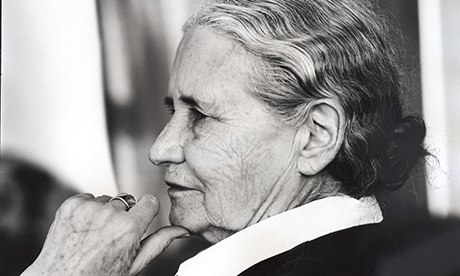
I remember very clearly how I met Doris. I took the initiative, which was very uncharacteristic for me. I wrote to her in the late 1960s, out of some kind of desperation, and she very kindly asked me to lunch. I had just read The Golden Notebook, which prompted my attempt at contact, and I was overawed by her. I didn’t pursue the friendship very vigorously until some years later, when somehow, slowly, a different pattern established itself between us. She gave large parties, to which I was invited, and for which she did her own cooking – great casseroles and pots and bowls of food, what she called the farmer’s food of a farmer’s daughter, which we ate sitting on the floor or perched on the arms of chairs. She was a good cook, and enjoyed seeing other people eat and drink. Her company was miscellaneous – African writers and politicians, feminist publishers from the antipodes, people she’d met at a Russian evening class, scientists, novelists, playwrights, poets, journalists, campaigners, translators, an old lady who lived down the (rather shabby) street. We all mixed in comfortably together. A cat or two would perch itself amid the throng, soliciting attention. Doris loved cats, and wrote a book about them. Some of them were strays that had wandered in, found a good welcome, and stayed. I once saw Doris’s grand American publisher Bob Gottlieb giving one of these intrusive cats a very hostile and suspicious look. I think he thought they’d got the upper hand and he feared for Health and Safety.
Doris would invite herself to lunch with me in Hampstead, when the mood took her. I never dared to say no. Hers was a royal command. Even if I was frantic with children’s activities or deadlines, Doris had to be accommodated. So I would drop everything and cook for her – soup, chicken casserole, fish stew. I know I wasn’t the only person to whom she issued these decrees.
I remember one occasion when Doris invited herself on the day when my cleaning lady was due to come. Mrs Van always came on Wednesdays, and I could not possibly have rearranged her. My cleaning lady was not only my cleaning lady, she was my surrogate mother. I loved and admired her, and I always cooked lunch for her. So there we were, at table together, Doris Lessing and Mrs Van and me.
We got on well. Mrs Van Blerk was South African Cape Coloured, and had come to England just after the war with her white Afrikaner husband and her three children, in flight from apartheid. (Her husband died shortly after their arrival, and she supported herself and her family for decades.) Doris had come to England from South Africa at much the same period, without her husband and with only one of her three children, in flight from her mother. These two wise, hard-working women exchanged notes and I listened. It was a historic conversation. I have forgotten what was said, but I remember the mood. After lunch, Doris and I went upstairs to hide in my bedroom with our coffee, to allow Mrs Van to carry on with her cleaning. I was in awe of both of them.