http://english.ucsb.edu:591/rchrono/default.htm
 |
Selected 17th-C. Events |
18th-Century to 1784 |
1785-1791 |
| 1792-1793 | 1794-1795 | 1796-1798 |  |
 |
1799-1806 |  |
1807-1814 |
| 1815-1822 |
1823-1830 | 1830-1837 | |
1838-1851 |
|||
Universitat de València PRESS – UVPress – weblog for research uses
| A Vindication of the Rights of Woman by Mary Wollstonecraft Table of Contents |
A Vindication of the Rights of Woman: with Strictures on Moral and Political Subjects (1792), by Mary Wollstonecraft, is one of the earliest works of feminist philosophy. In it, Wollstonecraft responds to the educational and political theorists of the eighteenth century who wanted to deny women an education. She argues that women ought to have an education commensurate with their position in society and then proceeds to redefine that position, claiming that women are essential to the nation because they educate its children and because they could be “companions” to their husbands, rather than mere wives. Instead of viewing women as ornaments to society or property to be traded in marriage, Wollstonecraft maintains that they are human beings deserving of the same fundamental rights as men.
Wollstonecraft was prompted to write the Rights of Woman by Charles Maurice de Talleyrand-Périgord’s 1791 report to the French National Assembly which stated that women should only receive a domestic education; she used her commentary on this specific event to launch a broad attack against sexual double standards and to indict men for encouraging women to indulge in excessive emotion. Wollstonecraft wrote the Rights of Woman hurriedly in order to respond directly to ongoing events; she intended to write a more thoughtful second volume, but died before she was able to complete it.
While Wollstonecraft does call for equality between the sexes in particular areas of life, such as morality, she does not explicitly state that men and women are equal. Her ambiguous statements regarding the equality of the sexes have since made it difficult to classify Wollstonecraft as a modern feminist, particularly since the word and the concept were unavailable to her. Although it is commonly assumed now that the Rights of Woman was unfavorably received, this is a modern misconception based on the belief that Wollstonecraft was as reviled during her lifetime as she became after the publication of William Godwin’s Memoirs of the Author of A Vindication of the Rights of Woman (1798). The Rights of Woman was actually well-received when it was first published in 1792.
 one or more chapters are available in a spoken word format.
http://www.bbc.co.uk/arts/romantics/
World changing events in the late 18th century – from the French Revolution via American Independence – instigated a new movement in the art, literature and thinking of Britain: The Romantics.
On this site you can find out more about the poets that forged that movement. Listen now, or download for later, exclusive readings of the major works by Blake, Wordsworth, Coleridge, Byron, Shelley, Keats and Clare.
Available to listen.
Last broadcast on Thu, 12 Oct 2000, 21:30 on BBC Radio 4 (see all broadcasts).
 Melvyn Bragg and guests discuss the ideals, exponents and legacy of Romanticism. In the space of a few years around the start of the nineteenth century the Romantic period gave us: Wordsworth, Coleridge, Blake, Burns, two Shelleys, Keats, De Quincey, Carlyle, Byron, Scott… the list goes on and on. And the poems: The Rhyme of the Ancient Mariner, Ode to a Nightingale, Tintern Abbey, Ozymandias, Don Juan… they make up some of the best known and most enjoyed works of literature in the English language.
How do we explain what seems to be an extraordinary explosion of talent? Were the Romantics really a movement with their own philosphy and ideals? And when its adherents often died so tragically young, and its poems often seem so steeped in nostalgia and so wrapped in the transcendental, is Romanticism really good for you in a modern world?
With Jonathan Bate, Professor of English, University of Liverpool; Rosemary Ashton, Professor of English, University College London; Nicholas Roe, Professor of English, University of St Andrews.
Available to listen.
Last broadcast on Thu, 15 Apr 2004, 21:30 on BBC Radio 4 (see all broadcasts).
 Melvyn Bragg and guests discuss the poetry, the tragedy and the idealism of the Later Romantics. There must have been something extraordinary about the early 19th century, when six of the greatest poets in the English language were all writing. William Blake was there and Wordsworth and Coleridge had established themselves as the main players in British poetry, when the youthful trio of Byron, Shelley and Keats erupted – if not straight onto the public stage, then at least onto the literary scene. The great chronicler of the age was William Hazlitt, whose romantic maxim was:
“Happy are they who live in the dream of their own existence and see all things in the light of their own minds; who walk by faith and hope; to whom the guiding star of their youth still shines from afar and into whom the spirit of the world has not yet entered…the world has no hand on them.”
How fitting an epitaph is that for the three great poets who all died tragically young? What were the ideals that drove them and how did their unconventional lifestyles infect the poetry they left behind?
With Jonathan Bate, Professor of English Literature at the University of Warwick; Robert Woof, Director of the Wordsworth Trust; Jennifer Wallace, Director of Studies in English at Peterhouse, Cambridge.
http://www.bbc.co.uk/poetryseason/poets/william_blake.shtml
| From “Auguries of Innocence” by William Blake (1757-1827) |
| To see a World in a Grain of Sand And a Heaven in a Wild Flower, Hold Infinity in the palm of your hand And Eternity in an hour… |
Poet, artist and mystic William Blake was one of England’s most original thinkers. His two volumes, Songs of Innocence and Songs of Experience contain some of the most unforgettable poems in the english language. On the surface, as simple as nursery rhymes, they offer profound insights into human nature, and the need for social justice.
Blake was born in Soho, in 1757, the son of a hosier. Apart from three years residing near Bognor Regis, he would spend his life in London, as Blake himself would note in his hymn to the capital, “near where the charter’d Thames does flow”. As a child, Blake claimed to have seen God at his window, and angels bespangling the treetops of Peckham Rye. He would have “visionary imaginations” throughout his life, and many regarded him as a madman. At the age of 10, Blake was apprenticed to an engraver, and later, studied briefly at the Royal Academy. During his long career as an artist and engraver he created magnificent illustrations for editions of Dante and John Milton , and all of his own works were self-illustrated, full of invented mythological characters and rich proverbial statements.
Blake died in poverty in 1827 and is buried alongside Daniel Defoe and John Bunyan in London’s Bunhill Fields. His imagery has influenced poets from Coleridge through to Ginsberg, and inspired novelists such as Philip Pullman, Tracy Chevalier and Silence of the Lambs author Thomas Harris, while quotes from his writing have inspired film titles such as Chariots of Fire. His poem Jerusalem, written as the preface for Milton’s A Poem, was set to music during the First World War and has been adopted as an alternative national anthem. Blake’s The Tyger is probably the most anthologized poem in English literature.
Is Blake
the Nation’s
Favourite Poet?
And did those feet in ancient time
Walk upon England’s mountains green?
William Blake
The Nation’s Favourite Poet
Slideshow of William Blake’s poem London
BBC © MMX
12 November 2009 in 1st Paper, 2nd Paper, General, Narrativa and tagged british literature, English Literature, links, Listados de links by fores | No comments (Edit)
A continuación disponéis de una serie de links imprescindibles y que todos deberíais consultar.
Editorial
John Patham
4
Amongst the many sceptical questions that ecocritics have got used to answering is
how we can justify examining the literature of the past when everybody ‘knows’ that
environmental concerns only began in the 1960s. That point is, itself, debatable: one
might consider, for example, John Evelyn in 1661 condemning the noxious effects
of London’s air pollution (as cited in Derek Wall’s Green History anthology); not to
mention the widespread ecological concerns of Victorian writers, whether it’s the
novelist Disraeli lamenting, in Sibyl, a landscape “interspersed with blazing furnaces,
heaps of burning coal, and piles of smouldering ironstone” and mining operations
that had left “whole rows of houses awry, from the shifting and hollow nature of
the land” or the poet Hopkins complaining about deforestation in ‘Binsey Poplars’
or the ‘ecological imperialism’ inflicted by the introduction of English trees into the
Australian landscape. Nevertheless, it is the case that the practice of what might be
called historical ecocriticism is not so much about excavating past environmental
anxieties – interesting and informative as these are – as about examining antecedent
attitudes towards nature for clues in the attempt to understand our own. As the
environmental historian Carolyn Merchant has put it, in The Death of Nature, “new
social concerns generate new intellectual and historical problems. Conversely, new
interpretations of the past provide perspectives on the present and hence the power to
change it” (1982: xvi).
Driven by the possibilities that Merchant has described a central component of
the ecocritical project has been uncovering those historical periods that can speak
to our own environmental anxieties. Ecocritics have predominantly turned, in this
context, to two traditions – British Romanticism and American nineteenth-century,
transcendental nature writing – in which a prototypical ecological consciousness is
believed to have emerged. Issue 13 of Green Letters will examine another potentially
fertile source by focusing on the Victorian ecology described above. This issue,
however, steps further back in time to examine the writing of pre-modernity, most
notably, that of the classical and medieval periods. By removing themselves ever
further from a contemporary green discourse, the contributors uncover, we believe,
some of the more complex ways in which the literature of the past might illuminate
our own ecological concerns.
In the final essay here Simon C. Estok raises the question as to what differentiates
Green Letters Volume 11
5
ecocriticism from the much longer tradition of writing about ‘literature and nature’
(or ‘environment’). The answer presented by the essays is that often radical “new
interpretations” of both familiar and less familiar texts can shed light on those attitudes
to nature which have shaped our own contemporary ideas and practices. This applies
whether we are talking about ecological or counter-ecological attitudes. So, on the
one hand, we discover Michel Serres identifying through Lucretius a long tradition in
which a view of (nonhuman) nature as characterised by motion, chance and diversity
leads us (as Laurence Coupe finds) towards a Gaian notion of interrelatedness and
interdependence that runs counter to the dominance of the Christian, hierarchical
chain of being; on the other hand, examinations of the thirteenth-century devotional
text Ancrene Wisse, and attitudes to rain in medieval poetry, uncover the origins of a
cultivation of the self that has alienated us both from nature and other human beings.
This attitude, as it has filtered into modern (or perhaps postmodern) culture, in turn
continues to impede the collective acts necessary to environmental amelioration (as
Gillian Rudd (via Val Plumwood) argues). A brief summary of the six articles published
in this issue of Green Letters, which follow a broadly chronological trajectory, makes
these links even clearer.
Mythical or not it seems appropriate to begin with Laurence Coupe’s discussion
of the book of Genesis, a discussion designed to reveal how religious myths of origin
can, once re-read, return us to a necessary knowledge of how to revere nature. Taking
his inspiration from Serres’ reading, as described above, of the Roman poet Lucretius’
On the Nature of Things Coupe, taking up the thread of this connection between
ancient mythology and contemporary ecology, in a re-visiting of his own work on
myth, delivers a green reading of creation myths drawn from the theologian Anne
Primavesi’s comparison of the seemingly disparate Genesis and Gaia myths.
Arguing that the Book of Genesis has been distorted by its forcible conversion
from mythos (narrative) into logos (idea), and ultimately into doctrine, Primavesi has
re-kindled its imaginative subtlety so as to suggest that the ‘wisdom of the Earth’ that is
‘personified in Gaia’ is explicitly anticipated by the Bible. With her work underpinned,
in a way that is important to literary critics, by a fidelity to proper scriptural scholarship,
Coupe points out that Primavesi’s audacious pairing of Genesis and Gaia can help
engender what she calls a ‘revolution within ourselves’; that is, alternative but still
credible readings of biblical texts might bring about a change of consciousness, in
terms of our sense of the human relationship to nature, that can be a prelude to more
radical changes in behaviour.
This notion as to the importance of new readings of pre-modern texts is then
directed, specifically, towards literature in our second essay by John G. Fitch. Here,
in a challenge to more conventional readings, Fitch asserts that nature was central to
the work of the Roman poet Horace. Much as Jonathan Bate did with Wordsworth in
Romantic Ecology – a book that, eighteen years ago, offered the earliest, substantial
British study of a literary predecessor – Fitch takes issue with prevailing literary
and new historicist treatments offering, instead, an environmentalist interpretation
John Parham
6
of Horace’s historical importance within western literary tradition. In an absorbing
survey that ranges across diverse aspects of Horace’s writing – from his concern with
nature’s limits and wealth, to writing about his farm, to the relevance of nature in
relation to the springs of creativity – Fitch examines, most substantially, Horace’s
notion of nature as a guide for human life, or a criterion for human behaviour.
Suggesting these as ideas that will resonate in particular with today’s environmentally
minded reader, he suggests that we are particularly likely to respond to ideas such as
parsimony and a ‘sparing’ lifestyle, and of true wealth as constituted by contentment
rather than incessant acquisition, messages which, having also been emphasised from
within ‘social ecology’, remain as urgent today as ever.
The third essay, by Alexander Moss, begins with the immediately intriguing – and
largely fulfilled – promise that it will “initiate a dialogue between ecocritical discourse
and a thirteenth-century devotional text known as Ancrene Wisse, or ‘Guide for
Anchoresses’”. In this endeavour Moss makes a compelling argument for the relevance
of medieval sources to contemporary ecocritical debates most notably through
his exploration of the now familiar nature-culture binary which he sees as having
developed in this period. Taking up the theme, Moss considers, in detail, the extent
to which humanism, as related to ‘the ethical life’, can be seen as being constituted
of either animality and/or “rational and spiritual fulfilment”. Much of the interest
in this essay lies, accordingly, in its examination of those elements of the Ancrene
Wisse drawn from the bestiary tradition. Yet Moss also signals, at least, some really
intriguing connections between this text and the Heideggerian notion of creating one’s
being through an ongoing process of becoming and dwelling: a negotiation between
the spiritual and the somatic that suggests, in turn, some interesting ways in which the
kind of dwelling an anchorite embarks upon can be compared to that described by
Heidegger. Moss, all the same, convincingly argues that the focus on the ‘self ’ which
originated in this period would precipitate the desire for mastery and so eventually
bring about a schism between the human and the nonhuman living world.” In the
regulatory energy, so carefully expounded by the author, the Ancrene Wisse can be
seen, therefore, as constituting a programme of cultivation that represents, in turn, a
mastery of nature in microcosm.
Gail Blick’s article examines the biblical association between wilderness and the
spiritual desert and turns, in doing so, to Langland’s Piers Plowman. Focusing on the
poem’s interspersing of Vulgate quotations with the vernacular, Blick embarks upon
some close textual analysis in order to explore the often neglected biblical quotations
as a way of enhancing our sense of that association. So, for example, she highlights
how surrounding verses in Philippians (to those we see in the poem) exhibit an
original understanding of pilgrimage as the exile’s journey through alien country, the
unnatural place, towards perfect nature, and heaven. Practising, therefore, precisely
the close textual scholarship advocated by Primavesi, Blick arrives, correspondingly,
at a new, more ecological reading of biblical references and the biblical context. From
there, the paper argues that, for Langland, Christ was the source of renewable energy,
Green Letters Volume 11
7
and that the interaction between species was divided between those who seek to
follow Christ and those who do not, the non-native species. Consequently, Langland
connected with his environment and sought to preserve the natural resources of his
world: to conserve souls for salvation, to encourage reform but also to protect against
undesirable change to the moral climate of fourteenth-century Christians.
Gillian Rudd takes a somewhat different tack in a very entertaining reflection on
the properties of rain. Suggesting that “the reaction to rain is more particular, precise,
long-standing and deep-rooted than we might have expected” and that that reaction
is “reflected in literature as well as promulgated by it” Rudd examines images of rain
in medieval poetry as a means to explore the degree to which this particular weather
condition, experienced both individually and collectively, has the potential (or not) to
take us out of ourselves and into our environment. The bulk of the essay is an informative
examination of various examples of that poetry. Aside from her own brief reflections
on Langland, these include other, less familiar sources such as ‘King Horn’, the earliest
surviving Middle English Romance (1225), a mid-fourteenth century, anonymous
lyric, ‘All other love is like the mone’, a sixteenth-century equivalent ‘Westron Wynde’,
and work by the poets Lydgate and Dunbar. Further to this survey, Rudd concludes
with an excellent illustration of how long-standing cultural ideas may have impacted,
detrimentally, on, in Val Plumwood’s words, a contemporary ‘environmental culture’.
Here Rudd offers the view that ‘a species that finds rain isolating, cold and miserable’,
in a cultural tradition that spans (amazingly) from the medieval poetry examined in
the essay to the 1990s indie music alluded to in its title, will struggle both to ‘take on
board the enormity of climate change’ and to make the collective act necessary to
environmental amelioration.
The final piece, Simon C. Estok’s combative ‘The Muddy Shakespearean Green’
takes us, strictly speaking, away from pre-modernity and into the early modern
period. Yet it nevertheless raises issues central to this edition, the other essays in it, and
ecocriticism as a whole, issues about the relationship between contemporary ecological
concerns and the extent to which these may or may not have been informed by our
historical, literary predecessors. Exploring the question (as alluded to above) of what
differentiates ecocritical studies of Shakespeare from those, already plentiful, studies
that connect his work to the environment (or nature), the answer appears to lie, for
Estok, in the specific, activist intentions of a Shakespearean ecocriticism. By raising
this point he puts forward some interesting, challenging, preliminary thoughts as to
what might constitute an activist ecocriticism. In their partial emphasis on individual
acts such as vegetarianism or veganism these connect back to Alexander Moss’ article
in that what Estok appears to offer is an alternative conception of ‘the ethical life’
that places this in a dialogue with ecological imperatives in a way often lost in its
more religious or spiritual manifestations. Amidst all this there also lies, in his essay,
some thought provoking broadsides at meat eating and the meat industry which, also
Interview
Archive | Latest | E-mail | Log In
December 18, 2006 5:30 A.M.
Three Cheers for the Patriarchy
Pride and prejudiced English professors.

Elizabeth Kantor is author of The Politically Incorrect Guide to English and American Literature. In it she chronicles both what is wrong with U.S. English departments and what you can do to both combat them and make up for their deficiencies in your personal library. Kantor recently took some questions from NRO editor Kathryn Lopez about higher ed, remedial education under the Christmas tree, and more.
Kathryn Jean Lopez: The cover of your book has a friendly professor calling it “Truly offensive — in the best sense of the word.” But if you truly wanted to offend, wouldn’t you have avoided Jane Austen and Flannery O’Connor and kept it all dead white males?
Elizabeth Kantor: Actually, the Jane Austen section is the part of the book that will really annoy the feminists. Because, contrary to what you may have heard, Jane Austen’s novels are not “subversive.” They’re funny. Jane Austen made fun of men (and of women, too). But it was human folly and vice, not “patriarchal oppression,” that made her mad. If Jane Austen were living today, we’d call her a conservative Christian. She was quite comfortable with traditional sex roles. The villains in her novels are not jealous, controlling patriarchs. They’re weaklings. The men who cause the real trouble in Austen novels are distant, uninvolved fathers; uxorious husbands who do selfish things to please their awful wives; and lovers who pay too much attention to girls they aren’t ready to marry. Jane Austen clearly thought a lot of men would be improved if they were more patriarchal than they actually are.
– – – – – – – – – – – – – – – – – – – – – – – – – – – – – – – – – – – – – – – – – – – – – – – – –
ADVERTISEMENT
– – – – – – – – – – – – – – – – – – – – – – – – – – – – – – – – – – – – – – – – – – – – – – – – –
Lopez: What’s so special about Flannery O’Connor anyway? She ain’t Shakespeare.
Kantor: No, there’s only one of him. But Flannery O’Connor’s a great American writer. And a great one to start with, if you’re at all intimidated by the thought of plunging into good literature on your own. O’Connor’s works are strange, funny stories about eccentric characters living in the Bible Belt. But they’re also profound investigations into original sin and supernatural grace. Not, as you can imagine, the hot topics in our English departments at the moment.
Lopez: Speaking of: Who says women shouldn’t read Shakespeare? What would Maureen Dowd do if our alma mater Catholic University (all three of us went there) didn’t teach any Hamlet?
Kantor: I can’t even begin to imagine. Of course women should read Shakespeare. However great an injustice it was that mostly “dead white males” had the opportunities necessary to write great literature in the Renaissance, it doesn’t fix that injustice to teach not-so-great literature instead. Affirmative action in the curriculum is as counterproductive as affirmative action in admissions. I mean, what good does it do women and minorities to enroll in college in greater numbers than in past, if the curriculum they get once they’re there is drastically dumbed down from the curriculum that white men used to get, back when mostly white men went to college?
Lopez: Rewinding a bit to some core questions: How bad is English and American lit teaching really? If you read Beowolf in high school were you just really, really lucky?
Kantor: It’s pretty bad. Postmodernist “literary theory” got a foothold at places like Yale in the 1960s and ’70s and has now swept across the country and through every level of our educational system. When I was doing research for The Politically Incorrect Guide, I looked at the MLA job list, which is the first stop for anybody hoping to get a tenure-track job in English. There were numerous openings for experts in multiculturalism, but only a single listing mentioned that the job candidate should know anything about Shakespeare. And that one was for a job at Hardon-Simmons University in Texas, which also required a “philosophy of teaching in a Christian context.”
Lopez: Is it your contention that English professors are worse than professors in other disciplines?
Kantor: English is unique, I think, in a couple of depressing ways. First, in that English professors seem to prefer teaching almost anything but their own subject. Including even the jetsam of other disciplines — discredited cast-offs including Marxism, Freudian analysis, and I, Rigoberta Menchu. Not to mention the English professors teaching foreign films, detective novels, comic books, and pornography. Second, in that English departments are ground zero for the postmodernist attack on — well, on almost anything of value you might name, from truth and beauty to Western civilization to the idea that words mean things. Virtually every college student takes one or more English classes. That made good sense when those classes taught universally valuable lessons such as how to read Shakespeare and how to write a coherent sentence. But now those English classes mean that virtually every college student gets introduced to some variety of anti-Western, anti-rational ideology.
Lopez: Who’s to say what literature is really great? I mean that both because I’m being a jerk and as a practical administrative and policy matter.
Kantor: Whoever makes the most compelling case that a work of literature is great — on the basis of its emotional power, the beauty of its language, its truth to the human condition, its expression of the eternal verities, its ability to inspire noble deeds, or its capacity to purge the mind of terror and pity. Or some combination thereof. In other words, on the basis of any actual criteria of literary excellence. We absolutely can — despite the silly arguments you used to hear in English departments in the 1980s — establish that the works of Shakespeare are more worth teaching than The Boy Scout Handbook, or the phone directory.
“The canon” was never absolutely fixed in stone. It was more like a snapshot of where informed judgments about literature were at any given moment in time. Even Shakespeare’s valuation has fluctuated over the centuries, though his stock never crashed. T. S. Eliot deflated Milton’s reputation gave the metaphysical poets a huge boost. The problem we’ve got now is that what you might call the free market in literary judgments was essentially shut down by the proponents of “literary theory” who have wrecked our English departments. They attacked the canon with the argument that some people — mostly women and “people of color” — had been excluded, and that therefore the standards for inclusion must have been skewed to “privilege” some groups over others. But, as we know from the world’s experience with Marxist economics, insisting that nothing can be done until everyone is included on a 100-percent equal basis is a recipe for disaster. The first step back toward sanity on this question is to quit paying attention to arguments that authors should be picked by their status as victims.
Lopez: Only a Regnery book would manage to work an Anita Hill reference into Beowolf. How did you do it? And did they pay you enough?
Kantor: You know, my cousin (who’s not a conservative) asked me essentially the same question: Does Regnery pay you to include these political references at regular intervals, the way the authors of bodice-rippers are supposed to be paid by the sex scene? No, it comes naturally. Wouldn’t you immediately think of those activists who kept saying how important it was that everyone “get it” about sexual harassment, during the Clarence Thomas hearings — with apparent total disregard for the question of whether Thomas was actually guilty of sexual harassment — if you read an English professor’s describing a female character’s murders (of men who looked at her the wrong way) as her mimicking the objectifying, destructive male gaze? That’s why I call Modthryth “the Anita Hill of the Dark Ages.”
Lopez: Why am I not supposed to read The Allegory of Love? Why should I?
Kantor: The history of courtly love is very politically incorrect. The feminist conspiracy theory about human history is that women have always been at a disadvantage because of patriarchal oppression. Putting women on a pedestal is supposed to be an especially sneaky way that men maintain their privileged status. Or perhaps “the patriarchy,” working away behind the scenes, makes this happen all by itself. But if you read Chaucer’s Canterbury Tales, for example, you can see that special courtesy towards women — which started out as a medieval literary fad, but by Chaucer’s day was trickling down into ordinary marriages — was transforming relations between the sexes in a way that was very liberating for women. (Unless, of course, you figure that Chaucer just told the story that way because he was doing his bit for the patriarchy.) There are reasons women have more freedom and dignity in the West than in, for example, Saudi Arabia. And it’s got little or nothing to do with 1970s feminism.
Lopez: Say something in postmodern English.
Kantor: I freely admit that I’m not fluent in the English professors’ wretched jargon. But I’ll give it a shot. How about: “As a cultural-studies professor, I interrogate Romantic texts to investigate the foregrounding of the problem of subjectivity in the nineteenth-century imaginary.” Rough translation: Because I’m a Marxist, I spend my time trying to show that Wordsworth’s poems about the imagination and the extraordinary powers of the human mind are the results of impersonal historical forces.
Lopez: You seriously suggest adult Americans should take time out of their busy lives to give themselves the lit educations they missed (even though they may still be paying off loans for that miseducation)?
Kantor: Well, somebody has to keep Western culture alive. Seriously, Shakespeare and Milton used to make educated Americans and citizens of the West. English professors who are into Marx and radical feminism aren’t succeeding in converting American college students to those dreary ideologies — at least not in large numbers. But they are, I’m very much afraid, successfully preventing the transmission of our literary heritage to the next generation. The Politically Incorrect Guide has lots of suggestions for making great literature a part of a busy adult life. Upgrade your bedtime reading: Trade in Tom Clancy for Tom Jones. Learn how to memorize a sonnet while you’re in the doctor’s waiting room, or with your toddler at the park. Throw a Shakespeare party — and find out which one of your friends is just a little bit more like Lady Macbeth than anyone else. And in case you do have time to thoroughly reeducate yourself (or want to teach your children), there are lists in the Guide that together make up a curriculum for a complete survey.
Lopez: Okay, okay. So let’s say I want my husband to get the best of American and British lit. Before he files the divorce papers because he’s so insulted that I think he’s uneducated, what would make a worthwhile Christmas-gift book collection?
Kantor: This is just what The Politically Incorrect Guide to English and American Literature is for. Let him read it and decide for himself that he needs a real literary education, and where to start. The Guide’s not condescending — the readings of the literature are for grown-ups. But it’s written to amuse as well as instruct. And I’ve done my best to hit all the basics: every period of the literature, and the essential techniques, such as “close reading.” There’s great literature for every taste, and something is bound to strike a chord with him — whether it’s the devastating satire of Dryden and Swift, T. S. Eliot’s painfully beautiful modern poetry, or Mark Twain’s quintessentially American stories. Give him the opportunity to find the literature that’s his own kind of thing. Once he gets started, he’ll want to branch out.
Lopez: What about a college student who, while I’m paying $40,000 a year, I need to make read real books she’s not reading in any of those classes she supposedly goes to. What do I give her? And how do I do it so there might be a shot she reads some of them, gets something out of them, and maybe even enjoys ‘em?
Kantor: Again, I think you have to start from where she is. If she likes chick lit, romance novels, or Jane Austen movies, get her started on Austen’s novels themselves. They’ve got everything of any value that you can get out of The Devil Wears Prada, but there’s so much more in Austen. Going from Bridget Jones’s Diary to Pride and Prejudice is like going from a potato chip-and-Twinkies diet to being fed by a five-star chef. If she spends all her time with an ipod in her ears, try her on some of the more musical poetry: Shakespeare’s sonnets, or Tennyson. If she’s a Lord of the Rings fan, give her Beowulf or The Battle of Maldon — after all, J. R. R. Tolkien spent his life studying Old English poetry, and it colored all his writing. But try something! Don’t trust her English professors — not if you want her to have a real education.
<title>The Politically Incorrect Guide to English and American Literature, by Elizabeth Kantor </title>
<link>http://www.nationalreview.com/redirect/amazon.p?j=1596980117</link>
<image>http://www2.nationalreview.com/kantor_politically.jpg</image>
July 18, 2010, 02:21 PM ET
 If you’re a fiction writer or a poet who planned to submit something to the Mississippi Review this summer, you might want to hold off for the moment. The journal’s editor, fiction writer Frederick Barthelme, will not be returning to his job as director of the University of Southern Mississippi’s creative-writing program, the Center for Writers. That means he’s also left the Review, which is published by the center.
For years the Review has been held in high regard, publishing Ray Carver, Rick Moody, Tao Lin, and other established and rising talents. According to Barthelme and to news reports, he’s not the only casualty; the managing editor is now gone too.
The Hattiesburg American has been covering the center’s drama in detail. The paper reported that the circumstances of Barthelme’s departure have dismayed the university’s creative-writing faculty members and students. (See more coverage here.) Julia Johnson, a poet and an assistant professor of English, voiced some of those concerns. “I came here to work in a nationally recognized creative writing program, with a national magazine, a visiting writer’s series and Rick Barthelme,” she told the Mississippi paper. “I didn’t come here to work in an English department with a little sideshow for its creative writing students.”
The Chronicle asked Barthelme via email what’s going to happen with the Review. “At present, then, there is no staff at all, and there is no one here who has actually run a magazine previously,” he responded. “The interim department chair has been talking to other English faculty (non-creative writing) about taking over the magazine. He is also talking to the remaining CW faculty about the same thing, and it’s unclear which way the tree will fall.”
The uncertainty has already had an effect, according to Barthelme, who told us that the summer 2010 online issue has been cancelled. “Another is scheduled for Oct. 1, and I have heard nothing about plans for it,” he said. “The online magazine has, as you may know, separate content, i.e. it is not a reprint, or a partial version of the print magazine–it’s completely separate with original content.”
There’s still a print issue scheduled for December 2010, Barthelme told the Chronicle, “but as far as I know there are no plans in process for producing it.”
Steven R. Moser, associate dean and professor of music at the university, is the interim head of the English department. Via e-mail, the Chronicle asked him to comment on the situation. Moser said that the editorship of the Review has been offered to Julia Johnson, “who had been groomed to assume these duties in recent years and assumed significant responsibilities last year.” Johnson did not immediately respond to a request for comment, and Barthelme said that although she might serve as editor temporarily she may not stay at the university past the coming year.
And the future of the Center for Writers? “The creative writing program at Southern Miss is an important and high profile program and we remain committed to it,” Moser said. “The four remaining faculty are all fine teachers and excellent mentors who will do all they can to support the students in the next few years. I am working with the creative writing faculty right now to find a visiting writer in residence to teach some of the fiction classes for the upcoming year.”
He added, “Going forward a search committee will be formed to begin a search for a faculty member for the fiction-writing position. While these times of transition are always challenging we are confident in the future of this program and of the Mississippi Review.”—Jennifer Howard
http://ted.hyperland.com/
Before the personal computer, and before the Web, there was Theodor Holm Nelson, who almost half a century ago understood how computers would transform the printed page.
The best summary of my work (except for certain details) is by Tim Berners-Lee, below. While I greatly appreciate his intention, I have added corrective footnotes. Thanks, Tim, for a kind and gracious summary within your frame of reference, and I hope someday we can reach a deeper understanding and a shared vision.
Ted Nelson, a professional visionary,1 wrote in 1965 of “Literary Machines,”2 computers that would enable people to write and publish in a new, nonlinear format, which he called hypertext.3 Hypertext was “nonsequential” text, in which a reader was not constrained to read in any particular order, but could follow links and delve into the original document from a short quotation.4 Ted described a futuristic5 project, Xanadu[®6], in which all the world’s information7 could be published in hypertext. For example, if you were reading this book in hypertext, you would be able to follow a link from my reference to Xanadu to further details of that project. In Ted’s vision, every quotation would have been a link8 back to its source, allowing original authors9 to be compensated by a very small amount each time the quotation was read10. He had the dream of a utopian11 society in which all information could be shared among people who communicated as equals.12 He struggled for years to find funding for his project, but success eluded him.
— Tim Berners-Lee with Mark Fischetti,
Weaving the Web.
Harper/San Francisco, 1999, p.5.FOOTNOTES CORRECTING THE ABOVE:
1. No one has ever paid me to be a visionary.
2. I don’t believe I used the term “literary machines” until 1981, when I made it the title of a book. However, 1965 is when I first used the word “hypertext” in print.
3. It is vital to point out that Tim’s view of hypertext (only one-way links, invisible and not allowed to overlap) is entirely different from mine (visible, unbreaking n-way links by any parties, all content legally reweavable by anyone into new documents with paths back to the originals, and transclusions as well as links– as in Vannevar Bush’s original vision).
4. Going back to the original must not be done by links but must be done by deeper transclusive means. The link mechanism, particularly the embedded link of the Web, cannot do this correctly.
5. “Futuristic” is one of those words which implies that an idea is not a possibility– just a crazy dream, and thus only an inspiration. I believe Tim thinks he made my ideas practical, whereas I think he oversimplified them– with today’s extreme complexity as the result.
6. “Xanadu” is a registered trademark which I maintain at considerable cost, and I ask all parties to respect this by using the “®” or “(R)” symbol for the first use of the trademark “Xanadu” in each document.
7. Not “all the world’s information”, but all the world’s documents. The concept of “information” is arguable, documents much less so. I believe Tim is finding his concept of pure information, the “Semantic Web”, much more difficult to achieve than hypertext documents.
8. No, not a link; a transclusive pathway. The two mechanisms are entirely different. A link connects two things which are different. A transclusion connects two things which are the same.
9. Not authors, rightsholders. Sometimes the author is a rightsholder, sometimes not. A rightsholder is generally someone who has bought or contracted the rights from the author. While we have sentimental concern for authors, in our system of law the rightsholder can be anyone, just as the owner of land is rarely the original settler any more. Besides fairness to authors and artists, a key objective is to bring in the commercial rightsholders– big publishers, university presses, movie studios– who will not otherwise publish their content digitally. Many people think I am against free content; nonsense. I want to create a shared world of mixable content both free and paid.
10. No, not every time it was read (pay per view) but the first time purchased, as with a paper document.
11. “Utopian” is another synonym for “impossible”, like “futuristic” in footnote 5. This shows a problem of understanding.
12. “Communicated as equals” is a gracious but confusing phrase. The author and the reader are not exactly equal, they occupy different roles with frequent conflict. If he means that anyone can be an author and anyone can be a reader, that has always been true (since self-publishing has always been respectable). I would say “shared a level playing field”. But I appreciate the spirit of this phrasing.
Theodor Holm Nelson PhD
Founding designer, Project Xanadu
the first computer hypertext project, 1960Visiting Fellow, Oxford Internet Institute
Visiting Professor, University of Southampton
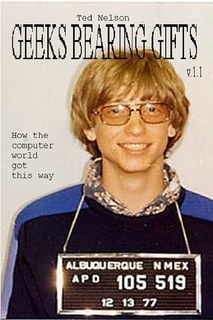
What they say about my new book, Geeks Bearing Gifts–
My friend Ted Nelson was one of the most inspirational figures in the home computer revolution. He now has a book that chronicles this important historic time. I highly recommend it...Woz
The book is a wonder at every level.
I read it almost straight away and loved it – wanted more.
… My prediction for the future – This is going to be one of the most important, and potentially one of the most influential, computing books ever.
xWendy Hall, president of the Association for Computing Machinery*.
*The world society of computer scientists.
The Dürer Woodcut: Marxism
This image is of interest for two different reasons: on the one hand, it offers a simple allegory of commodification; on the other hand, Sebastian Brant’s Narrenschiff, where one can find the original, was itself a work that helped pave the way for the emergence of a mass market.
I’ll begin with the second: as explained in the General Intro to Postmodernism, the Renaissance was an important turning point in the movement towards our contemporary “modern” society. What interests Marxists about this transition is the gradual implementation and validation of capitalism, and the rise of literacy was very much a part of this transition, as was the transition from the culture of the manuscript to that of print. After all, without the ability to print numbers and text, you could not have paper money. Indeed, we should keep in mind that the woodcut helped to establish the technologies that would eventually lead to the printing of paper money. The establishment of a book market also allowed the middle class to educate themselves and helped to usher in the notion of proprietary authorship, the issue of copyright, and the belief that knowledge can be achieved through acquisition (rather than by apprenticeship). Brant’s Narrenschiff helped to secure the rise of a market in books by moving away from the Latin editions of texts that had previously been published mostly for the sake of clerics and scholars. Brant’s text and Dürer’s illustrations, by contrast, are decidedly vernacular; indeed, Dürer’s woodcuts for this edition may well be the first examples of intentionally comic illustration in the printed book, and they were certainly a major reason for this edition’s market success. The Narrenschiff was commonly known in England as the Stultifera Navis or Ship of Fools (which is the translation of Narrenchiff) and the book represents a sequence of fools and their follies. (In the image on the left, the protuberances from the central figure’s neck is a marker for his status as fool: they represent the traditional ass’s ears of a fool, complete with bells on the end.) Through the use of humor, the Narrenschiff is attempting to reach a whole new mass audience, one that is only beginning to become conscious of itself as a middle-class readership. As John Harthan puts it in his History of the Illustrated Book, “Brant brought together medieval and Renaissance elements, satirizing man’s vices and follies in humorous verses which look back… to medieval exemplars…and…to classical modes…but is aimed at a new reading public, urban, skeptical and ready to be entertained” (63). Brant’s illustrated Narrenschiff was clearly a major success: a second edition followed in the very next year and the text was quickly translated into all the major European languages, which marks it as one of the very first printed works to reach a large audience.
Beyond these important considerations, the image on the left itself engages the issue of commodification. The image accompanies Chapter 52, the title of which is “Of fools that take old women to wife for their riches”; the caption to the image is “Der ist ein Narr…/ Dass er ein alt Weib nimmt zur Eh’/ Einen guten Tag ER hat und keinen mehr” or “A fool is… someone that takes an old hag to wife; he has one good day and never any more.” The original text thus places the scene squarely in the tradition of the medieval exemplar and points to a pre-capitalist gift culture and barter economy. In such an economy, before the introduction of money, one had to exchange one thing for another, for example one might purchase a chair by exchanging so many chickens. A barter economy tends to be supported by a gift culture, in which one cements bonds between people through the circulation of “gifts,” including the circulation of women, who are circulated through marriage and dowry to cement social bonds (eg. between families, principalities or nations) and to maintain power within royal lines.
In Dürer’s image for this text, we are presented with someone who appears to own land, given his association with the land and buildings around him. This fact alone makes him either a poor member of the aristocracy or a rich member of the emergent middle class. What marks him as something other than a traditional feudal lord is the fact that this individual feels the need to marry a rich, if ugly woman in order to maintain his property. We are therefore being presented here with the increasing importance of money and of monetary exchange in an emergent capitalist economy. The bag of coins makes it clear that we have moved beyond a simple barter economy; what is important is no longer the use-value of an object but rather the system of equivalences made possible by the semiotic system of money. Indeed, a series of equivalences are proposed in the image: 1) the woman is equivalent to so much money; the woman here is buying into marriage: not for power or aristocratic lineage or the resolution of internecine conflict but as a mere purchase; the new idea here is that money can buy you anything, even a man if you are an ugly old hag (as the chapter characterizes the woman). We are also thus moving away from woman as gift to woman as goods (as investment); 2) the woman is equivalent to an ass (both the animal and the orifice), a relation that is underlined both by the man’s dual grasp and by the “x” that is prominently displayed on his chest in the dead center of the image. The orientation of the man’s dagger completes the sexual joke suggested by the image: to make love to a hag, who has here been reduced to the level of chattel, is like making love to an animal. There is, of course, also a hidden pun here, at least in English: what we are dealing with here is, clearly, filthy lucre, or, as the Germans would phrase it, schnöder Mammon.note; 3) the man is equivalent to what he owns. This relationship is made clear in the image through the alignment of the standing man and the standing tower behind him. This connection would appear to tie the man to an earlier feudal system of land ownership, with the crucial difference that this individual must turn to monetary exchanges in order to maintain his property; and 4) the man is himself equivalent to an ass, an alignment that is made clear by his own ass’s ears and the fact that in this scene it is the man that is, in effect, being purchased by the woman. In a capitalist system of exchanges, Dürer appears to be saying, no one wins: everyone is a fool or an ass.
For another application, click the following link:
Proper Citation of this Page:
Felluga, Dino. “The Dürer Woodcut: Marxism.” Introductory Guide to Critical Theory.[date of last update, which you can find on the home page]. Purdue U. [date you accessed the site]. <http://www.purdue.edu/guidetotheory/narratology/image/>.
Visits to the site since July 17, 2002


  The Next Big Thing — Words! Digital media are transforming the publishing industry. It’s time for publishers to return the favor, writes Ralph Lombreglia. “What we already know” More on Digital Culture |
February 1997
To: Ralph Lombreglia RL: Could you say how you view the Web and its literary prospects? FB: There seem to be two basic views of the Web among literary folk. The first and most common is that the Web is a wasteland, another television, a form of advertising — all utterly unsuitable for literary activity. Among these folk there is a curious parallel between response to the Web and response to alternative literatures. Those who are terrorized by any change in the habits, practices, and product of writers, any change that might tend to disenfranchise them, are also, and perhaps not surprisingly, terrorized by the rise of the Web as a publishing forum. The second common view is the giddy “it’s all experimental” approach that proclaims that anything on the Web is a fabulous extension of literary activity as we have known it and will clearly destroy all not up-to-date literary activity in about twenty minutes. Both these views are, even in their most sophisticated disguises, silly. My sense is that the Web is a gun. It’s all potential, what we do with it; it’s a device, a system, a “site” in the linguistic sense, a prospect. How we use it over the next decade or two will define it. At the moment it’s politically and socially semi-neutral, uninflected, a tool for, in our case, the distribution of literary information. Years ago Charles Newman wrote a series of acute essays for TriQuarterly in which he discussed at length the power and potential of literary distribution systems. I know he didn’t have the Web in mind, and who knows what he thinks about the Web, but the Web certainly qualifies as a stunning development in distribution systems. RL: Why did you decide to put your literary journal on the Web? What do you hope to see happen? FB: The simplest answer is that the Web was there. I’ve been working on computers since the very late seventies. They’ve always intrigued me. When the Internet got out of the geeks-only stage in late 1993 and the Web emerged, I got involved. My main interest in it was as an extraordinary new delivery system that put stories and poems right into readers’ homes and offices. I’ve edited a literary magazine for twenty years, partly because I did my time among the unpublished and thought-to-be-unpublishable, and partly for the joy of finding a wonderful story or poem or essay that I know will not be allowed to show its face in The New Yorker or The Atlantic Monthly. It’s a not undesirable duty. When the Web came along, this duty compelled me to move the magazine online. Certain things became clear at once. It’s a great deal easier to publish online than on paper. This may not be true if you’re a publishing Goliath, but for mom-and-pop lit mags it is absolutely true. Because it’s easier, you can do more of it — we print the paper magazine twice a year, and even that is hard with no staff, no money, no time. By contrast, the Web magazine is a monthly, it’s relatively easy to produce (everything is digital, first to last, so there’s no typesetting, no scanning, no paste up), and the production costs next to nothing. Sure, we’ve dispensed with niceties such as paying contributors, but literary magazines don’t pay enough to count anyway, and, in some sense, the fundamental idea of art is that art should be free. The artist makes a gift for the world. It’s a book, a story, a painting, a piece of music. With the Web we’ve got a delivery system with such a radically reduced overhead that carrying out the idealized notion of giving the art away becomes practical. RL: Are you doing (or planning to do) anything on the Web that you can’t do on paper? FB: Yes. We’re getting a literary journal out once a month. We’re reaching a much larger audience than the paper magazine does. As far as the writing goes there’s not much difference — we find curious fictions and poems, curious written artifacts, and we provide a public venue. There are a hundred obvious things about the presentation that are different. The most interesting of these may be that Web publishing allows, even encourages, the kind of tinkering that paper publication prohibits. Often I add a story mid-month, or redesign the site, or add graphics, or change the way I’m treating type. The Web allows much more hands-on activity than paper printing. This has the potential for making the Web a more pliable and responsive medium than print. I’m also adding a few typical Web bells and whistles. Sound is something I’m very interested in. I hope to deliver new music of some kind on the MR site. It’s no good simply to pipe in some Muzak, or some comfortable jazz, so I’ll use Koan to produce the music to start with, then try to get involved with people who are making interesting hearable things. The prospects for doing similar things with visual material are slimmer at the moment, but I expect that to change. RL: Has your journal’s Web site changed anything about the way you design or produce the paper publication? If not, can you foresee changes down the road? FB: It hasn’t had much impact on the paper magazine. It has changed the way we look at the magazine, and I suppose it must be admitted that for me the Web version is now the real Mississippi Review. The paper version is vestigial. I should add that this isn’t a widely shared view — there’s still a premium among writers in appearing in a paper publication over a Web publication. But I expect this to pass also. RL: Web publishing isn’t free, and nobody seems to be paying to read what’s published online. Do you see a workable financial model besides killing the paper magazines to feed the Web sites? FB: The only reason Web publishing isn’t free is that some larger sites are paying editors. For those of us who work in small-scale publishing, the Web is free, or close enough. I don’t have to do a Web magazine, and the university I work for isn’t paying me more because I’m doing it (and wouldn’t pay me less if I stopped tomorrow). If I were operating outside the university, publishing a Web magazine might cost me $20 a month, unlike paper publishing where paper and printing and distribution would make doing a magazine impossible. Slick magazines will no doubt build big editorial staffs, paying many people for doing little work, and this will necessitate that the Web be profitable. What many of us are hoping is that this sort of publishing will just die, leaving the Web to the rest of us. That said, I know well enough that this sort of publishing won’t die, that money will be made, and made in abundance, and made in the literary business, on the Web. What I don’t know yet is whether this will destroy the Web by reducing it to another mechanism of cultural control of the many by the few, though this is what I fear. See next question. RL: How do you see the long-term impact of the Web on the literary life of the country? FB: This is tricky. The answer depends more or less on whether the Web is essentially taken over by large publishing and media corporations. If it is not, then the Web will be the most powerful agent of change since the printing press, and the changes that it will bring about are not readily foreseeable. On the other hand, if the Web is gobbled up by the standard purveyors of culture (magazines, newspapers, television, and so on), then it will become another means of control, like television, and the long-term impact will be to enhance the dominion over the culture by its established “owners.” RL: Do you see your journal ever sponsoring or publishing “multimedia literature” that cannot be experienced without a computer, or a collaborative ongoing literature created by many writers in some networked “groupware” situation? Or some other experiments impossible in a paper-based magazine? Or would you rather keep doing more or less what you’ve always done on paper? And why? FB: This is a dicey area for me, since I started off as a visual artist, and came into literary work through the then multimedia door (here I’m referring to the sixties, Fluxus, happenings, indeterminacy, books with graphics, photos, objects, peculiar texts, odd ways of meaning, and so on). Thus many things now presented as hypertext do not interest me. It’s a grave indictment of experimental literature, and in particular hypertext, that the best work on offer so far pales by comparison to the elegant work of Alain Robbe-Grillet (and a dozen others) who took uncertainty as a central system of construction and as a central thematic interest some thirty years ago and made successful literary art. We can’t simply rehash all these old ideas and present them as the fabulous new art of hypertext. I’ve seen a few things worthy of attention. In particular the work of Christy Sheffield Sanford seems to be an authentic step. There’s also a site at http://www.jodi.org/index.html that confuses the boundaries of literary action on the Web in an interesting way. I’m sure there are others working at the edges and genuinely changing the definition of literary art, but I wouldn’t expect there are many such artists. So far, the tendency has been old messages in new bottles. Frederick Barthelme is the author of nine books including Moon Deluxe, Second Marriage, Tracer, Two Against One, Natural Selection, The Brothers, and most recently, Painted Desert. He is an occasional contributor to The New Yorker, and his work has appeared in GQ, Kansas Quarterly, Epoch, Playboy, Esquire, TriQuarterly, North American Review, Frank, and other publications. He teaches writing at the University of Southern Mississippi, where he also edits the Mississippi Review. Copyright © 1997 by The Atlantic Monthly Company. All rights reserved. |
Basic references:
Klarer, Mario. An Introduction to Literary Studies. 2nd ed. London and New York: Routledge, 2004. google books
Peck, John, and Martin Coyle. How to study a poet. London: Palgrave.
Pope, Rob. The English Studies Book. Routledge, 1998.
Guerin, W. L. et alli. A Handbook of Critical Approaches to Literature. OUP, 1992.
Gibaldi, Joseph. MLA Handbook for Writers of Research Papers. 6th ed. New York: Modern Language Association, 2003.
Works on critical approaches and literary theory:
Selden, Raman, et alii. A reader’s guide to contemporary literary theory. London: Prentice Hall, 1997.
Selden, Raman. Practicing Theory and Reading Literature: An Introduction. 1989.google books
Lodge, D. (ed.) : 20th Century Literary Criticism. A Reader. Longman, 1972.
Wellek, Renè and Austin Warren. Theory of Literature. New York: Harcourt, Brace & World, 1956.
Internet Encyclopedia of Philosophy APeer-reviewed Academic Resource Literary Theory
Dictionaries, glossaries, and other reference works:
Baldick, Chris. The Concise Oxford Dictionary of Literary Terms. Oxford UP, 1990.
Coyle, Martin, ed. Encyclopaedia of Literare and Criticism. London: Routledge, 1991.
Harmon, William and C. Hugh Holman. A Literature Handbook. Upper Saddle, NJ: Prentice Hall, 2000.
Fowler, Roger, ed. A Dictionary of Modern Critical Terms. London and New York: Routledge, 1987.
Preminger, Alex, and T.V:F. Brogan, eds. The New Princeton Encycolpaedia of Poetry and Poetics. Princeton: Princeton University Press, 1993.
Abrams, M. H. A Glossary of Literary Terms. Forth Worth, TX: Harcourt Brace Jovanovich, 1994.
On language, style, and prosody
Blake, N. F. An Introduction to the Language of Literature. Houndmills and London: Macmillan, 1990.
Brooks, Cleanth, and Robert Penn. Understanding Poetry. London: Holt, Rinehart & Wilson, 1968.
Carter, Ronald, ed. Language and Literature: An Introductory Reader in Stylistics. George Allen & Unwin, 1982.
Leech, G. N. & M. Short. Style in Fiction. London, Longman, 1981.
Leech, G. N. A Linguistic Guide to English Poetry. London: Longman,
Page, Norman (ed.) : The Language of Literature: A Casebook. Macmillan, 1994
Shapiro, Karl. A Prosody Handbook. Bew York: Harper and Row, 1965.
Wales, Katie. A Dictionary of Stylistics. London: Longman, 1991.
On scholarly writing:
Harner, James L. Literary Research Guide: A Guide to Reference Sources for the Study of Literatures in English and Related Topics. New York: Modern Language Association, 2002.
Oshima, Alice, and Ann Hogue. Writing Academic English. London: Longman, 1998.
Video provided by YouTube
Beatles – Shakespeare Skit
Check out the Beatles performing a Shakespearean skit on a 1964 British television program. The audience seemed to be having as much fun as the Fab Four were! Where else can you see John dressed up as a woman, playing Paul’s love interest? Hilarious! Don’t miss it!
http://www.encyclopedia.com/topic/Shakespeares_Plays.aspx#1O142-playsofWilliamShakespeare
http://www.encyclopedia.com/video/DOpEZM6OEvI-beatles-shakespeare-skit.aspx
KEATS-SHELLEY PRIZE 2010
NOW IN ITS THIRTEENTH YEAR
Keats-Shelley Prize 2010: The shortlist: Simon Armitage and last year’s Buddhist winner Maitreyabandu among the poets
ESSAYISTS:
Gorman Cassandra, for “Keats’s Broken Idealism: Spirituality, Sensuality and the Supernatural in ‘Lamia'”, Emily Hockley, for “Poetic Labour and Sound in Keats”, Paul Keen, for “Shelley on the Assembly Line”, Andrew Lacey, for “Wings of Poesy: Keats’s Birds”, Stacey McDowell for “Full of Air: Inspiration and Air-Eating Poets”.
POETS:
Simon Armitage, for “The Present”, Anne-Marie Austin, for “Slow Vocation”, Judy Brown, for “The Expats”, Martyn Crucefix, for “Your Dark-Haired Daughter”, Pat Borthwick, for “Seeing the Light”, Chris Edgoose, for “A Perfect Cube”, Charles Evans, for “Ice Man”, Emma Harding, for “Another Name for Snow”, Alice Kavounas, for “Ice”, Gill Learner for “Chill Factor” and “The Power of Ice”, Victor Tapner, for “Gunnlaugsson’s Wilderness”, Pat Winslow for “The Cold Water Experiment, Dachau” and “The Theatre at the End of the Pier”.
The Awards will take place on Wednesday 13th October at the British Academy in central London, when the scholar and poet Jack Mapanje will present the prizes and read from his work. Catherine Payling, Curator of the Keats-Shelley House, will show photographs of recent activities in Rome. Friends of KSMA and all entrants to the competition have now been invited, and others will be welcome on a first-come-first-served basis, email awardsksma@yahoo.com
Sponsored by The Cowley Foundation, The School of English, University of St Andrews, and The Liberal Magazine
Press Release: Prizes and Awards
The Best Romantic Novel Of Modern Times
Posted at 12:05PM Thursday 16 Sep 2010
ROMANTIC NOVELISTS’ ASSOCIATION
The Best Love Story of the Last 50 Years
Thursday 16th September.
Linda Gillard’s book Star Gazing topped a poll to find the most romantic novel of the last 50 years. She beat Barbara Taylor-Bradford’s classic book, A Woman of Substance and Trisha Ashley’s Every Woman for Herself, who were both runners-up. The poll was organised by Woman’s Weekly in conjunction with the Romantic Novelists’ Association and the awards were presented at a champagne breakfast at London’s New Cavendish Club by best-selling author and Chair of the RNA, Katie Fforde.
Linda Gillard was thrilled with her success as she has had mental health issues for some years which writing has helped her to overcome. To have achieved such a success is a terrifically positive step forward. Despite only writing three novels to date, Linda has been on six shortlists and Star Gazing on three, and she said, ‘I am particularly thrilled to finally win a prize especially one associated with the RNA as I first joined the association as a member of the NWS. Having come up through the ranks of the RNA this is the icing on cake.’
Trisha Ashley was ‘amazed and honoured to be a runner up and very grateful to all who voted for me.’
The poll was conducted by Woman’s Weekly to celebrate 50 years of the Romantic Novelists’ Association which was founded ‘to raise the prestige of romantic authorship and generally to encourage and foster the writing of romantic works’. Maureen Jones, who entered her selections in the poll and won a chance to meet her favourite authors, was also be present. Barbara Taylor-Bradford was unable to be there but she was represented by Harper Collins’ Director of Publicity, Elizabeth Dawson and by Barbara’s editor, Lynne Drew
For further information and details contact;
pressofficer@romanticnovelistsassociation.org or 07966 949590
Further information.
•The Romantic Novelists’ Association (RNA) was set up in 1960 to promote respect for the genre and to encourage excellence. Full membership is open to authors who have published a romantic novel or a romantic serial. Aspiring writers are admitted as probationary members. This is the only professional body of writers to encourage actively new writing in this manner. In 2005, an RNA team beat teams from Wisden and The Economist in University Challenge – The Professionals, only just losing to the Privy Council in the final. The Chairman is Katie Fforde. For more information log onto www.rna-uk.org.
•Trisha Ashley is the author of fourteen novels currently lives in North Wales but was born and raised in St Helens. She has been shortlisted for the Melissa Nathan Award for Romantic Comedy two years running with A Winter’s Tale and Wedding Tiers. For an interview with Trisha please contact her at trisha_ashley@hotmail.com
•Linda Gillard lives on the Isle of Arran and is the author of 3 novels. Star Gazing was shortlisted for the Romantic Novel of the Year in 2009. She can be contacted on 07887 970654 or info@lindagillard.co.uk
•Barbara Taylor-Bradford was born in England and currently lives in New York City. Her 26th novel will be published in October 2010. For further information please contact Liz Dawson at HarperCollins Elizabeth.dawson@harpercollins.co.uk or on 020 8307 4412
Gilded monuments and living records: A note on critical editions in print and online
Eric Rasmussen
University of Nevada
rasmusse@unr.nevada.edu
Rasmussen, Eric. “Gilded monuments and living records:A note on critical editions in print and online”. Early Modern Literary Studies 9.3 / Special Issue 12 (January, 2004): 7-1-6 <URL: http://purl.oclc.org/emls/09-3/rasmgild.htm>.
Notes
[1] See http://web.uvic.ca/shakespeare/Library/Texts/Poems/Ven/index.html
[2] http://web.uvic.ca/shakespeare/Library/Texts/Poems/Ven/Ven_QT/Ven_QPages/Ven_QE4v.html
[3] http://web.uvic.ca/shakespeare/Library/Texts/Poems/Ven/Ven_QI/Ven_QIE4v.html
[4] http://web.uvic.ca/shakespeare/Library/Texts/Poems/Ven/Ven_QI/Ven_QIH1v.html
[5] For a complete list of the textual errors in this edition, see my review of ‘The Year’s Contributions to Shakespeare Studies: Editions and Textual Studies’, Shakespeare Survey 56 (2003).
Works Cited
Responses to this piece intended for the Readers’ Forum may be sent to the Editor at M.Steggle@shu.ac.uk.
© 2004-, Matthew Steggle (Editor, EMLS).
In the BBC News’ Meet The Author series, writer, broadcaster and actor Stephen Fry talks to Jane Hill about The Fry Chronicles: An Autobiography, his second volume of memoirs.


CC licenses anticipate that a licensor may want to waive compliance with a specific condition, such as attribution.
A work is in the public domain when it is free for use by anyone for any purpose without restriction under copyright.
All jurisdictions allow some limited uses of copyrighted material without permission. CC licenses do not affect the rights of users under those copyright limitations and exceptions, such as fair use and fair dealing where applicable.
In addition to the right of licensors to request removal of their name from the work when used in a derivative or collective they don’t like, copyright laws in most jurisdictions around the world (with the notable exception of the US except in very limited circumstances) grant creators “moral rights” which may provide some redress if a derivative work represents a “derogatory treatment” of the licensor’s work.
Publicity rights allow individuals to control how their voice, image or likeness is used for commercial purposes in public. If a CC-licensed work includes the voice or image of anyone other than the licensor, a user of the work may need to get permission from those individuals before using the work for commercial purposes.
The Commons Deed is not a license. It is simply a handy reference for understanding the Legal Code (the full license) — it is a human-readable expression of some of its key terms. Think of it as the user-friendly interface to the Legal Code beneath. This Deed itself has no legal value, and its contents do not appear in the actual license.
Creative Commons is not a law firm and does not provide legal services. Distributing of, displaying of, or linking to this Commons Deed does not create an attorney-client relationship.
This is a human-readable summary of the Legal Code (the full license).
Use this license for your own work.

CC licenses anticipate that a licensor may want to waive compliance with a specific condition, such as attribution.
A work is in the public domain when it is free for use by anyone for any purpose without restriction under copyright.
All jurisdictions allow some limited uses of copyrighted material without permission. CC licenses do not affect the rights of users under those copyright limitations and exceptions, such as fair use and fair dealing where applicable.
In addition to the right of licensors to request removal of their name from the work when used in a derivative or collective they don’t like, copyright laws in most jurisdictions around the world (with the notable exception of the US except in very limited circumstances) grant creators “moral rights” which may provide some redress if a derivative work represents a “derogatory treatment” of the licensor’s work.
Publicity rights allow individuals to control how their voice, image or likeness is used for commercial purposes in public. If a CC-licensed work includes the voice or image of anyone other than the licensor, a user of the work may need to get permission from those individuals before using the work for commercial purposes.
Este resumen no es una licencia. Es simplemente una referencia práctica para entender el Texto Legal (la licencia completa) — es una redacción simple de los términos más importantes de la licencia. Este resumen por si mismo no tiene valor legal, y su contenido no aparece en la licencia auténtica.
Creative Commons no es una oficina de abogados y no ofrece servicios legales. La distribución, la muestra o el enlace de este resumen no crea ningún vínculo cliente-abogado.
Esto es un resumen simple del texto legal (la licencia completa).
Mary Ann Buckles
When Willie Crowther and Don Woods wrote the narrative-based game Adventure, they most likely did not foresee that they were creating a new way of telling a story or that Adventure might some day be considered a work of literature.
The adventure game genre is now called interactive fiction (IF). In some ways, IF closely resembles the traditional literary genres of mysteries, science fiction, fantasy, and adventure tales. These types of popular literature are based on rules, games, and the creation of fantasy worlds. They all emphasize a step-by-step, action-consequence type of thinking and imagination.
Edgar Allen Poe would have loved IF; he was a master at solving cryptograms and thought problems, and he wrote the first detective story, “Murder in the Rue Morgue.” Ever since then, mystery literature has been compared to games. The Sherlock Holmes stories, for example, have been called “crossword puzzles.” Mystery novels like those of Agatha Christie and Dashiell Hammett are more like jigsaw puzzles, while James Bond novels and spy stories can be compared to games of chess.
Mysteries challenge the reader’s powers of deduction; they are games in the form of stories, in which the reader competes with the author, matching wits in the game of “who done it” and how.
Some writers have even established mystery literature “rules” to make sure the competition between the reader and the characters, or the reader and the author, is fair. One set of rules that was set forth to give the reader a sporting chance requires that the author at least mention the criminal early on in the story, that there be no more than one secret passage per story, and that no secret twin brothers or sisters may suddenly appear to explain the crime. To promote such fair play with the reader, the famous Detection Club (founded by G. K. Chesterton, Agatha Cristie, Dorothy Sayers, and others) requires new members to swear to the following initiation oath (see reference 1):
Ruler: Do you solemly swear never to conceal a vital clue from the reader?
Candidate: I do.
Ruler: Do you promise to observe a seemly moderation in the use of Trap-Doors, Chinamen . . . and utterly and forever to forswear Mysterious Poisons unknown to science?
Candidate: I do.
Of course, fair play in no way hinders an author from trying to fool the reader; trickery and the ability to manipulate the rules to one’s own advantage are admired qualities in gamesmanship.
As in mystery literature, the fascination of the intellectual challenge in IF may make up for weaknesses in characterization and style, which often suffer from the all-consuming goal of making the plot as thick as possible. In both IF and in detective literature, events and characters’ choices are often not explained psychologically. In many mystery stories, the author simply establishes that the crime is puzzling, without providing any plausible motivation for it.
However, the suspense in mysteries can evoke total involvement and escape from our real-world problems. Because the reader is the detective and unraveller of puzzles in IF, and therefore more actively and intensely involved in solving the problems, IF can become a more powerful type of suspense and escape literature than current mystery literature.
Crowther and Woods’ Adventure is a story of exploration, like Jules Verne’s Journey to the Center of the Earth. Both take place in caves, and many of the descriptions are similar. Perhaps surprisingly, the cave descriptions in Adventure are often more realistic and vivid than in Verne’s story. Whereas Jules Verne explored only in his imagination, Willie Crowther is a real-life spelunker. Adventure began as a map, a computer model of an actual Colossal Cave in Kentucky, which Crowther explored and then accurately duplicated in the first few levels of Adventure’s cave.
Similarly, Adventure is related to Robert Louis Stevenson’s Treasure Island. The desire for treasure motivates both stories, and both were inspired by maps. Location and physical setting dictate the process of action. Stevenson once explained how he got the idea for his famous story:
I made the map of an island; it was elaborately and (I thought) beautifully coloured; the shape of it took my fancy beyond expression; it contained harbours that pleased me like sonnets; and with the unconsciousness of the predestined, I ticketed my performance ‘Treasure Island’ . . . as I paused upon my map of ‘Treasure Island,’ the future character [sic] of the book began to appear there visibly among imaginary woods; and their brown faces and bright weapons peeped out upon me from unexpected quarters as they passed to and fro, fighting and hunting treasure, on these few square inches of a flat projection. The next thing I knew I had some papers before me and was writing out a list of chapters . . . the map was most of the plot. (See reference 2.)
Adventure, which was made possible by technological advancements in computers, is similar to the first “novels,” which were also dependent upon a new technology, the printing press. These novels of chivalry were prose versions of medieval knightly verse epics that, with the introduction of the printing press, could be mass-produced for a wide audience.
Compare Irving Leonard’s comments on the romances of chivalry to the reactions of Adventure lovers:
These tremendously popular works of fiction . . . stimulated the emotions and won the passionate devotion of all literate classes of Spain, from the great Emperor Charles V himself to the lowliest clerk in his service. . . . The pages of this chivalric fiction were thumbed with an enthusiasm amounting to a passion. . . . The aristocracy of every shade and degree, including its womenkind, and even the clergy, devoted much of their ample leisure to this diverting pastime.” (See reference 3.)
The prose novels of chivalry, which Cervantes satirized in Don Quixote, delight in childlike fantasies of overcoming all difficulties, vanquishing all foes, and being rewarded with treasure and success in the process. The hero and characters in the chivalry stories are basically cardboard figures without internal conflicts and can be said to have no psychology at all. The pop-up characters in Adventure are limited in the same way.
Adventure and the novels of chivalry are based on a story structure of more of less independent units that are strung together and can be expanded infinitely. Today, we do not usually consider plot profusion and complexity as positive literary attributes, but this was not always the case. In the Renaissance, entangledness and complexity of plot were regarded as admirable qualities; the novels of chivalry have been considered “vast, almost unreadable jumble(s) of episodes that stand as a fitting monument to sixteenth-century taste for the fantastic.” (See reference 4.)
Similarly, complexity in Adventure is achieved through the difficulty of remembering the layout of the cave and through the intricacies of the brainteasers you encounter. Such complexity seems to appeal to the computer enthusiast mentality. In The Second Self (see reference 5), Sherry Turkle comments on the worship in the computer subculture of the fantastic, the bizarre, and the intricate. This applies not only to a style of programming but also to tastes in literature (science fiction and fantasy) and music (baroque and jazz).
The loose structure in the prose novels of chivalry promoted joint or multiple authorship, another characteristic of text adventures. John O’Conner writes: “In general, the longer a chivalric prose narrative, the better and more influential it was. This kind of tale was written in such a way that, if popular response warranted, succeeding books could easily be added. Hence the number of volumes a romance finally attained is an approximate gauge of its popularity.” (See reference 4.)
The same can be said for text adventures as they get passed around on computer networks, modified, and expanded: the longer, the better.
In fantasy and science fiction, the author makes up an imaginary world and plays with the probable consequences of a set of rules that may be different from those governing our real lives. The author can set up the rules for the imaginary world in any way desired, but he or she must abide strictly by them.
This attitude toward rules is similar to that in computer programming, where the rules are arbitrary but absolutely binding. It is also an age-old literary technique. Around 330 B.C. Aristotle wrote:
The poet should choose probable impossibilities rather than incredible possibilities . . . if a poet does take such a[n impossible] plot and appears to have handled it with some appearance of probability, the absurdity may be pardoned. Even the improbabilities about putting Odysseus on shore in the Odyssey would clearly not be tolerable if treated by an inferior poet. As it is, the skill of Homer conceals the absurdity and makes it pleasing.” (See reference 6.)
Adventure’s authors drew some of the content, characters, and motifs from science fiction and fantasy literature, especially from Tolkien’s The Lord of the Rings. Don Woods says that he had glanced at Tolkien’s description of Orodruin (Mount Doom, the volcano in the Land of Mordor where the evil Sauron forged the One Ring of Power) before he wrote the “Breathtaking View” scene in Adventure. Tolkien says of Mount Doom,
. . . its ashen cone would grow hot and with a great surging and throbbing pour forth rivers of molten rock from chasms in its sides . . . some would wind their way into the stone plain, until they cooled and lay like twisted dragon-shapes vomited from the tormented earth. Sam beheld Mount Doom, and the light of it . . . now glared against the stark rock faces, so that they seemed to be drenched with blood.” (See reference 7.)
Compare this to the beginning of Wood’s “Breathtaking View”:
Far below you is an active volcano, from which great gouts of molten lava come surging out, cascading back down into the depths. The glowing rock fills the farthest reaches of the cavern with a blood-red glare, giving everything an eerie, macabre appearance.
Although the story content of Adventure and other interactive works is related to established forms of literature, IF also differs from them on a very basic level—the reader’s participation in creating the story and text makes the reader both a character and, in some sense, the coauthor of the story.
In IF, the nature of the text is also changed. The fluid computerized text allows a personalization and individualization of a literary work. The reader can talk to the text, and the text, in the form of the story’s narrator, can talk back to the reader.
In conventional literature, a “gap” occurs when readers must interpret for themselves what the text means; the story is told, but its meaning is not. IF, however, contains not only gaps in meaning, but physical gaps in the text that the reader must fill in. These physcial gaps in the interactive text allow such a wide range of explanations or interpretations of the fictional events taking place in Colossal Cave that it often seems as if different readers are not reading the same story. Some people play Adventure strictly as a game, while others read it as a straight story about exploring a cave and discovering the treasures.
Many, however, see Adventure as a story with deeper meanings. One player/reader believed the treasures in the cave were left by the good wizard of a long-vanished civilization, whose long-lost secrets would be revealed only when all of the puzzles in the cave were solved completely.
Another reader, a camper-backpacker, imagined that careless spelunkers had left the treasures in the cave. Yet another reader interpreted taking the treasures in the cave as stealing them.
The texts these three readers created were completely different because they read different stories into Adventure. This apparent drive to make context is a reflection in some ways of readers’ psychological needs.
Some attempts have been made in more conventional literature to allow the reader choices about how a story unfolds, such as the “Choose Your Own Adventure” series. These books contain many story units; each lasts only a few pages and is complete in itself. At the end of a unit, either the story ends or you are given a choice and the story continues.
The artistic effects of these techniques fall far short of those in IF, due to the linear nature of text printed on paper. In IF, you make choices about each individual step and construct the story units for yourself; the choices are not predefined.
The quantitative difference between the number of possible stories in computer-based fluid text and the printed texts is also great. In one printed book, The Cave of Time (see reference 8), for example, there are 56 possible stories. In Adventure, the number of different stories must be, strictly speaking, infinite, since you can travel in repetitive loops within the cave and type in any comment and elicit at least some response. Even without resorting to loops and nonsense commands, though, the number of distinct possible texts is astronomical. A scientist acquaintance has calculated that the “battery maze” in Adventure alone (which has 12 different locations, 11 of them connected to 9 or 10 of the others) can be experienced in 187 billion trillion unique ways.
The fluid nature of interactive text and its computer medium explodes the traditional literary concept of the individual authorships of a printed text. In some ways, the authorship and transmission of the interactive text is similar to those of oral literature. With a printed text, we generally have the idea that there is a single author who “owns” the text; copyrighting reflects our views about this. But in oral literature and IF, single, joint, multiple, communal, unknown, and anonymous authorships are common. Adventure, for example, was first written and released by William Crowther, enlarged and improved by Don Woods, and released again. There are now many versions of Adventure, and programmers often personalize the programs so that the dwarves have the names of their friends, enemies, or despised professors, for example.
For those who would like to write interactive fiction, a few suggestions and observations follow. I have based them on the scripts of the texts readers created while playing Adventure and on the varying degrees of enthusiasm the readers expressed in interviews when they discussed Adventure’s literary qualities.
The first interactive texts were written by programmers who thought of them mostly as games, and the literature they created is unsophisticated. The computer itself, however, does not limit IF to frivolous works. Consider the development of film. Early film was an unsophisticated medium, “so crude in its initial stages that it was considered to be beneath contempt” (see reference 9). Only with D. W. Griffith’s “Birth of a Nation” and, later, Charlie Chaplin’s films, did audiences become aware that film could transmit and aesthetically mature experiences.
Now interactive stories are being written by traditional authors with technical assistance from programmers. Perhaps it will take someone who is both a programmer and an author to explore the artistic promise of IF and create works of literature that rank with the classics of traditional literature. <
REFERENCES
Mary Ann Buckles (9240-L Regents Rd., La Jolla, CA 92037) is co-owner and writing consultant of Transgalactic Software. This article is based on her doctoral dissertation written at University of California at San Diego.
http://www.ifarchive.org/if-archive/articles/byte87_buckles.html
MAY 1987 • B Y T E 135–142
Posted on September 12, 2010
The People’s Republic of Interactive Fiction Presents: LOST PIG! We will be playing today, Sunday, September 12, from 2pm – 5pm at MIT Campus, Building 1, Room 135. For those who can’t make the event in person, you can catch it via our live broadcast:
Play games from a list of Interactive Fiction titles selected by the People’s Republic.