Scientists Uncover Literary Fingerprints

The Book Bench

December 18, 2009

Scientists Uncover Literary Fingerprints

Print.jpg

A group of Swedish physicists, writing in The New Journal of Physics, contend that they can identify individual authors based on a unique “literary fingerprint” of word use. (My first thought: we’ll finally be able to settle the Shakespeare authorship controversy! My second thought: unfortunately, we’ll simultaneously put an end to the profitable stream of books on the Shakespeare authorship controversy.) Cosmos magazine writes that the findings, which could be used to detect literary fraud and identify anonymous authors, also

led the authors to consider the concept of a “meta book”—a hypothetical “mother” book which would provide an abstract representation of the “word-frequency curve” characteristic of a particular author.

That sounds a little like post-structuralist mumbo-jumbo (to me, physicists in search of a “meta-book” is a scenario out of Pynchon, not Sweden), but if scientists really could create some sort of formula for identifying authorship, it would have interesting implications for the way we read, browse, and borrow. Could we match similar fingerprints to create a literary Pandora? Would Apple come out with an accurate iTunes Genius for books? If so, it would take some of the delightful happenstance out of reading—after all, we don’t actually want to read the same sort of thing all the time—but it would be nice to know that, no matter how formulaic, I was taking a book reliably to my taste home for the holidays.

(Image: Print from Penny Mathews, on Flickr)

00 Los derechos de autor, a debate en ’59 segundos’

http://www.rtve.es/mediateca/videos/20091217/derechos-autor-a-debate-59-segundos/651363.shtml

Los derechos de autor, a debate en ‘59 segundos‘

02:43El compositor y consejero de la SGAE, José Miguel Fernández Sastrón; el director de cine y presidente de DAMA (Derechos de Autor de Medios Audiovisuales), Enrique Urbizu; el periodista y bloggero, Ignacio Escolar; el abogado especialista en propiedad intelectual y derecho informático, David Bravo; el presidente de AETIC, la patronal de las empresas de comunicación, Jesús Banegas y el escritor Lorenzo Silva han estado en el programa “59 segundos” para abordar la polémica en torno a la propiedad intelectual y la protección de los derechos de autor en Internet, tras conocerse la disposición final de la Ley de Economía Sostenible que ha suscitado un importante debate por contemplar el posible cierre de webs sin autorización judicial. (16/12/09).

00 Jane Austen’s Life and Legacy

http://www.themorgan.org/exhibitions/exhibition.asp?id=22

Exhibitions | Current

A Woman’s Wit: Jane Austen’s Life and Legacy
November 6, 2009, through March 14, 2010


Isabel Bishop (1902–1988)
Scene from Pride and Prejudice: “The examination of all the letters which Jane had written to her.” 20th century
Pen and black ink, gray wash, over pencil
Gift of Mrs. Robert E. Blum in honor of Charles Ryskamp on his 10th anniversary as director, 1979; 1979.32:15
Photography by Schecter Lee, 2009.

Online exhibition:
The Divine Jane film »
Lady Susan facsimile »
Selected images »This exhibition explores the life, work, and legacy of Jane Austen (1775–1817), regarded as one of the greatest English novelists. Offering a close-up portrait of the iconic British author, whose popularity has surged over the last two decades with numerous motion picture and television adaptations of her work, the show provides tangible intimacy with Austen through the presentation of more than 100 works, including her manuscripts, personal letters, and related materials, many of which the Morgan has not exhibited in over a quarter century.

A Woman’s Wit: Jane Austen’s Life and Legacy also includes first and early illustrated editions of Austen’s novels as well as drawings and prints depicting people, places, and events of biographical significance. A highlight of the exhibition is a specially commissioned film by the noted Italian director Francesco Carrozzini, featuring interviews with artists and scholars such as Siri Hustvedt, Fran Lebowitz, Sandy Lerner, Colm Tóibín, Harriet Walter, and Cornel West.

The exhibition is organized into three sections: Austen’s life and personal letters, her works, her legacy, and concludes with the documentary-style film.

Only a relatively small number of Austen’s personal letters have survived. The Morgan is a major repository of her correspondence, with one third of all surviving letters held in the department of Literary and Historical Manuscripts. These materials—from correspondence to her beloved sister, Cassandra, to a letter to her niece in which all the words are spelled backwards, to “crossed letters” (also known as “cross-hatching,” in which Austen, to save paper and reduce postal charges, wrote across the horizontal lines of text at right angles)—offer a remarkable glimpse into Austen’s everyday life and relationships, as told in her characteristically witty and confident voice. Some highlights include a letter dated 2 June 1799 to her sister, which includes a drawing of the lace pattern of her cloak, and a letter dated 20 July 1817, written by Cassandra to Fanny Knight, Austen’s beloved niece, reporting Austen’s death: “I have lost a treasure, such a Sister, such a friend as never can have been surpassed.”

Drawings and prints of people, places, and events of importance in Austen’s life and times will provide visual context for the letters. On view is a Portrait of Mrs. Q (Mrs. Harriet Quentin) by William Blake. Upon seeing this portrait in London, Austen remarked that this was just as she imagined Mrs. Bingley (Jane Bennet, who marries Charles Bingley at the conclusion of Pride and Prejudice). There will also be numerous prints by James Gillray (1757–1815), an influential printmaker and social satirist, who touched on many of the same subjects and themes found in his illustrious contemporary’s letters and novels, including women’s fashions, marriage, and social rank.

The section on Austen’s works includes the autograph manuscript of Lady Susan (rewritten ca. 1805), the only surviving complete manuscript of any of her novels. Also included in the exhibition is an unfinished autograph manuscript of The Watsons (ca. 1805), which remained unfinished and is the only surviving manuscript of Austen’s novels showing her work in progress and under revision. Also on view is an autograph note by Austen, listing the date of composition of her novels Mansfield Park, Persuasion, and Emma. Another note lists the profits of her novels.

The exhibition also incorporates rare books and manuscripts from the Morgan’s collections by authors who influenced Austen, including Fanny Burney, William Cowper, Samuel Richardson, and Lord Byron. After reading Byron’s poem The Corsair: A Tale, Austen wrote in a letter to her sister, “I have read The Corsair, mended my petticoat, and have nothing else to do.” The legacy of Jane Austen is examined through later writers’ responses to her work. Beginning with a diary entry by her contemporary Sir Walter Scott, the exhibition also features comments by twentieth-century writers, including Vladimir Nabokov, William Butler Yeats, and Rudyard Kipling.

The influence and popularity of Jane Austen is also examined through the film at the conclusion of the exhibition. It features interviews about Austen with an eclectic group of artists and scholars.

The exhibition is organized by Declan Kiely, Robert H. Taylor Curator, and Clara Drummond, Assistant Curator, Literary and Historical Manuscripts, The Morgan Library & Museum.

A Woman’s Wit: Jane Austen’s Life and Legacy is generously supported by the Laurence Levine Charitable Fund, Inc. and Sir Thomas R. Moore.

00 AN INTERVIEW WITH YOUNG-HAE CHANG

“DISTANCE, HOMELESSNESS, ANONYMITY,
AND INSIGNIFICANCE”:
AN INTERVIEW WITH YOUNG-HAE CHANG
HEAVY INDUSTRIES

Thom Swiss: Thanks for premiering this new piece on IR Web. There’s a lot of interest in your work these days from many quarters–art world, literary world, programming world…what do you call what you do?

YOUNG-HAE CHANG HEAVY INDUSTRIES: We combine text with jazz to create Flash pieces. It’s a simple technique that shuns interactivity, graphics, photos, illustrations, banners, colors, and all but the Monaco font, and at the same time cuts across the lines separating digital animation, motion graphics, experimental video,
i-movies, and e-poetry. To us, though, it’s Web art.

TS: Can you talk a bit about historical influences?

YHCHI: Well, we are writing in three different languages, English, Korean, and French. (We collaborate with others when it comes to other languages.) Each one comes with a full baggage of history and culture. Language is the essence of the Internet, the real gateway to using the Web.

To write, read, and chat in English on the Internet is to implicitly justify a certain history. Certain governments don’t ban or burn books anymore, they prevent access to the Web, meaning they justify a different history than the one we do by using English. So our choice of language is probably the biggest historical influence on our work.

TS: How about specific literary influences–or art and artists–how do they figure into your work?

YHCHI: Well, DAKOTA, for example, is based on a close reading of Ezra Pound’s Cantos I and first part of II. Of course, you don’t need to know this to enjoy the piece.

Other cultural influences on our work are Marcel Duchamp, who one day decided to stop painting, saying he was tired of getting his hands dirty; Roy Lichtenstein, who found a simple artistic vocabulary, and stuck to it; and Andy Warhol, who, more than the Chinese government ever could, succeeded with his Mao portraits in putting a certain face on China.

TS: Can you help readers “locate” your work in terms of its tone? How about the “look” of your work?

YHCHI: It’s pretty obvious that the “tone” or “voice” of Internet literature is more distant and difficult to “locate” than traditional writing. Mere book packaging tells a lot about the book and the author; browser packaging is generic. Internet writers can either see this as a problem or welcome it as a relief from the critical
fashion of reading biography into every aspect of literature.

As for the look of our work, we do what we can. We’ve never been interested in graphic design (a lot of Web artists–and even writers– start out or double as graphic artists). There are hundreds of fonts, millions of colors, and we don’t know what to do about that.

So to answer your question, no, we can’t and won’t help readers to “locate” us. Distance, homelessness, anonymity, and insignificance are all part of the Internet literary voice, and we welcome them.

TS: Can you say a few things about your process of collaboration?

YHCHI: We sit in front of our computers side by side on the floor of our tiny pre-World War II Japanese house in Seoul and try to ignore each other. Something inevitably comes up, and the laughs–sorry — the collaboration process begins.

TS: What do you make of the critical writing out there thus far on Web-based art and Web-based writing?

YHCHI: There isn’t much critical writing yet on Web writing. One reason is that it’s a young medium. Another is that it’s not taken very seriously (i.e., there’s no money in it). Still another is that
it’s more satisfying to create than to criticize.

There’s a tendency to read quickly on the Internet. Speed is everything, and densely written texts, be they creative or critical, seem to make the reader anxious — maybe because of the phone bill. Then again, maybe another reason for the dearth of critical Web writing is that there’s nothing to criticize — Web writing might not be very good.

TS: Let’s hope that’s not true! Thanks, Young-hae and Marc.

More work by YOUNG-HAE HEAVY INDUSTRIES can be seen on its Web site: http://www.yhchang.com

00 Young-Hae Chang – Heavy Industries

http://www.yhchang.com/

THE LAST DAY OF BETTY NKOMO

Based in Seoul, South Korea, YOUNG-HAE CHANG HEAVY INDUSTRIES combines text with jazz to create Web-based New Media work. Writing in three different languages, Young Hae Chang and Marc Voge strip away interactivity, graphics, photos, illustrations, and colors to leave viewers with language and sound. Their website is www.yhchang.com

A short selection including pieces in ESPANOLA and Galego

THE NEW AND IMPR0VED
Y0UNG-HAE CHANG HEAVY INDUSTRIES
PRESENTS

DAK0TA ENGLISH ESPAN0LA K0REAN P0RTUGUES
CUNNILINGUS IN N0RTH K0REA ENGLISH DEUTSCH FRANCAIS ESPAN0LA
SAMSUNG ENGLISH K0REAN FRANCAIS DEUTSCH ESPAN0LA TANG0 VERSI0N
ARTIST’S STATEMENT N0. 45,730,944: THE PERFECT ARTISTIC WEB SITE ENGLISH K0REAN FRANCAIS ESPAN0LA
RAIN 0N THE SEA ENGLISH K0REAN ESPAN0LA
SUBJECT: HELL0 ENGLISH ESPAN0LA
MR. PRESIDENT ENGLISH GALEG0

00 Agapea and Lightning Source collaborate

Contacts:

For Lightning Source:
Keel Hunt, Nashville
(615) 321-3110

Suzanne Wilson-Higgins, UK
(44) 845 1214567

For Agapea:
Pilar Fernandez
International Relations
(34) 952 04 0689

www.agapea.com
News Release
02 Dec 2009
Agapea and Lightning Source collaborate to introduce wider selection of books to Spain
LA VERGNE, TN AND MALAGA, SPAIN. Agapea, the largest distributor and retailer of Spanish and multi-language books in Spain, and Lightning Source Inc., an Ingram Content Group company and preferred print on demand partner in the book industry, today announced that they have formed an alliance to offer on-demand print and distribution services to the Spanish book market.
Working with Lightning Source, Agapea will build upon the range of books that are accessible to its customers worldwide. Hundreds of thousands of books in the Lightning Source digital library will be made available for purchase from Agapea’s website www.agapea.com. In addition, books will also be orderable from its retail outlets throughout Spain. A key benefit of the Lightning Source alliance for the company is the introduction of a full range of titles, which span all genres, from outside of Spain.
“We are committed to offering Agapea customers the ultimate in choice and convenience when it comes to book availability,” said Miguel Ángel Ferrero, Owner and Co-Founder, Agapea. “Our newfound relationship with Lightning Source provides to us the robust and practical digital print and distribution solutions we need to serve our customers better, faster and more effectively. I am delighted to be working with Lightning Source and look forward to a long and successful relationship.”
The addition of Agapea to the current distribution structure of Lightning Source expands the reach of the company’s print on demand distribution prowess into mainland Europe.
“The printed book is nowhere near dead, and Agapea’s use of the globally distributed print model from Lightning Source offers the Spanish market access to the largest selection of print on demand titles in the world,” said David Taylor, Senior Vice President of Content Acquisition for Ingram Content Group, and President of Lightning Source.
“Our channel partners have business needs, and Lightning Source solutions simplify the supply chain allowing them to get content to every possible destination faster and more reliably than ever before,” Mr. Taylor continued. “I am delighted to welcome Agapea on board, and in addition, provide yet another international sales channel for the publishers that work with us.”
Books from the Lightning Source digital library are expected to be available to the customers of Agapea on December 3, 2009.

ABOUT AGAPEA

Agapea is the leading Spanish book company that provides a wide range of Spanish, German and English titles through its web and bookshop locations. No other company has more Spanish titles in stock. Agapea’s central warehouse, located in Malaga, is over 3000 square meters. In the central warehouse, picking is the key factor for Agapea that guarantees a fast delivery service. Agapea continually grows the number of titles available in its catalogue, stock, bookshops and titles that are available from international markets. For more information, visit www.agapea.com.

ABOUT LIGHTNING SOURCE INC.

Lightning Source Inc. is part of Ingram Content Group Inc. which provides a broad range of physical and digital services to the book industry. Ingram’s operating units are Ingram Book Company, Lightning Source Inc., Ingram Digital, Ingram Periodicals Inc., Ingram International Inc., Ingram Library Services Inc., Spring Arbor Distributors Inc., Ingram Publisher Services Inc., Tennessee Book Company LLC, Coutts Information Services, and Ingram Marketing Group Inc. For more information, visit www.lightningsource.com and www.ingramcontent.com

###
The Lightning Source name, corresponding logos, taglines and other service marks identifying Lightning Source and its services are the proprietary marks of Lightning Source Inc. and must be represented accordingly. Other products and company names mentioned herein may be the trademarks of their respective owners.

00 UbuWeb | Fall 2009

http://www.ubu.com/
UbuWeb | Fall 2009

Publishing The Unpublishable, 1-50 We’re halfway through this series, which asks “What constitutes an unpublishable work?” It could be many things: too long, too experimental, too dull; too exciting; it could be a work of juvenilia or a style you’ve long since discarded; it could be a work that falls far outside the range of what you’re best known for; it could be a guilty pleasure or it could simply be that the world judges it to be awful, but you think is quite good. We’ve all got a folder full of things that would otherwise never see the light of day. Invited authors were invited to ponder to that question.The series will conclude when the 100th manuscript is published.

All rights for materials presented on UbuWeb belong to the artists.

All materials are for non-commercial and / or educational use only

About UbuWeb Contemporary

Concrete poetry’s historical move from the poetic line to the visual linguistic constellation, predicted parallel moves in computing from command line interface to graphical user interfaces. With concrete poetry’s implied dynamism and hyperspace, the concrete poets seemed to be begging for multimedia to enter into their practice. Since the technology was not yet available, they stuck with the page. With the advent of the web, we’ve seen the fulfillment of this tendency.

UbuWeb’s Contemporary section focuses on the rich tradition bestowed by the 1950s pioneers in electronic form. As more artists flock to the web, many become unknowing practitioners of concrete poetry as streaming and morphing of language moves to the forefront of graphical web-based practices, be it fine or commercial art. As such, we hope to present a selection of artworks that historically fulfill or extend the practices of the original practitioners of concrete poetry in the cyber medium.

Works included in this section, on the whole, must not be able to be reproduced on the page in static form. They must be medium specific, employing text, image, or text + image in dynamic ways. Java, Flash, back-end programming or simple animated .gifs are the common parlance. As web technologies continue to develop, UbuWeb’s Contemporary section will showcase them as they relate to the historical development of concrete poetry.

This section has undergone several changes recently, as noted above. We have maintained an archive of older works that do not fit UbuWeb’s Contemporary technical requirements but are nevertheless excellent, and in many cases, important static works of concrete poetry. That archive can be found here.

For submissions information, please see here.

UbuWeb

00 Electronic Literature Collection (Volume One)

http://collection.eliterature.org/1/aux/authors.html

Contents by Author

Electronic Literature Collection Volume One

Alphabetical by first listed author. Search the page (CTRL-F, Command-F) to find others.

00 Intimacies

The Plot of Intimacies
Two young professionals “meet” through a mis-sent e-mail. They become “attracted” in cyber-space and tentatively agree to a “real” meeting. A brutal assault follows. The obvious suspect is the e-mail partner, but one person is unconvinced. A series of surprises and revelations follows — all delivered in digital form, all entirely possible, and all representing ways we now learn of events in our world where virtual reality constantly fights its counterpart.

Screenshots

(Click on the Screen to See a Larger View)

“A short, fast, entertaining ‘read’ in a new format for our new age!“
H. A. McBride, Professional editor

00 Dreaming Methods, Digital Fiction

Dreaming Methods, Digital Fiction

Home

Current Projects

Atmospheric digital fiction projects designed to be experienced on a computer with the lights down and your sound turned up. Use the mouse to pan around and interact.

Consensus Trance Dim O Gauble Clearance

Multimedia Digital Fiction

Our work explores digital storytelling, imaginary memories and dream-inspired states.

The Flat Capped Last Dream The Diary of Anne Sykes The Incomplete The Scrapbook of Anne Sykes Spawn Inside: A Journal of Dreams The Rut Floppy The Virtual Disappearance of Miriam Book of Waste

Subscribe to our feed for the latest news

Featured content

A history of Dreaming Methods
Artwork from projects
Frequently Asked Questions
Hypnagogia blog

Press Comments

“One of the most impressive purveyors of the new art of internet reading…. a distinctive voice that couldn’t be replicated in print.”
– Times Educational Supplement

00 The Tulse Luper Suitcases, by Peter Greenaway.

Otro ejemplo de ‘interactive hyperfiction’, que en este caso debido a su ecléctico autor desplaza lo narrativo del texto a la imagen integrando perfectamente ambos elementos.

The Tulse Luper Suitcases, is a multi-platform fiction from famous film director Peter Greenaway.

Que lo disfrutéis.

00 The Endless Forest

http://tale-of-tales.com/

en particular:

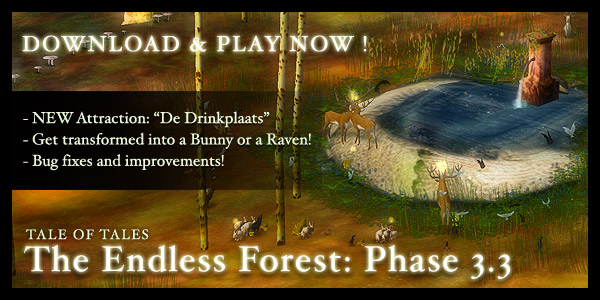
The Endless Forest is a multiplayer online game and social screensaver, a virtual place where you can play with your friends. When your computer goes to sleep you appear as a deer in this magical place. There are no goals to achieve or rules to follow. Just run through the forest and see what happens.

<!–

DOWNLOAD the new
PHASE THREE client!

–> Download The Endless Forest You are a deer. So are the other players. You meet each other in an endless forest on the internet. The setting is idyllic, the atmosphere peaceful. You communicate with one another through sounds and body language.

Currently The Endless Forest consists of a forest, a mysterious ruin, a lovely pond and as many deer as there are players at any given time. You can play the game anonymously but we encourage you to name your deer so other players can recognize you.

Although not goal-oriented, there are several activities that you can engage in. Nothing very demanding or violent. Just fun things to do in a nice environment.
Once every so often, the forest deities will appear, either in person or through their divine powers. Beware of falling rocks and sudden showers!

Over the course of the following years, we will add many things to The Endless Forest. Some may indeed be slightly game-like while others simply pretty or poetic. For an idea of our general plans, look here. But we invite you to play the game and make suggestions of your own in our forum.

The Endless Forest client as well as the multiplayer service are available free of charge thanks to the support of several cultural institutions (see Credits for details). If you would also like to help support this unique game project please feel free to donate. <!–

Endless Forest News

<! ajaxinclude("rss.php");

–>

00 Examen para alumnos NO_PIE

Examen para alumnos NO_PIE, Martes 19.01.2010 de 9:00 a 12:00 aula 401.

Todos los alumnos que no deseen seguir el calendario propuesto para este curso o incumplan los deadlines, o no quieran participar en el programa P.I.E. podrán realizar, para aprobar este cuatrimestre, un examen de tipo tradicional el 19.01.2010 de 9:00 a 12:00 en el aula 401.

El examen consta de 2 partes una teórica y otra práctica.

1) Teórica: desarrollaréis (en forma de ensayo crítico) UNO de los dos temas que os propondré mediante un pequeño fragmento extraído de entre los textos que podéis encontrar on-line en:

para Métodos:

03 #14213 Métodos

para Narrativa:

http://uvpress.blogs.uv.es/03-14214-narrativa/

o podéis adquirir las copias impresas que están disponibles en la fotocopiadora de la Facultat

2) Práctica: desarrollaréis en forma de ensayo crítico UNO de los tres fragmentos (mediante un análisis del texto completo y no sólo del fragmento) entre los textos que podéis encontrar on-line en:

http://uvpress.blogs.uv.es/2009/01

A todos los que planteen dudas o preguntas ruego lo hagan a través de comentarios a este mismo post de lo contrario tengo que repitir las mismas respuestas una y otra vez.

salut

Dr. Forés

00 Google wave – preview

Google

About Google Wave

Google Wave is an online tool for real-time communication and collaboration. A wave can be both a conversation
and a document where people can discuss and work together using richly formatted text, photos, videos, maps, and more.

screenshot2

What is a wave?

A wave is equal parts conversation and document. People can communicate and work together with richly formatted text, photos, videos, maps, and more.

A wave is shared. Any participant can reply anywhere in the message, edit the content and add participants at any point in the process. Then playback lets anyone rewind the wave to see who said what and when.

A wave is live. With live transmission as you type, participants on a wave can have faster conversations, see edits and interact with extensions in real-time.

When to use Google Wave >>

<!–

Communicate

Google Wave features make it more efficient and even fun to plan activities, make decisions or just keep in touch.

Reply anywhere Real-time chat Replay
Instead of copying the message over, as you do in email, with one shared conversation you can answer questions or make comments anywhere. Live transmission in Google Wave lets you see as other participants type in a wave and respond more quickly, meaning faster conversati The playback feature lets you catch up on how a conversation has evolved even if you were added after the start of the discussion.

Collaborate

Google Wave is suited to teamwork whether you are in the same room or across the globe

Edit simultaneously Share organization Add rich content
Participants can collaborate on a single shared document without worrying about versions and see edits appear in real-time Organize waves with tags and links to to make sharing complex projects simpler Files, photos and extensions can be easily included in a wave to make rich collaborative reports

Some key technologies in Google Wave

Real-time collaboration Natural language tools Extending Google Wave
Concurrency control technology lets all people on a wave edit rich media at the same time.

Watch the tech video

Server-based models provide contextual suggestions and spelling correction.

Watch the tech video

Embed waves in other sites or add live social gadgets, thanks to Google Wave APIs.

–>

00 The Sonatas of Saint Francis by M. Joyce et altri

http://supertart.com/sonatas/index.html

The Sonatas of Saint Francis
Open up a reading…

New

About:

About: Tech:

Apologies to Mac OS X, Openstep, and NeXTStep users browsing the fiction with Omniweb, as our JavaScript is a bit lacking, and you’ll be missing some of the fiction. We’re working on it.
If you have any problems with the site, drop an email to techsupport@supertart.com.

00 Holier Than Thou – an exploratory hypertext fiction

http://www.duke.edu/~mshumate/fiction/htt/index.html

Holier Than Thou

an exploratory hypertext fiction

by Michael Shumate
mshumate@acpub.duke.edu

-----

About “Holier Than Thou”

Although “Holier Than Thou” is a work of fiction that can be read in its own right, it is also part of a larger web of text. It is part of my final project “Writing Lives: Technology, Creativity, and Hypertext Fiction,” which I will be submitting for completion of my M.A. in Liberal Studies, Duke University, Summer, 1996. As part of this project, more detail on the writing of “Holier Than Thou” and its metamorphosis into a hypertext is available, although–I hope–not necessary to an enjoyable and informed reading of the story.

“Holier Than Thou” should be readable from all browsers–there are no images as yet except an image map. However, since it uses “client pull,” one of the “dynamic documents” extensions to HTML proposed by Netscape, reading it with Netscape Navigator version 1.1 or higher will be a very different experience than reading it with other browsers. I have no problem with this–in fact, it is done on purpose and I will discuss this in more detail in my final project. My inspiration to introduce this feature came directly from Stuart Moulthrop‘s recent fiction, Hegirascope, which I highly recommend.


Navigation

Project Entrance | Bibliography | Glossary | Main Map

Version Notes

Initial release: October 19, 1995
Last update: July 25, 1996


©1996 Michael Shumate

00 The Company Therapist

http://www.thetherapist.com/Introduction.html

Introduction to The Company Therapist

Dr. Charles Balis completed his psychiatric residency at Columbia Presbytarian Hospital in New York City. Like many other New Yorkers, he came out to San Francisco to set up a solo practice. Cautious by nature, Dr. Balis contracted with CalaCare, Inc., an HMO, and agreed to sell 60% of his time to provide mental health services for Silicon Impressions Inc., a CalaCare contracting company. Silicon Impressions Inc. (SII) is a large computer hardware and software company located in San Francisco.

The stories of Dr. Balis’ patients are revealed through his files. There are transcripts of therapy sessions, patient diaries and logs, doodles, personnel records, telephone conversations, and other written and graphical materials. The Company Therapist is designed to allow a deep exploration of its characters and their stories.

First time visitors to this site can start with Dr. Balis’ Personal Diary & Notes, but are encouraged to explore. Below is a list of the patients and both their first and most recent sessions with the Doctor. Click on the patient’s name to go to their file which has links to all the material on that patient, or click on the session date to go directly there.

Over the three years of its run, readers were encouraged to become writers and create their own patients and associated therapy sessions. To learn how it worked, go Backstage.