07 Sexo literario para eternos adolescentes

Carlos García Miranda

Escritor y guionista

Recibir actualizaciones de Carlos García Miranda

Sexo literario para eternos adolescentes

Publicado: 11/05/2013 10:15


Recibir alertas:

Las editoriales están apostando por un nuevo género juvenil bautizado al otro lado del charco como new adult fiction, literalmente ficción para nuevos adultos. Los protagonistas y lectores de sus libros estandartes, Maravilloso desastre (Jamie McGuire, Suma de letras) o El chico Malo (Abbi Glines, Destino) entre otros, se encuentran en esa edad intermedia entre la adolescencia y la edad adulta que no tiene nombre. Son ficciones de jóvenes que llegan a la universidad o a sus primeros trabajos, conflictos a los que se tienen que enfrentar ya sin la protección de sus padres; libros que dialogan sobre la pérdida de los resquicios de la inocencia y la confirmación de la identidad.

En realidad estos temas no son nuevos, aunque lo que había antes se publicaba en sellos adultos y no se catalogaba como un género propio. Ponerle un nombre y agruparlos en las filiales más juveniles los ha hecho mucho más accesibles.

También da la sensación de que con este movimiento las editoriales quieren alargar la adolescencia de los lectores, aunque el fenómeno puede entenderse como una necesidad de ofrecer ficciones más acordes con la realidad actual. Ahora los adolescentes lo son por mucho más tiempo, el acceso al verdadero mundo laboral o la maternidad se pospone casi una década por culpa del engranaje defectuoso del sistema. Los libros de la ficción para nuevos adultos se adaptan así a un tiempo de letanía en la transición a la vida adulta, en el que las limitaciones de la crisis que asfixia el mundo no permiten que los jóvenes crezcan.

2013-05-05-oie_5122124M4CwXXpF.jpg
Fotos: imagen cedida por Destino (izq.) y Vimeo (dcha).
El tema de la NA (acrónimo en inglés de new adult fiction) está lleno de controversia, no sólo por los motivos de su repentina aparición y las dudas sobre su existencia previa, sino porque muchos de sus libros incluyen sexo explícito. Si bien es cierto que no es una condición intrínseca del género (The scorpio Races de Maggie Stiefvater es otro de los libros insignes en el que no hay páginas de alcoba), una parte de ellos se centra más en el sexo que en dar cabida a los problemas de una etapa vital concreta.

Encontrar esas descripciones tan exhaustivas en las páginas de una novela con intención de convertirse en un éxito de ventas aparentemente es una consecuencia de la onda expansiva de la novela erótica de moda 50 sombras de Grey. Parece innegable lo mucho que ha tenido que ver en el surgimiento de ciertos títulos de NA ya que los viciosos protagonistas escritos por E. L. James se encuentran en la veintena. Aunque el hecho de que los sellos juveniles incorporen títulos calientes a su catálogo evidencia un cambio… Parece que muchos lectores adolescentes ya no se conforman con un puñado de metáforas cuando se habla del encuentro físico entre los protagonistas de las historias que leen.

Este cambio comenzó en Internet, en parte porque muchos libros de la nueva ficción para adultos se autoeditaron en la red, y en parte por el cada vez más poderoso fenómeno de la fanfiction (ficción de fans). En estos relatos, escritos sin pretensión económica por los seguidores de una novela o película, se utilizan los personajes y las situaciones de la historia original para crear una nueva ficción. La web FanFiction.net es la más famosa de todas ellas, aunque ya no aceptan nada para mayores de dieciocho años. La censura llegó entre otros motivos porque mucha de la fanfiction gira en torno a las relaciones sexuales no tratadas en la versión original y a menudo descritas con detalles explícitos (la propia 50 sombras de Grey comenzó de esta manera en la red).

El fenómeno existe desde la década de los sesenta, en los fanzines, pero antes de Internet los jóvenes estaban más protegidos de este tipo de literatura no adulta con contenido erótico. Ahora el acceso se ha vuelto mucho más natural y no sólo para su lectura, sino también para su escritura. Y es que la mayoría de los que crean los contenidos en esas páginas webs que reciben millones de visitas diarias son adolescentes. Las editoriales supieron ver que el sexo, en todo su esplendor literario, podía tener un mercado y decidieron apostar por lo que ya triunfaba en Internet, primero en adultos y ahora en adolescentes. En nuestro país se aunaron a ambos lectores en la novela Los tatuajes no se borran con láser, de Carlos Montero, coordinador de una de las series de la televisión que más ficción de fans generó en la red, Física o química.

La inclusión del sexo sin tabúes en la literatura juvenil siempre ha suscitado la polémica. Aunque lo realmente paradójico de su repentina invasión es que los adolescentes no parecían necesitarlo; ahora más que nunca el acceso a la pornografía en bruto está a golpe de clic en Internet. No sería justo generalizar, pero da la sensación de que en la literatura juvenil se encuentra algo diferente a la actuación exigente y rápida del sexo de la red. La elaboración imaginaria que ofrece la lectura del erotismo, aún en su extremo más pornográfico, devuelve parte de lo que el sexo tenía de misterioso y de descubrimiento antes de su sobreexposición en la red.

Las encargadas de este rescate de la sexualidad, por llamarlo de alguna forma, han sido las chicas, ya que son ellas mayoritariamente las que lo escriben y también las que lo leen. Este fenómeno podría tomarse como una reacción a las (necesarias) libertades que se ofrecieron en las décadas pasadas y que hicieron que la sexualidad, para muchos jóvenes y no tan jóvenes, se convirtiera en una forma más de consumo y no en un conocimiento de uno mismo a través del otro.

La literatura juvenil erótica parece que ha echado el freno a la pornografía de la pantalla de ordenador. Se ofrece una alternativa menos obvia desde el papel, lo que podría interpretarse como una vuelta atrás, aunque también como una búsqueda para reordenar o redefinir la sexualidad tras las vueltas de más que se le han dado. Tal vez haya ocurrido como con el péndulo de Foucault, que una vez alcanzado el límite de un lado sólo puede volver al otro.


Seguir a Carlos García Miranda en Twitter: www.twitter.com/CarlosG_Miranda

07 Beckett’s Not I: how I became the ultimate motormouth

Que pena que no publicaran este artículo un día antes, así lo hubiera incluído en mis comentarios que hice al hablar de esta obra de Beckett. Encontrarás el texto por si te interesa leerlo mientras lo ves o lo escuchas en:

http://www.english.emory.edu/DRAMA/beckettnoti.html


Beckett’s Not I: how I became the ultimate motormouth

Samuel Beckett left strict instructions for his ‘one-mouth’ play. Don’t act. And you can never go fast enough. Easier said than done, writes actor Lisa Dwan

Lisa Dwan as the mouth in Not I, by Samuel Beckett

A role to chew on … Lisa Dwan as the mouth in Not I, by Samuel Beckett. Photograph: Allan Titmuss

Every pore of my face and neck is smothered with thick black grease and cloaked in charcoal. With surgical precision, I wet-wipe my lips and pull down the opaque tight shroud. Blinded now, I reach out for the hand that will guide me up the steep steps to the platform. “That’s the first strap, Lisa.”

  1. Not I
  2. by Samuel Beckett
  3. Royal Court,
  4. London
  1. Starts 21 May
  2. Until 25 May
  3. Box office:
    020-7565 5000
  4. Venue website

The sound is muffled, but I can pick out some voices in the crowd below. My forehead is pushed forward, pressed between a thick blindfold and plank of wood. My arms are placed inside metal clasps, and my heartbeat reverberates against the blackened boards: don’t panic, don’t panic. I will never get used to this claustrophobic grip. Becky, my stage manager, pushes my neck forward through a gap large enough for only a third of my face and fastens the second strap of the head harness. Now my ears are closed off. Breathe. I breathe in dust from the curtain in front of me, into a mouth that hovers exactly eight feet above the stage.

I first heard about Not I in my teens, from the great Beckett actor Stephen Brennan. He told me about this short, intense play, where an actor is suspended in utter darkness except for her disembodied mouth spewing a torrent, a stream of consciousness. The mouth appears to float about the stage. I was transfixed by the image he painted.

In 1972, shortly after Beckett wrote Not I, the American actor Jessica Tandy played the role. Backstage, he told her she had destroyed his play. At 22 minutes, she had delivered it far too slowly. He then wrote to its director Alan Schnieder to say he would direct Billie Whitelaw in London himself, “to find out if this is theatre or not”.

In 2005, I was sent the script by the director Natalie Abrahami. In between the sheer poetry and the fractured narrative, I saw a transcript of how the mind works – not a linear stream of thought, but layers of interjections, interruptions, insurrections. In the scattering of Christian pieties and Irish colloquialisms, I also heard the sound of home.

From the moment I was cast, Abrahami banned Whitelaw’s name from the rehearsal room. But it looms large among Beckettians; her close affiliation to him provokes a natural call and response. The impact of her original 14-minute triumph at the Royal Court in London resonates 40 years on. And yet it was vital not to let that performance affect mine. If I was to pay homage to Beckett’s ultimate note – “Don’t act” – I’d have to find my own entry point. To this day, I have never seen any version of the piece performed in the theatre, but I have watched the film version of Billie’s, directed by Beckett in 1977 (the year I was born). When Beckett watched the rushes, he turned to his friend and biographer James Knowlson to say: “My god, it looks like a giant vulva!”

Samuel Beckett with Billie Whitelaw in Not I, at the Royal Court in 1979Samuel Beckett with Billie Whitelaw, whom he handpicked to star in Not I, at the Royal Court, London in 1979. Photograph: John Haynes/Lebrecht Music & ArtsThere is not a single aspect of Not I that isn’t difficult. As with all Beckett’s work, there are strict stage directions that must be adhered to. He was a holistic artist, and the visual, textual and sensory elements of the performance are of equal importance. Included in this, I might add, is the actor’s terror. Every performance is knife-edge stuff. Beckett wanted this piece to play on the nerves of the audience, not the intellect. And in writing a text so near to unlearnable as Not I, with its exhaustively tricksy repetition and countless interjections to be spoken at such speed, he gets it. It is so rarely performed that I cannot afford a mistake.

I have been fortunate in that everywhere I’ve lived has had stairs. In the run-up to a show – I’ve done it in 2005 and 2009 – I perform the piece at least three times a day, fastening myself into my makeshift harness between the bannisters. I record each performance, then carefully play it over with the text. If I go wrong even halfway through, back I go.

There is not a cell of my body that isn’t called to arms while performing, but most challenging of all is to silence one’s own internal Not I. There’s no room for reckless thoughts. They disturb the concentration. But like vultures, they hover above his lean lines. “Out into this world …” it begins. Did you turn off the gas? Your mobile? “This World …” This forever feral mind of mine.

When I met Billie in 2006, we bonded immediately, like two shell-shocked war veterans. About a year later, I received a call from her out of the blue. “I want to give you his notes, I need to give you his notes. Can you come round?” Soon she was conducting me over her kitchen table. “I can’t read or write music,” she said, “but if I were a musician, I’d have put a crotchet here instead of a quaver.” She recalled what Beckett had told her: “‘You can’t go fast enough for me.’ Also, ‘If the word has several syllables, use them. Ev-er-y-thing. No-thing.'”

When I was asked to perform the piece again at London’s Southbank Centre in 2009, Billie and I stepped up our sessions. In repeatedly instructing “No colour” or “Don’t act”, Beckett requires us to offer up our entire nervous systems – our “centre”, as Billie calls it. When I can simply let the words play their music out on my whole being, only then can I begin to approach the result I’m aiming for: pure Beckett.

I once asked Billie if she felt like a puppet. “No!” she exclaimed. “Because without me, he couldn’t do it.” And without Billie, neither could I. Only a few of us know what it is to hang in that darkness, terrified and alone till the curtain opens to let in the laser of light that fires the mouth and then to speak so fast you can’t think and think so fast you can’t speak … yet speak she must.

07 Multicultural Shakespeare

http://www.degruyter.com/view/j/mstap

Online

Open Access
* Prices subject to change. Shipping costs will be added if applicable.
ISSN:
2083-8530

Multicultural Shakespeare

Translation, Appropriation and Performance

1 Issue per year

VERSITA

Open Access

Multicultural Shakespeare developed into a publication mediating vigorous discussions on the adaptation of Shakespeare’s texts, their ontology and cross-cultural significance. It created an opportunity to present the universal dimension of Shakespeare’s works by focusing on their local values found in various cultures worldwide.
First printed in Japan, now published in Łódź, Poland, Multicultural Shakespeare seeks co-operation with people who make, teach or simply enjoy theatre and literature, and who are interested in addressing the problems of translating, staging, reading and teaching Shakespeare.

Issues

Volume 8 (2011)

Issue 24 (Dec 2012), pp. 1 – 105

The Turn of the Shrew: Gendering the Power of Loquacity in Othello

Ganguly, Swati

Page 1

Published Online: 12/28/2012

Hamlet in Slovenia: From Myth to Theatre

Zlatnar Moe, Marija

Page 14

Published Online: 12/28/2012

Polish Macbeth and the Middle East Crisis

Kwapisz Williams, Katarzyna

Page 26

Published Online: 12/28/2012

Nothing like the Sun: Shakespeare in Spain Today

González, José Manuel

Page 34

Published Online: 12/28/2012

The Absence of Allusion to Warfare in Álvaro Cunqueiro’s Don Hamlet: A Galician Text of the Shakespearian Play

Jarazo Álvarez, Rubén / Domínguez Romero, Elena

Page 53

Published Online: 12/28/2012

A Holonic Approach to Shakespeare: The Digital Reference System (DRS)

Forés López, Vicente / Saiz Molina, Jose

Page 61

Published Online: 12/28/2012

A Holonic Approach to Shakespeare: The Digital Reference System (DRS)

Vicente Forés López1 / Jose Saiz Molina2

1 Associate Professor at the University of Valencia

2 PhD in English Studies and is a member of the Anglotic Project at the University of Valencia

Citation Information: Multicultural Shakespeare: Translation, Appropriation and Performance. Volume 9, Issue 24, Pages 61–70, ISSN (Print) 2083-8530, DOI: 10.2478/v10224-011-0016-3, December 2012


07 Jane Austen: Strictly ballroom

Jane Austen: Strictly ballroom

For Jane Austen’s heroines a ball is a rare chance to mingle with the opposite sex. Now a BBC reconstruction of the Netherfield dance reveals the rigid social conventions that governed regency life

Pride & Prejudice: Having A Ball

The BBC’s Pride And Prejudice: Having A Ball. Photograph: Andrew Hayes-Watkins/BBC/Optomen

In Emma, Jane Austen concedes that it may be just possible to live without dancing. “Instances have been known of young people passing many, many months successively, without being at any ball of any description, and no material injury accrue either to body or mind.” But what an empty life! For anyone who still has sap in them, there is nothing like dancing – nothing to rival what Austen calls “the felicities of rapid motion”. In Austen’s fiction, as in many novels of the 19th century, a ball is the ultimate occasion for a heady kind of courtship – a trying out of partners that is exciting, flirtatious and downright erotic.

In Pride and Prejudice, the complicated mutual attraction of Elizabeth Bennet and Mr Darcy is established through their behaviour towards each other at a succession of balls. They approach and retreat, tease and repel each other, as in an elaborate dance. Among the many media events marking the bicentenary of the publication of Austen’s most popular novel, none is more elaborate than BBC2‘s restaging of the most important of these, the Netherfield ball given by Mr Bingley. It is a gorgeous, telegenic enactment, but also reveals the conventions on which Austen’s narrative relies.

She takes it for granted that all her readers will know what a ball is like and will see the manoeuvres of her characters as clearly as she does herself. She does not tell us what dances were performed, what music was played, or what food was eaten. Yet from other publications of the age – including the copious instructions of contemporary dance masters – it is entirely possible to reconstruct such an event. We are used to the glimpses given in film adaptations, but never have dancers been made to perform exactly as Bingley’s guests must have done. “Every savage can dance,” observes Mr Darcy sardonically, and when you see it happening in a thronged ballroom you certainly notice the physicality. Individual dances last up to 15 minutes and, in a room lit only by candles, the heat soon rivals any Ibizan dancefloor. The performers are dance students from the University of Surrey, and probably more athletic than the average denizen of Meryton in 1813, but soon the sweat is pouring off them. You begin to feel the force of Austen’s observations that, at the earlier assembly ball in Pride and Prejudice, Mr Bingley “danced every dance”. He was clearly a thoroughly vigorous young man.
The BBC staging of the Netherfield ball … click here to view on mobile

In life, Austen loved balls, which were the most exciting events in provincial life. In her novels, she uses them brilliantly for their combination of propriety and passion. Codes of behaviour were exacting. At the Netherfield ball, Elizabeth must dance with Mr Collins because if a woman turns down one request for a dance she must turn down all others. Say no to Mr Collins and you must stand out for the whole evening. Her first two dances (the maximum you were allowed with the same partner) are therefore “dances of mortification”. Mr Collins, “often moving wrong without being aware of it”, gives her “all the shame and misery which a disagreeable partner for a couple of dances can give”. He, of course, thinks that he has done brilliantly, the dance being a preparation for his proposal of marriage the next day.

See what these dances involve close-up and you feel some sympathy for the badly co-ordinated young vicar. The patterns of steps and movements are delightfully complicated, and unimaginable without a great deal of practice. Our rather accomplished dance students were only able to perform the likes of the Boulanger and the Cotillion after long sessions in the studio. You could see that dancing well was a test, and that when Austen’s heroines take the floor with the men they love it is in order to perform well together. Even the Bennet girls, whose education was entirely neglected by their mother, would have had lessons. Dancing was indeed one of the “accomplishments” that Mr Darcy solemnly lists during Elizabeth’s earlier stay at Netherfield.

In many 19th-century novels, balls are the occasions for the release of passion and libido. In Thackeray’s Vanity Fair, the ball in Brussels on the eve of the battle of Waterloo is the occasion for Becky Sharp to flirt mercilessly with her best friend Amelia’s husband, George. Amorously intoxicated, he invites her to elope with him. In risqué French fiction a woman risks losing a great deal at a ball. In Maupassant’s famous short story “The Necklace”, it is all her worldly prospects. In Flaubert’s Madame Bovary, the heroine, bored by her new husband, glimpses a more exciting life at the ball given by the Marquis d’Andervilliers. She dances with a viscount and feels, for the first time, the thrill of her own allure. Many of the grandes passions of European fiction were sealed at balls. Where would Tolstoy have been without them? In War and Peace, Prince Andrei is entranced by Natasha when he encounters her at a grand ball. In Anna Karenina, the desolate Kitty knows that Vronsky has fallen for Anna when she sees the two of them dancing together at a ball.

Tolstoy’s characters would have been whirling in waltzes. Austen’s are performing in more restricted patterns. In her novels, as recent film versions have recognised, a dance was not an opportunity for a couple to spin off à deux. You danced in a group and made a shape together. When her fellow dancers at the Netherfield ball see Elizabeth take the floor with Mr Darcy, they are suitably awed. As she stands opposite him, she reads “in her neighbours’ looks” their “amazement”. Some of the other young ladies will also have to come into contact with him as they prance and rotate.

Matthew Macfadyen and Keira Knightley in PRIDE AND PREJUDICE (2005)Matthew Macfadyen and Keira Knightley take a twirl in Pride and Prejudice. Photograph: The Kobal CollectionThe drama of Austen’s fiction is shaped around the very protocol of the ball. A man can only ask a woman to dance if he has been formally introduced to her. In Northanger Abbey, Henry Tilney asks the master of ceremonies to introduce him to Catherine Morland. He must already have had his eye on her. When he attends the Meryton assembly ball, Mr Darcy declines to be introduced to any woman in the room. He will dance only with the women he knows, the baleful Bingley sisters. Not only is he too proud to mingle with the vulgar locals, as a rich young man he is also sick of being the target of husband hunters.

The electric relationship between Elizabeth and Mr Darcy is most clearly expressed in dancing, but also in the very business of sizing each other up as possible partners. The first volume of Pride and Prejudice is structured around a series of three balls. At the assembly ball Mr Darcy, with extraordinary rudeness, lets Elizabeth overhear his description of her as “tolerable; but not handsome enough to tempt me”. He is then forced to taste the hubris of this when he offers himself as her dance partner at the Lucases and is turned down. Finally, at the Netherfield ball, he suddenly asks for “her hand” and, “without knowing what she did”, she accepts. “Without knowing what she did”, indeed, for the ball allows Austen to stage Elizabeth’s almost unconscious interest in Mr Darcy.

At the balls in Austen’s novels, you can talk during dances, especially those that require some partners to wait while others perform. In Mansfield Park, we can feel the anticlimax when Fanny finally gets to dance with Edmund, the man she loves, and he tells her that he does not want to talk. “You will not want to be talked to. Let us have the luxury of silence”. In Pride and Prejudice, of course, Elizabeth and Mr Darcy have their most erotically charged conversation, a kind of verbal fencing match, while they are dancing. “Perhaps by and bye I may observe that private balls are much pleasanter than public ones”, is Elizabeth’s opening gambit.

While entrance to the Meryton assembly ball was achieved merely by purchasing a ticket, allowing hoi polloi to be present, the Netherfield ball is a private affair, by invitation only. As the BBC re-enactment makes clear, guests should be dazzled. Thus the significance of the food. Chez Bingley, the food would have been to impress as well as sustain. For the programme, food historian Ivan Day prepared the dishes with which Mr Bingley’s supercilious sister Caroline would have flaunted the family’s wealth and sophistication. These included the white soup that Mr Bingley mentions as an essential element of a ball. A somewhat sickly concoction of veal stock, ground almonds and cream with a dash of booze, its main function seems to have been that it was difficult and expensive to prepare. The incredible spread of mousses and pies, platters of meat and fish (poached sturgeon being the eyecatcher) was to invigorate the dancers for another few hours of gyration.

In Emma, Mrs Weston provokes outrage with her suggestion that, as the room set aside for the ball supper at The Crown is so small, there be “no regular supper; merely sandwiches, &c., set out in the little room”. What a “wretched suggestion”! “A private dance, without sitting down to supper, was pronounced an infamous fraud upon the rights of men and women; and Mrs Weston must not speak of it again.” The supper came as a kind of half-time break at a proper ball, and in Pride and Prejudice is central to the plot. It is where Mrs Bennet mortifies Elizabeth by talking loudly to Lady Lucas of her eldest daughter’s prospects of marrying Mr Bingley (“such a charming young man, and so rich”). She talks so loudly that Mr Darcy can clearly hear her. “Elizabeth blushed and blushed again with shame and vexation.”

She cares very much about what Mr Darcy thinks, without quite realising what has gone on as they danced together. For the reader, the intimacy between them has been sealed. How could Elizabeth think Mr Wickham was a likely marriage partner for her when she has not danced with him? All Austen’s heroines except Elinor Dashwood dance with the men they love, and all of them have their feelings confirmed by dancing. Catherine Morland in Northanger Abbey meets her husband-to-be, Henry Tilney, at a dance. Fanny Price in Mansfield Park experiences true felicity when she dances with Edmund at the ball that Sir Thomas Bertram stages in her honour. Emma Woodhouse first alerts us to the sexual chemistry between herself and Mr Knightley when she dances with him at the ball at the Crown. “We are not really so much brother and sister as to make it at all improper,” she observes. His answer makes it clear, to us if not to her, that he is taking to the floor for a reason. “Brother and sister! No, indeed.”

Anne Elliot in Persuasion, her chance of happiness with Captain Wentworth apparently lost eight years earlier, seems condemned to a sexless existence, playing the piano for the Musgrove sisters as they dance with the man she loves. But we know that she and Captain Wentworth did used to dance together. She overhears Captain Wentworth asking one of the Musgrove girls “whether Miss Elliot never danced”. The reply is heart-sinking. “Oh, no; never; she has quite given up dancing. She had rather play.” To dance was to be sexually alive. Couples were performing together, feeling each other’s physical proximity (though both men and women wore gloves throughout) and being watched by others. In Mansfield Park Mrs Norris and Mrs Rushworth watch Maria Bertram and Mr Rushworth dancing together and pretend that they look like beautifully suited partners. We must imagine that the clod-hopping Mr Rushworth is nothing of the sort.

The reconstruction of the ball will delight any addict of period costume dazzle. The clothes are sumptuous as well as authentic: they were, after all, designed to attract the eye of the opposite sex. Yet the programme should also show any lover of Austen’s novels that dancing was at the heart of her stories. It was all about pairing off. The ball was the occasion for a couple to perform together in front of others. It was their opportunity for physical intimacy. They could not clinch each other or even touch each other’s flesh, yet they were brought closer than they could be on any other occasion. And, as Elizabeth and Mr Darcy show us, if they were consummate performers they could talk as they did so. Once these two have danced together, they are destined for each other. Anyone in that ballroom should have been able to see it, even if they did not see it themselves.

• John Mullan is the author of What Matters in Jane Austen: Twenty Crucial Puzzles Solved (Bloomsbury)

07 Develop Hyper-Connected Critical Research Skills for Higher Ed

http://www.onlineuniversities.com/university-for-the-21st-century/


Blog

Apr 23, 2013

Develop Hyper-Connected Critical Research Skills for Higher Ed


by Follow Justin on TwitterFollow Justin

What exactly is critical thinking? You hear about it all the time as a valuable 21st Century skill that everyone should have, and one that a good education will help you develop. If it is so important, why aren’t there specific courses, seminars, self-help videos, or even whole schools focused on helping students develop it? This post, which focuses on research skills, and the next one, “Applying Hyper-Connected Critical Thinking in Higher Education”  present a few things that you can do during your college career to make sure that you develop the kind of critical thinking ability that will make you an innovator and leader in the hyper-connected 21st Century, global economy.

What is Critical Thinking?
Surprisingly, critical thinking as a distinct area is relatively new, having only been formally defined in the late 20th Century. Its roots however, go back as far as recorded human history, as we have always been striving to apply these concepts to our existence in the world. The formal definition we use today comes from Michael Scriven and Richard Paul, who presented the concept at the 8th Annual International Conference on Critical Thinking and Education Reform in 1987. Here is their summary:

“Critical thinking is the intellectually disciplined process of actively and skillfully conceptualizing, applying, analyzing, synthesizing, and/or evaluating information gathered from, or generated by, observation, experience, reflection, reasoning, or communication, as a guide to belief and action. In its exemplary form, it is based on universal intellectual values that transcend subject matter divisions: clarity, accuracy, precision, consistency, relevance, sound evidence, good reasons, depth, breadth, and fairness.”
Scriven and Paul, 1987)

According to Scriven and Paul, there are two distinct parts of critical thinking: gathering information from the world around you (researching for class assignments) and making sense of that information (completing class assignments). They list several different ways in which information can be gathered and several steps necessary for actively understanding the facts gathered. Both aspects of the critical thinking process can be developed and sharpened by the thoughtful college student interested in enhancing their ability to think critically and thus to make informed judgments and take appropriate action in any circumstance that they might encounter.

Gathering information is the first step in critical thinking. Here’s how you can become a thoughtful and thorough researcher to provide the best data for your critical consideration.

Building Your Critical Capacity
Prior to applying your critical thinking skills, you must first acquire the material that you are going to analyze and synthesize. This is a process which can be honed, thus providing you with the best possible information to consider. Whenever you are engaged in looking for targeted information, whether for conducting scholarly research or to determine which new cell phone to purchase, you will be well served by following these tips for conducting critical research:

  1. Cast a wide net/conduct primary research – In any information gathering task you should begin by considering the broadest possible array of sources. In the 21st Century, this generally means using the Internet and your favorite search engine such as Google or Bing. More important than which engine you use are the search terms that you enter. Start with the most general. If you are doing research on the Native American occupation of Alcatraz Island in 1969, starting with a generic search for Native American history, or Indigenous movements will net you some results that may help place your specific topic in a broader context and that may open up additional avenues of inquiry. You are looking for the most authoritative and reputable sources regardless of the search you conduct. Google does a fairly good job sifting out the bad ones, but following these tips from George Mason University will help to ensure that you are targeting the best resources possible.
  2. Refine your questions – Once you have done your initial search and background reading you will be ready to dig in to specific questions and your targeted issue. First you will want to formulate a research question. Referring back to the Alcatraz occupation as an example, you may choose to ask “What were the objectives in occupying the prison?” or “What events led to the occupation and how does it contribute to an understanding of the indigenous rights movement?” or even more specifically, “What was John Trudell’s role in the occupation and why is he a controversial figure in the indigenous rights movement?”Once you have generated a specific question you are interested in answering you should generate a list of key words – names, dates, concepts, etc. that can help you create a list of search terms that will help you find your answers. At this point you should also consider switching to a more academically focused search engine such as Google Scholar or any of these others recommended by TeachThought.com. These engines will return results from even more authoritative sources such as scholarly journals that will give your assertions real weight, and lead you to further articles.
  3. Track back other sources – As you read through the sources you are finding at both levels above, you should be making a list of additional references given in what you are reading. Specifically make note of those that seem to provide more detailed information about some aspect of your research. Write down the author’s name, title of the work, and date of publication whenever available. Then begin searching for those sources. I have had surprisingly good luck putting titles and author names into Google and receiving results that link directly to digital copies of the work I am looking for. Start there for the broadest possible search. Then head to the library for some old fashioned catalogue/stack searching, or search online research databases such as JSTOR, or ERIC. The specific one you use will depend on the field you are researching. For a list of which databases contain what type of information check out studenthacks.org’s “Super-Sized List of Online Academic Databases.”

Putting Your Research to Work
Part of the problem with doing all of this critical research is going to be keeping it organized. Best Colleges Online blogger Michael Keathley offers three steps for dealing with the “information overload” you are likely to generate by doing thorough research in the Internet Age.  Keathley’s suggestions for organizing and incorporating your findings are excellent, but in addition to just using them, you want to make sure that you are incorporating them into your personal critical framework.

Once you have applied critical thinking to the process of finding valuable information about a topic you are researching, you will need to understand how to make sense of the material in order to draw sound conclusions.  I will address that process in the next post.

Follow the thread and share your thought on critical thinking in the 21st Century on Twitter or Google+.

Image courtesy of Nutdanai Apikhomboonwaroot / FreeDigitalPhotos.net


A 10th Grader Explains How Social Media Can Replace Textbooks

05/02/2013, , 3 Comments

2

math-books-rulerThis article was written by Noa Gutow-Ellis, a high school sophomore in Houston, Texas. She’s passionate about all things related to the Arab Spring and 21st Century Education. As an 8th grader, Noa gave a TEDx talk about the power of social media.

We can do better.

Better than the outdated, limiting, and somewhat irrelevant resources that are textbooks. Better than pulling out the bolded words in textbooks and quizzing students on them the next day. Better than focusing solely on events that took place hundreds or thousands of years ago instead of learning about events taking place right now.

Social media can transform a class from a traditional, cookie cutter, textbook-using class into an innovative, fascinating, and extremely relevant course. For example, a class that focuses on current events. Everyone deserves to understand what’s going on in the world. In school, why aren’t current events as important as events that took place hundreds of years ago? Moving beyond the textbook and utilizing resources like social media doesn’t mean we’re disregarding events of the past.

It can mean the opposite.

While learning about the Arab Spring, a class could analyze the history of tyrannical regimes of the Middle East in order to understand the events that took place in early 2011. When ancient events are compared to things pertinent to our lives, we’re able to have a deeper, clearer understanding of what took place. Moving beyond the textbook allows for just that: the class could explore Twitter hashtags that activists used, read books like Revolution 2.0, and watch YouTube videos of protests. Without a textbook, the possibilities are virtually endless.

A few paragraphs on a subject in a textbook cannot compare to the infinite amount of resources available on the Internet. In turn, it’s an important skill to be able to discern a valid source on the Internet. A class that makes plenty of use of the Internet is a timely opportunity to teach students that valuable lesson.

Whether filling a Google Reader with a variety of sources to identify types of bias or using an Interactive Whiteboard to track an event while it’s happening, replacing (or even supplementing) textbooks affords an interesting, always different, exciting way for students to connect with the world around them.

As a student, I want to feel like I’m in the 21st century, both in and out of the classroom.

Image attribution flickr user len

Next Post →


16 Learning Strategies To Promoting Grit And Delayed Gratification In Students


← Previous Post


25 Top Concept-Mapping Tools For Visual Learning

3 Responses

07 Digital Public Library of America (DPLA) opens to public

Digital Public Library of America (DPLA) opens to public

Online archive of more than 2m books, documents, photographs and artworks from all over US now available to view for free

Abraham Lincoln and his son Tad in a photograph by Mathew Brady

President Abraham Lincoln and his son Tad … a souvenir of American cultural history now available to view via the DPLA. Photograph: Mathew Brady/AFP/Getty Images/National Archives and Records Administration

Gold paint glowing, there’s an illuminated manuscript page from The Book of Hours, dated 1514. A gruelling photograph of the standoff between strikers and militia at the Bread and Roses strike of 1912 in Lawrence, Massachusetts. Black men marching, protesting against segregation in downtown Atlanta in 1960. Extraordinary accounts of the lives of Native Americans during the 19th century. The Digital Public Library of America has just launched, gathering together more than 2m items – books, photographs, manuscripts, art – from the country’s libraries, archives and museums, and making them available to the public online for free. It’s as if, a member of its steering committee said as the library opened its virtual doors late in April, “the ancient library of Alexandria had met the modern world wide web and digitised America for the benefit of all”.

The DPLA has been in the works for the past two years. A non-profit initiative, it has received millions of dollars of funding to digitise and bring together online the collections of the US’s great libraries, as well as pieces and texts from regional museums and archives. “One of the best things which people are discovering is that we have brought together lots of very small collections,” says Dan Cohen, executive director, who joined the project from a role as director of the Roy Rosenzweig Centre for history and new media at George Mason University. “Yes, we have hundreds of thousands of items from the Smithsonian … but we’ve also worked with, for example, a historical society from Red Wing, Minnesota, who have amazing images of one of the first hot air balloon flights. It’s completely fascinating – it’s enabling people to find really incredible local history.”

The DPLA has also just announced a new partnership with the David Rumsey map collection, adding tens of thousands of historical maps and images to its online archive, from an 1833 “Eagle” map of the US, showing an eagle “sitting atop the nation”, to an early 19th-century map giving the first accurate depiction of the relationship of the sources of the Missouri, the sources of the Columbia and the Rockies. “It has everything from medieval diagrammes to very modern material,” says Cohen.

There are “millions of objects in the pipeline” to add to the 2.4m currently online, with “service hubs” around the country aggregating material from smaller places. “We are in a growth phase and as quickly as we can we will expand out the library,” Cohen says. “But we want to make sure all the metadata is very rigorous.”

The main issue the DPLA is facing is copyright – just as Google did when it was sued by authors and publishers for its plans to digitise millions of books for Google Book Search, including in-copyright titles.

“Copyright is the biggest point of friction right now,” according to Cohen, “particularly for certain kinds of things like books, where everything before 1923 is in the public domain, and from 1923 on you start running into barriers.”

Cohen is working together with scholar, author and Harvard University librarian Robert Darnton, a key member of the DPLA’s committee, to solve the issue. “One of the things Bob and I are both really interested in is are there some creative ways we can think of getting more … books into the public sphere,” says Cohen. “We want authors and publishers to make money, but the vast majority of books make most of their money in the first five years, then sit in copyright for the next 100 years. We think there might be creative ways to get more of those authors into the public sphere.”

One of these options could be an “authors’ alliance”, where the author receives their rights back from the publisher after a certain amount of time, and can donate them to the DPLA if they want. “Or a ‘library licence’, where a book could be under standard copyright protection for a certain period of time set by the publisher, five or 10 or 15 years, and after that the DPLA would get a gift of a single ebook copy, and we could host a version.”

“We want to have a variety of methods so publishers and authors can feel more confident about saying ‘we are going to recoup our costs’, but provision for the fact that we don’t need to lock stuff down until 2118, when we’ll all be on Mars … But these are conversations which have just started, and there may be other creative ways of doing things,” says Cohen. “There needs to be some sort of balance. It is a lot healthier to have a nation of voracious readers who sometimes get their reading material for free either through their libraries or the DPLA, than a nation of TV watchers.”

In the meantime, Cohen is “really curious” to see how people interact with the DPLA and the millions of items it already has to show. “I’ve already got messages from teachers who have integrated it into their classrooms [and] we also view the DPLA as a technology platform others can build on. We have a growing app library where the material can be used, for instance to create a mobile app to access the local history around you,” he says. “We are 100% open. You can download the DPLA and do with it what you want.”

07 La UE aprueba prohibir dos años el uso de plaguicidas que afectan a las abejas

UNA GRAN NOTICIA, de las pocas buenas que se han aprobado en la UE

 en mucho tiempo.

La UE aprueba prohibir dos años el uso de plaguicidas que afectan a las abejas

Los tres neonicotinoides más frecuentes en las plantaciones de girasol o maíz pueden causar la muerte de los insectos

Colmenas de abejas en la Sierra de Guadarrama. / Santi Burgos

La Comisión Europea ha conseguido este lunes el apoyo de una mayoría de países suficiente para prohibir durante dos años el uso de los tres neonicotinoides más frecuentes como plaguicidas en la siembra del girasol, la colza, el algodón y el maíz, por los riesgos que plantean para la salud de las abejas. Un total de quince países han dado su visto bueno al veto de dos años, incluidos Alemania y Bulgaria, países que en reuniones anteriores se abstuvieron, y de España, que ya se mostró a favor meses atrás, según han informado a Europa Press fuentes comunitarias. En contra han votado ocho delegaciones, entre ellas Reino Unido, y se han abstenido cuatro países.

La Agencia europea de seguridad alimentaria (EFSA, por sus siglas en inglés) ha señalado tres plaguicidas de la familia de los neonicotinoides comercializados en Europa por Bayer y Syngenta: clotianidina, tiametoxam e imidacloprid. Estos químicos pueden afectar al sistema nervioso de los insectos causándoles parálisis y hasta la muerte, pero no suponen un riesgo para la salud humana.

La medida podría afectar a un tercio de las semillas preparadas en la UE y España es uno de los principales productores, por lo que inicialmente pidió aplazar cualquier decisión hasta tener más datos científicos concluyentes, aunque finalmente se pronunció a favor en una primera votación celebrada en marzo.

Este ha sido el segundo intento del comisario de Salud y Consumo, Tonio Borg, para tratar de sacar adelante las medidas restrictivas. En marzo no contó con el apoyo suficiente de los Gobiernos europeos para ello, pero no supuso el bloqueo de las medidas.

La medida podría afectar a un tercio de las semillas preparadas en la UE y España

Varias organizaciones ecologistas han presionado en las últimas fechas para tratar de convencer a los Gobiernos reticentes de que acepten la medida y para asegurarse de que los que apoyaron el plan en marzo, mantuvieran el sentido de su voto.

También el sector apícola, que en España cuenta con la mayor cabaña de la UE y es el principal productor de miel de los 27, ha pedido restringir el uso de químicos. Y un centenar de colectivos en España, sociales, ambientales y de consumidores, habían pedido al ministro de Agricultura, Miguel Arias Cañete, que mantuviera su apoyo al veto.

En concreto, la propuesta de la Comisión aboga por revisar las condiciones de autorización de los neonicotinoides para restringir su uso “solo a los cultivos no atractivos para las abejas y para los cereales de invierno”, ya que la exposición a su polvo en otoño no se considera un riesgo para el insecto.

España es el principal productor de miel de la UE y apoya la restricción

Borg también quiere que se prohíba la venta de “semillas tratadas” con productos fitosanitarios que contengan los químicos señalados, aunque esta medida no se aplicaría a las plantas que no atraen a las abejas, y vetar su uso por no profesionales.

El objetivo del Ejecutivo comunitario sigue siendo que el plan de medidas legislativas “ambiciosas y proporcionales” esté listo para ser aplicado desde el 1 de julio.

07 Applying Hyper-Connected Critical Thinking in Higher Education


http://www.onlineuniversities.com/blog/2013/04/applying-hyper-connected-critical-thinking-in-higher-education/


Blog

Apr 25, 2013

Applying Hyper-Connected Critical Thinking in Higher Education


by Follow Justin on TwitterFollow Justin

“Critical thinking…the awakening of the intellect to the study of itself.”
(Critical Thinking.org)

In my most recent post, “Develop Hyper-Connected Critical Research Skills for Higher Education,” I outline a process by which students can thoughtfully acquire information in any facet of their lives that can then be evaluated in order to make the most well-informed, globally aware, intellectually contemplated decision possible. Now that you know how to get the information necessary for critical thinking, here is a process that you can employ to put that data to work for you and to develop lifelong habits that will help make you a valuable contributor to society.

What is Critical Thinking? A Refresher
The basic concept behind the idea of critical thinking as summarized by from Michael Scriven and Richard Paul (1987).

“Critical thinking is the intellectually disciplined process of actively and skillfully conceptualizing, applying, analyzing, synthesizing, and/or evaluating information gathered from, or generated by, observation, experience, reflection, reasoning, or communication, as a guide to belief and action. In its exemplary form, it is based on universal intellectual values that transcend subject matter divisions: clarity, accuracy, precision, consistency, relevance, sound evidence, good reasons, depth, breadth, and fairness.”

The important aspects of this definition for the college student are that critical thinking is a set of skills for actively “conceptualizing, applying, analyzing, synthesizing, and evaluating” information about the world we live in. In short, this is a process for making sense of the world around you.

Not coincidentally, the steps of critical thinking mirror the levels of Bloom’s Taxonomy of learning which provide a structure for the most efficient way that people learn: remembering, understanding, applying, analyzing, evaluating, and creating. Combining these two models provides an excellent plan for undertaking a process of critical reflection, particularly in a media rich, hyper-connected world. Here’s my model for “Hyper-Connected Critical Thinking” and some suggestions for how you can apply it within the existing framework of your higher education.

Stage 1: Researching – Conducting solid, informed research is the basis of all critical thinking in the Information Age, and thus is deserving of its own post, which can be read here, “Develop Hyper-Connected Critical Research Skills for Higher Education.”

Stage 2: Evaluating– Critical thinking is an iterative process, meaning that as you learn more, you return to earlier steps to invest what you have discovered back into previous levels of the process. You will be evaluating both the information you are finding and your own though process continually as you work through the critical thinking progression. This process is also addressed in “Develop Hyper-Connected Critical Research Skills for Higher Education,” but at the most basic level, you will want to make sure that the sources you are incorporating are reputable. Here’s how from George Mason University.

The process of critically evaluating your own thought process is far more complex and involves developing self-awareness and open-mindedness. For starters you should create a list or diagram that captures your own perceptions of the issues and the effects of your potential findings. I would suggest a simple SWOT analysis (Strengths, Weaknesses, Opportunities, and Threats) that describes your stake in the issue.


(Source: Wikipedia)

In the case of the sample diagram, think of the areas as relating to you personally. For example, are there personal strengths you have that would help you understand the issue? Are you a member of the group or organization you are studying? If so, this also can be a weakness as your ability to see clearly may be effected by your involvement. For Opportunities and Threats, are there personal gains that you will achieve as a result of your findings? Those will need to be factored into your critical understanding of the issue.

Stage 3: Conceptualizing – Once you have conducted your initial research and evaluate it you need to create a conceptual model, either in your head or physically, of how the information you are finding fits together. In formal academic courses, your professors may do some of this for you by presenting historical contexts or explicitly emphasizing links to ongoing events or research. If they don’t, or you are working outside of formal educational channels, you can do this for yourself using free online concept mapping tools. This list from Indiana University contains several suggestions. Additionally you could use PowerPoint or Prezi, particularly if you are looking to collaborate with others.

Stage 4: Analyzing – In the critical thinking process, analyzing applies to discrete pieces of information, the larger issue being considered, and your own thought process. The process of analysis is where true critical perspective begins to develop. Take all of the information you have acquired, the broad concepts you have formulated, and your own burgeoning self-awareness from the SWOT analysis, and put them all together to form a complete picture of the issue(s) and your place in relation to it. This process will be different for every problem you tackle, but basically you should consider the mainstream perspective on an issue and then as many alternative perspectives as you have encountered or can conceive of. Refer back to your education to think about these alternative points of view. World history, political science, philosophy, classics, and other disciplines will help provide divergent perspectives. Additionally, return to the Internet and consult discussion boards, affinity groups, and social media sites to find real people whose opinions you can elicit.

Stage 5: Synthesizing – It is now time to begin putting everything together to synthesize your new critical perspective on the issue or topic. The best way to synthesize the information you have gathered, conceptualized, and analyzed is to clearly articulate your position. You have done all of the necessary legwork to take this step, but formalizing your point of view will be intellectually challenging. This is the point of the process where social media and face-to-face contacts are essential to developing a clear articulation of your conclusions. Talk to friends, family, and experts in the field such as professors or professionals available online and walk through your process with them and your conclusions. As this is an iterative process, you should remain flexible about incorporating any new information into your developing understanding.

Stage 6: Creating – Finally, in the Information Age, the end result of any critical thinking endeavor is to create and share a product that will add value to the ongoing conversation and solidify your thinking on the topic. If you are in a class, the guidelines for this production will be clear – PowerPoint, paper, or some other project. If you are coming to your critical perspective on your own, you can create a blog, video, video game, or some other piece of media that takes your synthesis and turns it into something that articulates and shares your newfound understanding.

For hyper-connected critical thinking this sharing and the ensuing conversation that follows from it will serve to further enhance your view, and should be funneled back into the process. Critical thinking will never end, and every new piece of information you receive should be incorporated into your ongoing process.

Keep It Going
Hyper-connected critical thinking is an ongoing process that never stops. Not only will it continue for any individual topic you research, but, if put into play, it will help you to develop the kind of lifelong habits of intellectualism and critical consideration that will make you a thoughtful, concerned, and ultimately successful person. Critical thinking will help you to make the most well-informed, best decision in any event that you encounter, It is a skill that will benefit you and the entire society. Go ahead and start honing your critical thinking skills right now.


07 Winnie the Pooh author AA Milne was first world war propagandist

Winnie the Pooh author AA Milne was first world war propagandist

Writer was anti-war but new discovery shows he was drafted by military intelligence service MI7b, shut down in 1918

AA Milne with Christopher Robin and the original Pooh Bear in 1928

Winnie the Pooh author AA Milne with Christopher Robin in 1928. Photograph: Pictorial Press

AA Milne famously denounced war in his pacifist essay Peace with Honour, but classified documents found in an old trunk reveal the author of Winnie the Pooh was recruited by a secret propaganda unit during the first world war.

Jeremy Arter was sorting through old paperwork in his aunt’s home when he stumbled across rare, classified documents from MI7b, a military propaganda outfit that worked with writers to present a positive version of the war to those at home.

It closed in 1918 with all official paperwork thought to have been destroyed, but Arter found more than 150 articles saved by his great uncle, Captain James Price Lloyd, who worked for the unit.

“As far as we’re aware this is the only surviving body of material from MI7b and it’s a truly remarkable record of how the British propaganda machine worked at the time,” said Rob Phillips, digitisation project manager at the National Library of Wales, which is creating an archive relating to the Welsh experience of the war.

Along with manuscripts and photographs, Arter found a pamphlet entitled The Green Book, dated January 1919 and stamped MI7b: “for private circulation”.

“I looked for Uncle Jim, but I found AA Milne as well. I also found Cecil Street, the author of the Dr Priestley novels; the frontiersman and author Roger Pocock; the Irish poet Patrick MacGill; and JP Morton of Bystander fame,” said Arter. “It was a bit like the Magnificent Seven had ridden into town, except that these were more than 20 or so of the greatest literary men of their day all working for MI7b, along with Uncle Jim.

“[The Green Book] was a valedictory in-house magazine probably printed in no more than 20 copies, for each of the people who probably had a farewell dinner at one of the London clubs. In it they vent their spleen and humour at the war and at each other … It’s a priceless document. Great Uncle Jim broke every rule in the book [to preserve it].”

In a series of poems, Milne, who also worked as a signalling officer during the first world war and served briefly in France, imagines how “some earlier propagandists” might have approached having to “lie” about the “atrocities” of the war.

In Captain William Shakespeare, of a Cyclist Battalion, Milne writes: “In MI7B, / Who loves to lie with me / About atrocities / And Hun Corpse Factories. / Come hither, come hither, come hither, / Here shall he see / No enemy, / But sit all day and blether.”

In Captain Thomas Campbell, of the Border Regiment he writes: “It was the schooner ‘Hesperus’ / Which sailed the wintry seas … / And victory must remain with us / While we have ships like these.”

Milne “probably stood out because he didn’t keep his pacifist views to himself”, said Arter. The author was discharged in 1919. Five years later he began his career as a children’s author, with the publication of two poetry collections, When We Were Very Young and Now We Are Six, and his two Winnie- the- Pooh novels.

His pacifist work Peace with Honour: an Enquiry Into the War Convention was released in 1934. He wrote it, he said, “because I want everybody to think (as I do) that war is poison, and not (as so many think) an over-strong, extremely unpleasant medicine.”

The second world war changed Milne’s mind, however. He accused his old friend PG Wodehouse, of near-treason for his radio broadcasts from a Nazi internment camp, and in 1940 he published War with Honour, which took a different line from his earlier assertion that “war is something of man’s own fostering, and if all mankind renounces it, then it is no longer there”.

07 Jornada: Implementación de las nuevas tecnologías en el ámbito de la investigación en lengua y lingüística inglesas

Esta jornada se plantea como un escenario para generar interés e impulsar la aplicación de las nuevas tecnologías y cómo se pueden utilizar para una enseñanza de lenguas de calidad. El programa combina exposiciones por parte de investigadores de la UVEG y de otras universidades con la participación de alumnos de titulaciones propias. Consideramos que los alumnos que se encuentran en su último año de estudios básicos (por ejemplo, 5º de Filología Inglesa o 4º del Grado en Estudios Ingleses) o ya en postgrado (por ejemplo, Máster de Investigación en Lenguas y Literaturas de la Facultat de Filologia, Traducció i Comunicació y el Máster de Profesor de Secundaria) muestran una inquietud que exige proporcionarles conocimientos aplicados más allá de las aulas. Este evento quiere ser una oportunidad de trabajar de forma más cercana con los profesores y de iniciarse en el ámbito de la investigación real.

Contacto:

jornadatic@yahoo.es

Participan:

logo_uvAngloTICBlogFinal00IULMAdepartament logo 50

07 Web censorship: the net is closing in

Web censorship: the net is closing in

Across the globe governments are monitoring and censoring access to the web. And if we’re not careful millions more people could find the internet fractured, fragmented and controlled by the state

Internet cafe in Guilin

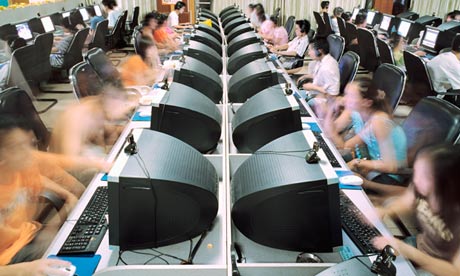
Customers at an internet cafe in Guilin, China, where the government places severe restrictions on web access. Photograph: Martin Puddy/ Martin Puddy/Corbis

Every state in the world has its own laws, cultural norms and accepted behaviours. As billions of people come online in the next decade, many will discover a newfound independence that will test these boundaries. Each state will attempt to regulate the internet, and shape it in its own image.

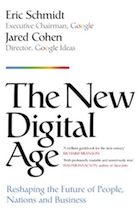
  1. The New Digital Age: Reshaping the Future of People, Nations and Business
  2. by Eric Schmidt, Jared Cohen
  1. Tell us what you think: Star-rate and review this book

The majority of the world’s internet users encounter some form of censorship – also known by the euphemism “filtering” – but what that actually looks like depends on a country’s policies and its technological infrastructure. Not all or even most of that filtering is political censorship; progressive countries routinely block a modest number of sites, such as those featuring child pornography.

In some countries, there are several entry points for internet connectivity, and a handful of private telecommunications companies control them (with some regulation). In others, there is only one entry point, a nationalised internet service provider (ISP), through which all traffic flows. Filtering is relatively easy in the latter case, and more difficult in the former.

When technologists began to notice states regulating and projecting influence online, some warned against a “Balkanisation of the internet”, whereby national filtering and other restrictions would transform what was once the global internet into a connected series of nation-state networks. The web would fracture and fragment, and soon there would be a “Russian internet” and an “American internet” and so on, all coexisting and sometimes overlapping but, in important ways, separate. Information would largely flow within countries but not across them, due to filtering, language or even just user preference. The process would at first be barely perceptible to users, but it would fossilise over time and ultimately remake the internet.

It’s very likely that some version of the above scenario will occur, but the degree to which it does will greatly be determined by what happens in the next decade with newly connected states – which path they choose, whom they emulate and work together with.

The first stage of the process, aggressive and distinctive filtering, is under way. China is the world’s most active and enthusiastic filterer of information. Entire platforms that are hugely popular elsewhere in the world – Facebook, Tumblr, Twitter – are blocked by the Chinese government.

On the Chinese internet, you would be unable to find information about politically sensitive topics such as the Tiananmen Square protests, embarrassing information about the Chinese political leadership, the Tibetan rights movement and the Dalai Lama, or content related to human rights, political reform or sovereignty issues.

To the average Chinese user, this censorship is seamless – without prior knowledge of events or ideas, it would appear that they never existed.

China’s leadership doesn’t hesitate to defend its policies. In a white paper released in 2010, the government calls the internet “a crystallisation of human wisdom” but states that China’s “laws and regulations clearly prohibit the spread of information that contains contents subverting state power, undermining national unity [or] infringing upon national honour and interests.”

The next stage for many states will be collective editing, states forming communities of interest to edit the web together, based on shared values or geopolitics. For larger states, collaborations will legitimise their filtering efforts and deflect some unwanted attention (the “look, others are doing it too” excuse). For smaller states, alliances along these lines will be a low-cost way to curry favour with bigger players and gain technical skills that they might lack at home.

Collective editing may start with basic cultural agreements and shared antipathies among states, such as what religious minorities they dislike, how they view other parts of the world or what their cultural perspective is on historical figures such as Vladimir Lenin, Mao Zedong or Mustafa Kemal Atatürk.

Larger states are less likely to band together than smaller ones – they already have the technical capabilities – so it will be a fleet of smaller states, pooling their resources, that will find this method useful. If some member countries in the Commonwealth of Independent States (CIS), an association of former Soviet states, became fed up with Moscow’s insistence on standardising the Russian language across the region, they could join together to censor all Russian-language content from their national internets and thus limit their citizens’ exposure to Russia.

Ideology and religious morals are likely to be the strongest drivers of these collaborations. Imagine if a group of deeply conservative Sunni-majority countries – say, Saudi Arabia, Yemen, Algeria and Mauritania – formed an online alliance and decided to build a “Sunni web”. While technically this Sunni web would still be part of the larger internet, it would become the main source of information, news, history and activity for citizens living in these countries. For years, the development and spread of the internet was highly determined by its English-only language standard, but the continued implementation of internationalised domain names (IDN), which allow people to use and access domain names written in non-Roman alphabet characters, is changing this. The creation of a Sunni web – indeed, all nationalised internets – becomes more likely if its users can access a version of the internet in their own language and script.

Within the Sunni web, the internet could be sharia-complicit: e-commerce and e-banking would look different, since no one would be allowed to charge interest; religious police might monitor online speech, working together with domestic law enforcement to report violations; websites with gay or lesbian content would be uniformly blocked; women’s movements online might somehow be curtailed; and ethnic and religious minority groups might find themselves closely monitored, restricted or even excluded. In this scenario, how possible it would be for a local tech-savvy citizen to circumvent this internet and reach the global world wide web depends on which country he lived in: Mauritania might not have the desire or capacity to stop him, but Saudi Arabia probably would. If the Mauritanian government became concerned that its users were bypassing the Sunni web, on the other hand, surely one of its new digital partners could help it build higher fences.

There will be some instances where autocratic and democratic nations edit the web together. Such a collaboration will typically happen when a weaker democracy is in a neighbourhood of stronger autocratic states that coerce it to make the same geopolitical compromises online that it makes in the physical world.

For example, Mongolia is a young democracy with an open internet, sandwiched between Russia and China – two large countries with their own unique and restrictive internet policies. The former Mongolian prime minister Sukhbaatar Batbold explained to us that he wants Mongolia, like any country, to have its own identity. This means, he said, it must have good relations with its neighbours to keep them from meddling in Mongolian affairs.

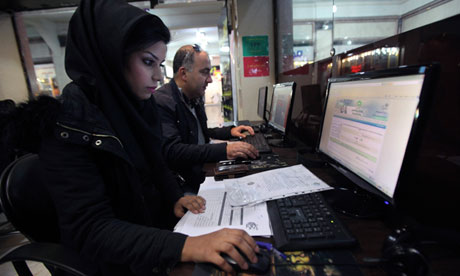
Iranian internet cafePeople use the internet in Tehran, Iran, where the government has spoken of creating its own ‘halal internet’. Photograph: Vahid Salemi/APA neutral stance of noninterference is more easily sustainable in the physical world. Virtual space significantly complicates this model. People sympathetic to opposition groups and ethnic minorities within China and Russia would look at Mongolia as an excellent place to congregate. Supporters of the Uighurs, Tibetans or Chechen rebels might seek to use Mongolia’s internet space as a base from which to mobilise, to wage online campaigns and build virtual movements. If that happened, the Mongolian government would no doubt feel the pressure from China and Russia, not just diplomatically but because its national infrastructure is not built to withstand a cyber assault from either neighbour. Seeking to please its neighbours and preserve its own physical and virtual sovereignty, Mongolia might find it necessary to abide by a Chinese or Russian mandate and filter internet content associated with hot-button issues.

What started as the world wide web will begin to look more like the world itself, full of internal divisions and divergent interests. Some form of visa requirement will emerge on the internet. This could be done quickly and electronically, as a method to contain the flow of information in both directions, requiring that users register and agree to certain conditions to access a country’s internet. Citizen engagement, international business operations and investigative reporting will all be seriously affected. This, along with internal restrictions of the internet, suggests a 21st-century equivalent of Japan’s famous sakoku (“locked country”) policy of near-total isolation enacted in the 17th century.

Some states may implement visa requirements as both a monitoring tool for international visitors and as a revenue-generating exercise – a small fee would be charged upon entering a country’s virtual space, even more if one’s online activities violated the terms of the visa. Virtual visas would appear in response to security threats related to cyber attacks; if your IP address (the unique number associated with each device on the internet) came from a blacklisted country, you would encounter heightened monitoring.

Under conditions like these, the world will see its first Internet asylum seeker. A dissident who can’t live freely under an autocratic Internet and is refused access to other states’ Internets will choose to seek physical asylum in another country to gain virtual freedom on its Internet. There could be a form of interim virtual asylum, where the host country would share sophisticated proxy and circumvention tools that would allow the dissident to connect outside.

Virtual asylum will not work, however, if the ultimate escalation occurs: the creation of an alternative domain name system (DNS), or even aggressive and ubiquitous tampering with it to advance state interests. Today, the internet as we know it uses the DNS to match computers and devices to relevant data sources, translating IP addresses (numbers) into readable names, with .edu, .com, .net suffixes, and vice versa. No government has yet achieved an alternative system, but if one succeeded in doing so, it would effectively unplug its population from the global internet and instead offer only a closed, national intranet. In technical terms, this would entail creating a censored gateway between a given country and the rest of the world, so that a human proxy could facilitate external data transmissions when absolutely necessary – for matters involving state resources, for instance.

It’s the most extreme version of what technologists call a walled garden. On the internet, a walled garden refers to a browsing environment that controls a user’s access to information and services online. (This concept is not limited to discussions of censorship; AOL and CompuServe, internet giants for a time, both started as walled gardens.) For the full effect of disconnection, the government would also instruct the routers to fail to advertise the IP addresses of websites – unlike DNS names, IP addresses are immutably tied to the sites themselves – which would have the effect of putting those websites on a very distant island, utterly unreachable. Whatever content existed on this national network would circulate only internally, trapped like a cluster of bubbles in a computer screen saver, and any attempts to reach users on this network from the outside would meet a hard stop. With the flip of a switch, an entire country would simply disappear from the internet.

This is not as crazy as it sounds. It was first reported in 2011 that the Iranian government’s plan to build a “halal internet” was under way, and the regime’s December 2012 launch of Mehr, its own version of YouTube with “government-approved videos”, demonstrated that it was serious about the project. Details of the plan remained hazy but, according to Iranian government officials, in the first phase the national “clean” internet would exist in tandem with the global internet for Iranians (heavily censored as it is), then it would come to replace the global internet altogether. The government and affiliated institutions would provide the content for the national intranet, either gathering it from the global web and scrubbing it, or creating it manually. All activity on the network would be closely monitored. Iran’s head of economic affairs told the country’s state-run news agency that they hoped their halal internet would come to replace the web in other Muslim countries, too – at least those with Farsi speakers. Pakistan has pledged to build something similar.

It is possible that Iran’s threat is merely a hoax. How exactly the state intends to proceed with this project is unclear both technically and politically. How would it avoid enraging the sizable chunk of its population that has access to the internet? Some believe it would be impossible to fully disconnect Iran from the global internet because of its broad economic reliance on external connections. Others speculate that, if it wasn’t able to build an alternative root system, Iran could pioneer a dual-internet model that other repressive states would want to follow. Whichever route Iran chooses, if it is successful in this endeavour, its halal internet would surpass the “great firewall of China” as the single most extreme version of information censorship in history. It would change the internet as we know it.

• Extracted from The New Digital Age: Reshaping the Future of People, Nations and Business by Eric Schmidt and Jared Cohen, to be published by John Murray at £25 on 25 April 2013. © Google Inc and Jared Cohen.

07 John le Carré: ‘I was a secret even to myself’

John le Carré: ‘I was a secret even to myself’

After a decade in the intelligence service, John le Carré’s political disgust and personal confusion ‘exploded’ in The Spy Who Came in from the Cold. Fifty years later he asks how much has changed

VARIOUS

‘Every interview I have faced since I wrote The Spy Who Came in from the Cold seems designed to penetrate a truth that isn’t there’ … John le Carré. Photograph: Image Broker/Rex Features

I wrote The Spy Who Came in from the Cold at the age of 30 under intense, unshared, personal stress, and in extreme privacy. As an intelligence officer in the guise of a junior diplomat at the British Embassy in Bonn, I was a secret to my colleagues, and much of the time to myself. I had written a couple of earlier novels, necessarily under a pseudonym, and my employing service had approved them before publication. After lengthy soul-searching, they had also approved The Spy Who Came in from the Cold. To this day, I don’t know what I would have done if they hadn’t.

  1. A Delicate Truth
  2. by John le Carré
  1. Tell us what you think: Star-rate and review this book

As it was, they seem to have concluded, rightly if reluctantly, that the book was sheer fiction from start to finish, uninformed by personal experience, and that accordingly it constituted no breach of security. This was not, however, the view taken by the world’s press, which with one voice decided that the book was not merely authentic but some kind of revelatory Message From The Other Side, leaving me with nothing to do but sit tight and watch, in a kind of frozen awe, as it climbed the bestseller list and stuck there, while pundit after pundit heralded it as the real thing.

And to my awe, add over time a kind of impotent anger.

Anger, because from the day my novel was published, I realised that now and forever more I was to be branded as the spy turned writer, rather than as a writer who, like scores of his kind, had done a stint in the secret world, and written about it.

But journalists of the time weren’t having any of that. I was the British spy who had come out of the woodwork and told it how it really was, and anything I said to the contrary only enforced the myth. And since I was writing for a public hooked on Bond and desperate for the antidote, the myth stuck. Meanwhile, I was receiving the sort of attention writers dream of. My only problem was, I didn’t believe my own publicity. I didn’t like it even while I was subscribing to it, and there was in the most literal sense nothing I could say to stop the bandwagon, even if I’d wanted to. And I wasn’t sure I did.

In the 60s – and right up to the present day – the identity of a member of the British Secret Services was and is, quite rightly, a state secret. To divulge it is a crime. The Services may choose to leak a name when it pleases them. They may showcase an intelligence baron or two to give us a glimpse of their omniscience and – wait for it – openness. But woe betide a leaky former member.

And anyway I had my own inhibitions. I had no quarrel with my former employers, quite the contrary. Presenting myself to the press in New York a few months after the novel had made its mark in the States, I dutifully if nervously mouthed my denials: no, no, I had never been in the spy business; no, it was just a bad dream – which of course it was.

The paradox was compounded when an American journalist with connections told me out of the corner of his mouth that the reigning chief of my Service had advised a former director of the CIA that I had been his serving officer, and that he had told nobody but his very large retinue of best friends, and that anyone in the room who was anyone knew I was lying.

Every interview I have faced in the 50 years since then seems designed to penetrate a truth that isn’t there, and perhaps that’s one reason why I have become allergic to the process.

❦

The Spy Who Came in from the Cold was the work of a wayward imagination brought to the end of its tether by political disgust and personal confusion. Fifty years on, I don’t associate the book with anything that ever happened to me, save for one wordless encounter at London airport when a worn-out, middle-aged military kind of man in a stained raincoat slammed a handful of mixed foreign change on to the bar and in gritty Irish accents ordered himself as much Scotch as it would buy. In that moment, Alec Leamas was born. Or so my memory, not always a reliable informant, tells me.

Today I think of the novel as a not-very-well-disguised internal explosion after which my life would never be the same. It was not the first such explosion, or the last. And yes, yes, by the time I wrote it, I had been caught up in secret work off and on for a decade; a decade the more formative because I had the inherited guilt of being too young to fight in the second world war and – more importantly – of being the son of a war-profiteer, another secret I felt I had to keep to myself until he died.

But I was never a mastermind, or a mini-mind, and long before I even entered the secret world, I had an instinct towards fiction that made me a dubious fact-gatherer. I was never at personal risk in my secret work; I was frequently bored stiff by it. Had things been otherwise, my employers would not have allowed me to publish my novel, even if later they kicked themselves for doing so: but that was because they decided it was being taken too seriously by too many people; and because any suggestion that the British Secret Service would betray its own was deemed derogatory to its ethical principles, bad for recruitment, and accordingly Bad for Britain, a charge to which there is no effective answer.

The proof that the novel was not “authentic” – how many times did I have to repeat this? – had been delivered by the fact that it was published. Indeed, one former head of a department that had employed me has since gone on record to declare that my contribution was negligible, which I can well believe. Another described the novel as “the only bloody double-agent operation that ever worked” – not true, but fun. The trouble is, when professional spies go out of their way to make a definitive statement about one of their own, the public tends to believe the opposite: which puts us all back where we started, myself included.

And if the spies hadn’t had me at that age, some equally luckless institution would have done, and after a couple of years I’d have been digging my way out.

❦

And the deep background of the novel? The sights, smells and voices that, 15 years after the end of the war, continued to infest every corner of divided Germany? The Berlin in which Leamas had his being was a paradigm of human folly and historical paradox. In the early 60s I had observed it mostly from the confines of the British Embassy in Bonn, and only occasionally in the raw. But I watched the Wall‘s progress from barbed wire to breeze block; I watched the ramparts of the cold war going up on the still-warm ashes of the hot one. And I had absolutely no sense of transition from the one war to the other, because in the secret world there barely was one. To the hard-liners of east and west the second world war was a distraction. Now it was over, they could get on with the real war that had started with the Bolshevik Revolution in 1917, and had been running under different flags and disguises ever since.

No wonder then if Alec Leamas found himself rubbing shoulders with some pretty unsavoury colleagues in the ranks of western intelligence. Former Nazis with attractive qualifications weren’t just tolerated by the Allies; they were positively mollycoddled for their anti-communist credentials. Who was America’s first choice to head West Germany’s embryonic intelligence service? General Reinhard Gehlen, former chief of Hitler’s Foreign Armies East (Russian theatre) where he had made himself a corner in the Soviet order of battle. Anticipating Germany’s defeat, the General had assembled his files and his people, and at the first opportunity turned them over to the Americans, who accepted them with open arms. Recruited, Gehlen tactfully dropped the “General” and became Herr Doktor instead.

But where to house this precious asset and his crown jewels? The Americans decided to install Gehlen and his people in the cosy Bavarian village of Pullach, eight miles outside Munich and handy for their intelligence headquarters.

And whose handsome country estate, now vacant, did they select for the Herr Doktor? Martin Bormann was Hitler’s most trusted confidant and private secretary. When the Führer established himself at his Eagle’s Nest just up the road, his buddies scurried to set up house nearby. Gehlen and his people were settled in Bormann’s villa, now the subject of a conservation order issued by the Bavarian government. Just a few years ago, in circumstances of extraordinary courtesy, one of the Bundesnachrichtendienst’s [German intelligence service’s] latter-day luminaries gave me a personal tour. I recommend the 1930s furniture in the conference room, and the Jugendstil statues in the gardens at the back. But the main attraction must surely be the great dark staircase winding into the cellars, and the fully furnished bunker, just like the Führer’s, but smaller.

Was Alec Leamas a regular visitor to Pullach? He had no choice. Few secret operations into East Germany could take place without the connivance of the BND. And did Leamas, on his regular visits, perhaps come across the Herr Doktor’s valued chief of counter intelligence, Heinz Felfe, formerly of the SS and Sicherheitsdienst [Nazi intelligence service]? He must have done. Felfe was a legendary operator. Had he not single-handedly unmasked a raft of Soviet spies?

Of course he had, and no wonder. When he was finally unmasked himself, he got 14 years for spying for Moscow, only to be traded for a bunch of hapless West Germans held there.

Did Leamas enjoy access to the ultra-secret “special material” obtained by Operation GOLD, the hugely costly quarter-mile-long, Anglo-American audio tunnel that tapped into Russian cables a couple of feet below the surface of a road in the Eastern Sector of Berlin? Before the first spade went into the ground, GOLD had been comprehensively blown by a Soviet agent named George Blake, the heroic ex-prisoner of North Korea and pride of the British Secret Service.

Yet to this day, many of GOLD’s architects would have us believe that their operation was not merely an engineering triumph but an intelligence coup as well, on the questionable grounds that, so reluctant were the Russians to blow their agent, they let communications flow as usual.

Dissolve to a couple of years later and Kim Philby, once in line for chief, was also revealed as Moscow’s man. No wonder poor Leamas needed that stiff Scotch at London airport. The Service that owned his unflinching allegiance was in a state of corporate rot that would take another generation to heal. Did he know that? I think deep down he did.

And I think I must have known it too, or I wouldn’t have written Tinker Tailor Soldier Spy a few years down the line.

❦

The merit of The Spy Who Came in from the Cold, then – or its offence, depending where you stood – was not that it was authentic, but that it was credible. The bad dream turned out to be one that a lot of people in the world were sharing, since it asked the same old question that we are asking ourselves 50 years later: how far can we go in the rightful defence of our western values, without abandoning them along the way? My fictional chief of the British Service – I called him Control – had no doubt of the answer:

“I mean, you can’t be less ruthless than the opposition simply because your government’s policy is benevolent, can you now?”

Today, the same man, with better teeth and hair and a much smarter suit, can be heard explaining away the catastrophic illegal war in Iraq, or justifying medieval torture techniques as the preferred means of interrogation in the 21st century, or defending the inalienable right of closet psychopaths to bear semi-automatic weapons, and the use of unmanned drones as a risk-free method of assassinating one’s perceived enemies and anybody who has the bad luck to be standing near them. Or, as a loyal servant of his corporation, assuring us that smoking is harmless to the health of the third world, and great banks are there to serve the public.

What have I learned over the last 50 years? Come to think of it, not much. Just that the morals of the secret world are very like our own.

• The 50th anniversary edition of The Spy Who Came in from the Cold, with “Fifty Years Later”, John le Carré‘s introduction, will be published by Penguin at £25 on 1 August. © David Cornwell 2013.

07 The Reading Brain in the Digital Age: The Science of Paper versus Screens

The Reading Brain in the Digital Age: The Science of Paper versus Screens

E-readers and tablets are becoming more popular as such technologies improve, but research suggests that reading on paper still boasts unique advantages

By Ferris Jabr  | Thursday, April 11, 2013 | 14

various-Kindles Image: Robert Drózd, Wikimedia Commons

In a viral YouTube video from October 2011 a one-year-old girl sweeps her fingers across an iPad’s touchscreen, shuffling groups of icons. In the following scenes she appears to pinch, swipe and prod the pages of paper magazines as though they too were screens. When nothing happens, she pushes against her leg, confirming that her finger works just fine—or so a title card would have us believe.

The girl’s father, Jean-Louis Constanza, presents “A Magazine Is an iPad That Does Not Work” as naturalistic observation—a Jane Goodall among the chimps moment—that reveals a generational transition. “Technology codes our minds,” he writes in the video’s description. “Magazines are now useless and impossible to understand, for digital natives”—that is, for people who have been interacting with digital technologies from a very early age.

Perhaps his daughter really did expect the paper magazines to respond the same way an iPad would. Or maybe she had no expectations at all—maybe she just wanted to touch the magazines. Babies touch everything. Young children who have never seen a tablet like the iPad or an e-reader like the Kindle will still reach out and run their fingers across the pages of a paper book; they will jab at an illustration they like; heck, they will even taste the corner of a book. Today’s so-called digital natives still interact with a mix of paper magazines and books, as well as tablets, smartphones and e-readers; using one kind of technology does not preclude them from understanding another.

Nevertheless, the video brings into focus an important question: How exactly does the technology we use to read change the way we read? How reading on screens differs from reading on paper is relevant not just to the youngest among us, but to just about everyone who reads—to anyone who routinely switches between working long hours in front of a computer at the office and leisurely reading paper magazines and books at home; to people who have embraced e-readers for their convenience and portability, but admit that for some reason they still prefer reading on paper; and to those who have already vowed to forgo tree pulp entirely. As digital texts and technologies become more prevalent, we gain new and more mobile ways of reading—but are we still reading as attentively and thoroughly? How do our brains respond differently to onscreen text than to words on paper? Should we be worried about dividing our attention between pixels and ink or is the validity of such concerns paper-thin?

Since at least the 1980s researchers in many different fields—including psychology, computer engineering, and library and information science—have investigated such questions in more than one hundred published studies. The matter is by no means settled. Before 1992 most studies concluded that people read slower, less accurately and less comprehensively on screens than on paper. Studies published since the early 1990s, however, have produced more inconsistent results: a slight majority has confirmed earlier conclusions, but almost as many have found few significant differences in reading speed or comprehension between paper and screens. And recent surveys suggest that although most people still prefer paper—especially when reading intensively—attitudes are changing as tablets and e-reading technology improve and reading digital books for facts and fun becomes more common. In the U.S., e-books currently make up between 15 and 20 percent of all trade book sales.

Even so, evidence from laboratory experiments, polls and consumer reports indicates that modern screens and e-readers fail to adequately recreate certain tactile experiences of reading on paper that many people miss and, more importantly, prevent people from navigating long texts in an intuitive and satisfying way. In turn, such navigational difficulties may subtly inhibit reading comprehension. Compared with paper, screens may also drain more of our mental resources while we are reading and make it a little harder to remember what we read when we are done. A parallel line of research focuses on people’s attitudes toward different kinds of media. Whether they realize it or not, many people approach computers and tablets with a state of mind less conducive to learning than the one they bring to paper.

“There is physicality in reading,” says developmental psychologist and cognitive scientist Maryanne Wolf of Tufts University, “maybe even more than we want to think about as we lurch into digital reading—as we move forward perhaps with too little reflection. I would like to preserve the absolute best of older forms, but know when to use the new.”

Navigating textual landscapes
Understanding how reading on paper is different from reading on screens requires some explanation of how the brain interprets written language. We often think of reading as a cerebral activity concerned with the abstract—with thoughts and ideas, tone and themes, metaphors and motifs. As far as our brains are concerned, however, text is a tangible part of the physical world we inhabit. In fact, the brain essentially regards letters as physical objects because it does not really have another way of understanding them. As Wolf explains in her book Proust and the Squid, we are not born with brain circuits dedicated to reading. After all, we did not invent writing until relatively recently in our evolutionary history, around the fourth millennium B.C. So the human brain improvises a brand-new circuit for reading by weaving together various regions of neural tissue devoted to other abilities, such as spoken language, motor coordination and vision.

Some of these repurposed brain regions are specialized for object recognition—they are networks of neurons that help us instantly distinguish an apple from an orange, for example, yet classify both as fruit. Just as we learn that certain features—roundness, a twiggy stem, smooth skin—characterize an apple, we learn to recognize each letter by its particular arrangement of lines, curves and hollow spaces. Some of the earliest forms of writing, such as Sumerian cuneiform, began as characters shaped like the objects they represented—a person’s head, an ear of barley, a fish. Some researchers see traces of these origins in modern alphabets: C as crescent moon, S as snake. Especially intricate characters—such as Chinese hanzi and Japanese kanji—activate motor regions in the brain involved in forming those characters on paper: The brain literally goes through the motions of writing when reading, even if the hands are empty. Researchers recently discovered that the same thing happens in a milder way when some people read cursive.

Beyond treating individual letters as physical objects, the human brain may also perceive a text in its entirety as a kind of physical landscape. When we read, we construct a mental representation of the text in which meaning is anchored to structure. The exact nature of such representations remains unclear, but they are likely similar to the mental maps we create of terrain—such as mountains and trails—and of man-made physical spaces, such as apartments and offices. Both anecdotally and in published studies, people report that when trying to locate a particular piece of written information they often remember where in the text it appeared. We might recall that we passed the red farmhouse near the start of the trail before we started climbing uphill through the forest; in a similar way, we remember that we read about Mr. Darcy rebuffing Elizabeth Bennett on the bottom of the left-hand page in one of the earlier chapters.

In most cases, paper books have more obvious topography than onscreen text. An open paperback presents a reader with two clearly defined domains—the left and right pages—and a total of eight corners with which to orient oneself. A reader can focus on a single page of a paper book without losing sight of the whole text: one can see where the book begins and ends and where one page is in relation to those borders. One can even feel the thickness of the pages read in one hand and pages to be read in the other. Turning the pages of a paper book is like leaving one footprint after another on the trail—there’s a rhythm to it and a visible record of how far one has traveled. All these features not only make text in a paper book easily navigable, they also make it easier to form a coherent mental map of the text.

In contrast, most screens, e-readers, smartphones and tablets interfere with intuitive navigation of a text and inhibit people from mapping the journey in their minds. A reader of digital text might scroll through a seamless stream of words, tap forward one page at a time or use the search function to immediately locate a particular phrase—but it is difficult to see any one passage in the context of the entire text. As an analogy, imagine if Google Maps allowed people to navigate street by individual street, as well as to teleport to any specific address, but prevented them from zooming out to see a neighborhood, state or country. Although e-readers like the Kindle and tablets like the iPad re-create pagination—sometimes complete with page numbers, headers and illustrations—the screen only displays a single virtual page: it is there and then it is gone. Instead of hiking the trail yourself, the trees, rocks and moss move past you in flashes with no trace of what came before and no way to see what lies ahead.

“The implicit feel of where you are in a physical book turns out to be more important than we realized,” says Abigail Sellen of Microsoft Research Cambridge in England and co-author of The Myth of the Paperless Office. “Only when you get an e-book do you start to miss it. I don’t think e-book manufacturers have thought enough about how you might visualize where you are in a book.”

At least a few studies suggest that by limiting the way people navigate texts, screens impair comprehension. In a study published in January 2013 Anne Mangen of the University of Stavanger in Norway and her colleagues asked 72 10th-grade students of similar reading ability to study one narrative and one expository text, each about 1,500 words in length. Half the students read the texts on paper and half read them in pdf files on computers with 15-inch liquid-crystal display (LCD) monitors. Afterward, students completed reading-comprehension tests consisting of multiple-choice and short-answer questions, during which they had access to the texts. Students who read the texts on computers performed a little worse than students who read on paper.

Based on observations during the study, Mangen thinks that students reading pdf files had a more difficult time finding particular information when referencing the texts. Volunteers on computers could only scroll or click through the pdfs one section at a time, whereas students reading on paper could hold the text in its entirety in their hands and quickly switch between different pages. Because of their easy navigability, paper books and documents may be better suited to absorption in a text. “The ease with which you can find out the beginning, end and everything inbetween and the constant connection to your path, your progress in the text, might be some way of making it less taxing cognitively, so you have more free capacity for comprehension,” Mangen says.

Supporting this research, surveys indicate that screens and e-readers interfere with two other important aspects of navigating texts: serendipity and a sense of control. People report that they enjoy flipping to a previous section of a paper book when a sentence surfaces a memory of something they read earlier, for example, or quickly scanning ahead on a whim. People also like to have as much control over a text as possible—to highlight with chemical ink, easily write notes to themselves in the margins as well as deform the paper however they choose.

Because of these preferences—and because getting away from multipurpose screens improves concentration—people consistently say that when they really want to dive into a text, they read it on paper. In a 2011 survey of graduate students at National Taiwan University, the majority reported browsing a few paragraphs online before printing out the whole text for more in-depth reading. A 2008 survey of millennials (people born between 1980 and the early 2000s) at Salve Regina University in Rhode Island concluded that, “when it comes to reading a book, even they prefer good, old-fashioned print”. And in a 2003 study conducted at the National Autonomous University of Mexico, nearly 80 percent of 687 surveyed students preferred to read text on paper as opposed to on a screen in order to “understand it with clarity”.

Surveys and consumer reports also suggest that the sensory experiences typically associated with reading—especially tactile experiences—matter to people more than one might assume. Text on a computer, an e-reader and—somewhat ironically—on any touch-screen device is far more intangible than text on paper. Whereas a paper book is made from pages of printed letters fixed in a particular arrangement, the text that appears on a screen is not part of the device’s hardware—it is an ephemeral image. When reading a paper book, one can feel the paper and ink and smooth or fold a page with one’s fingers; the pages make a distinctive sound when turned; and underlining or highlighting a sentence with ink permanently alters the paper’s chemistry. So far, digital texts have not satisfyingly replicated this kind of tactility (although some companies are innovating, at least with keyboards).

Paper books also have an immediately discernible size, shape and weight. We might refer to a hardcover edition of War and Peace as a hefty tome or a paperback Heart of Darkness as a slim volume. In contrast, although a digital text has a length—which is sometimes represented with a scroll or progress bar—it has no obvious shape or thickness. An e-reader always weighs the same, regardless of whether you are reading Proust’s magnum opus or one of Hemingway’s short stories. Some researchers have found that these discrepancies create enough “haptic dissonance” to dissuade some people from using e-readers. People expect books to look, feel and even smell a certain way; when they do not, reading sometimes becomes less enjoyable or even unpleasant. For others, the convenience of a slim portable e-reader outweighs any attachment they might have to the feel of paper books.

Exhaustive reading
Although many old and recent studies conclude that people understand what they read on paper more thoroughly than what they read on screens, the differences are often small. Some experiments, however, suggest that researchers should look not just at immediate reading comprehension, but also at long-term memory. In a 2003 study Kate Garland of the University of Leicester and her colleagues asked 50 British college students to read study material from an introductory economics course either on a computer monitor or in a spiral-bound booklet. After 20 minutes of reading Garland and her colleagues quizzed the students with multiple-choice questions. Students scored equally well regardless of the medium, but differed in how they remembered the information.

Psychologists distinguish between remembering something—which is to recall a piece of information along with contextual details, such as where, when and how one learned it—and knowing something, which is feeling that something is true without remembering how one learned the information. Generally, remembering is a weaker form of memory that is likely to fade unless it is converted into more stable, long-term memory that is “known” from then on. When taking the quiz, volunteers who had read study material on a monitor relied much more on remembering than on knowing, whereas students who read on paper depended equally on remembering and knowing. Garland and her colleagues think that students who read on paper learned the study material more thoroughly more quickly; they did not have to spend a lot of time searching their minds for information from the text, trying to trigger the right memory—they often just knew the answers.

Other researchers have suggested that people comprehend less when they read on a screen because screen-based reading is more physically and mentally taxing than reading on paper. E-ink is easy on the eyes because it reflects ambient light just like a paper book, but computer screens, smartphones and tablets like the iPad shine light directly into people’s faces. Depending on the model of the device, glare, pixilation and flickers can also tire the eyes. LCDs are certainly gentler on eyes than their predecessor, cathode-ray tubes (CRT), but prolonged reading on glossy self-illuminated screens can cause eyestrain, headaches and blurred vision. Such symptoms are so common among people who read on screens—affecting around 70 percent of people who work long hours in front of computers—that the American Optometric Association officially recognizes computer vision syndrome.

Erik Wästlund of Karlstad University in Sweden has conducted some particularly rigorous research on whether paper or screens demand more physical and cognitive resources. In one of his experiments 72 volunteers completed the Higher Education Entrance Examination READ test—a 30-minute, Swedish-language reading-comprehension exam consisting of multiple-choice questions about five texts averaging 1,000 words each. People who took the test on a computer scored lower and reported higher levels of stress and tiredness than people who completed it on paper.

In another set of experiments 82 volunteers completed the READ test on computers, either as a paginated document or as a continuous piece of text. Afterward researchers assessed the students’ attention and working memory, which is a collection of mental talents that allow people to temporarily store and manipulate information in their minds. Volunteers had to quickly close a series of pop-up windows, for example, sort virtual cards or remember digits that flashed on a screen. Like many cognitive abilities, working memory is a finite resource that diminishes with exertion.

Although people in both groups performed equally well on the READ test, those who had to scroll through the continuous text did not do as well on the attention and working-memory tests. Wästlund thinks that scrolling—which requires a reader to consciously focus on both the text and how they are moving it—drains more mental resources than turning or clicking a page, which are simpler and more automatic gestures. A 2004 study conducted at the University of Central Florida reached similar conclusions.

Attitude adjustments
An emerging collection of studies emphasizes that in addition to screens possibly taxing people’s attention more than paper, people do not always bring as much mental effort to screens in the first place. Subconsciously, many people may think of reading on a computer or tablet as a less serious affair than reading on paper. Based on a detailed 2005 survey of 113 people in northern California, Ziming Liu of San Jose State University concluded that people reading on screens take a lot of shortcuts—they spend more time browsing, scanning and hunting for keywords compared with people reading on paper, and are more likely to read a document once, and only once.

When reading on screens, people seem less inclined to engage in what psychologists call metacognitive learning regulation—strategies such as setting specific goals, rereading difficult sections and checking how much one has understood along the way. In a 2011 experiment at the Technion–Israel Institute of Technology, college students took multiple-choice exams about expository texts either on computers or on paper. Researchers limited half the volunteers to a meager seven minutes of study time; the other half could review the text for as long as they liked. When under pressure to read quickly, students using computers and paper performed equally well. When managing their own study time, however, volunteers using paper scored about 10 percentage points higher. Presumably, students using paper approached the exam with a more studious frame of mind than their screen-reading peers, and more effectively directed their attention and working memory.

Perhaps, then, any discrepancies in reading comprehension between paper and screens will shrink as people’s attitudes continue to change. The star of “A Magazine Is an iPad That Does Not Work” is three-and-a-half years old today and no longer interacts with paper magazines as though they were touchscreens, her father says. Perhaps she and her peers will grow up without the subtle bias against screens that seems to lurk in the minds of older generations. In current research for Microsoft, Sellen has learned that many people do not feel much ownership of e-books because of their impermanence and intangibility: “They think of using an e-book, not owning an e-book,” she says. Participants in her studies say that when they really like an electronic book, they go out and get the paper version. This reminds Sellen of people’s early opinions of digital music, which she has also studied. Despite initial resistance, people love curating, organizing and sharing digital music today. Attitudes toward e-books may transition in a similar way, especially if e-readers and tablets allow more sharing and social interaction than they currently do. Books on the Kindle can only be loaned once, for example.

To date, many engineers, designers and user-interface experts have worked hard to make reading on an e-reader or tablet as close to reading on paper as possible. E-ink resembles chemical ink and the simple layout of the Kindle’s screen looks like a page in a paperback. Likewise, Apple’s iBooks attempts to simulate the overall aesthetic of paper books, including somewhat realistic page-turning. Jaejeung Kim of KAIST Institute of Information Technology Convergence in South Korea and his colleagues have designed an innovative and unreleased interface that makes iBooks seem primitive. When using their interface, one can see the many individual pages one has read on the left side of the tablet and all the unread pages on the right side, as if holding a paperback in one’s hands. A reader can also flip bundles of pages at a time with a flick of a finger.

But why, one could ask, are we working so hard to make reading with new technologies like tablets and e-readers so similar to the experience of reading on the very ancient technology that is paper? Why not keep paper and evolve screen-based reading into something else entirely? Screens obviously offer readers experiences that paper cannot. Scrolling may not be the ideal way to navigate a text as long and dense as Moby Dick, but the New York Times, Washington Post, ESPN and other media outlets have created beautiful, highly visual articles that depend entirely on scrolling and could not appear in print in the same way. Some Web comics and infographics turn scrolling into a strength rather than a weakness. Similarly, Robin Sloan has pioneered the tap essay for mobile devices. The immensely popular interactive Scale of the Universe tool could not have been made on paper in any practical way. New e-publishing companies like Atavist offer tablet readers long-form journalism with embedded interactive graphics, maps, timelines, animations and sound tracks. And some writers are pairing up with computer programmers to produce ever more sophisticated interactive fiction and nonfiction in which one’s choices determine what one reads, hears and sees next.

When it comes to intensively reading long pieces of plain text, paper and ink may still have the advantage. But text is not the only way to read.

07 What the Geeks Know: Hypertext and the Problem of Literacy

 What the Geeks Know: Hypertext and the Problem of Literacy


Stuart Moulthrop

University of Baltimore 1420 N. Charles St Baltimore, Maryland, U.S.A. 21201 01-410-837-5301

smoulthrop@ubalt.edu


CATEGORIES & SUBJECT DESCRIPTORS

Hypertext/hypermedia: user issues.

GENERAL TERMS

Human factors. Theory.

ABSTRACT

Recent theories of hypertext usefully emphasize continuity with earlier media; but in the general social environment, this continuity is not well understood, and may even be opposed in some quarters. The paper argues that we should define hypertext as the basis for a new version of general literacy and place greater emphasis on teaching in our agenda for applications and research.

KEYWORDS

Theory, remediation, archive, literacy, pedagogy.

1. CATCHING WAVES

He conocido lo que ignoran los griegos: la incertidumbre. [5]

Following Dalgaard [6] and Liestøl [19], we can identify three waves in the history of hypertext so far. In the first instance, pioneers like Nelson, Engelbart, and Van Dam originated the concept and built the first experimental systems. A second wave, beginning with the introduction of personal computers and running through the popularization of the Internet, produced widely distributed systems and the first examination of their uses and implications. The arrival of the World Wide Web opened a third phase, characterized less by wild experimentation and utopian ideas than refinement of existing technologies. In many respects, the third wave represents the oft cited transition from digital immigrants to digital natives, driven largely by researchers who have had access to advanced technologies from the start of their careers.

The third wave concerns itself with hypertext as reality, not novelty: with what Dalgaard calls the “archive,” a communication environment in which virtually all texts are exposed to automated search, retrieval, and hypertextual reference. The term is general in scope, referring to no particular system, and might thus stand for any application of hypertext. Still, Dalgaard restricts himself to scholarly discourse, speaking of “the scholarly archive”. This paper broadens the concept to include all areas of communication, a shift in focus that could have significant implications for hypertext research and development.

There is much to admire in the third wave, even among those earlier surfers on whom it tends to break. Much of the recent criticism is productive. As Dalgaard says, early accounts of hypertext emphasized the rejection of linear presentation in ways that sometimes limited both our understanding of hypertext’s other properties, and our awareness of what others have called “remediation” [4], the co-evolution of older and newer media. Approaching hypertext not as a negation of previous practice, but as a medium in its own right, facilitates connections with related, parallel developments such as the emerging concept of “new media” [20] or Aarseth’s more precise and useful notion of “cybertext” [1]. It also permits us to think about forms of hypertext that depart from the metaphor of pages or screens [33]. There can be no doubt that third-generation ideas, particularly the concept of the archive, are essential to further progress in this field.

However, as we situate the archive in relation to other media, and within areas of communication beyond academia, it appears that the integrative, “remediating” approach that marks the third wave may fail to address certain aspects of social reality. Thus the post-millennial revision of hypertext theory may itself benefit from critique. To some extent we may need to reassert or re-examine earlier positions, particularly the difference between hypertext and what has been called print culture. Yet the aim here is not to refute the third wave, but rather to temper and strengthen its doctrine. We must indeed understand reading, writing, and participation in the context of the archive, but we must first recognize that in some sectors of society, the archive, and digital media generally, have yet to establish legitimacy.

2. MISREADING READING

This last claim may seem dubious, if not outrageous. Technologies based on personal computing and Internet Protocol are generally acknowledged as leading factors in the long awaited productivity gains of the 1990s. The World Wide Web continues its global expansion, making hypertext, or at least information retrieval from hypertextual networks, a regular experience for hundreds of millions. Home pages proliferate, and the “blogosphere” has become a rising force in political, social, and personal life [25].

Yet for some, these developments seem either invisible, or worse, ominous. Recently the U.S. National Endowment for the Arts (NEA) released a lugubrious report called “Reading at Risk,” focusing on declining interest in leisure reading of literature [13]. Among other things, the report predicts that in another half century there will be no paying customers for fiction and poetry, aside from compulsory assignments in schoolrooms. The end of these reading practices, we are told, will somehow make Americans less inclined to think critically, vote, or take part in civic life. The findings are eminently debatable, but seem less important in themselves than as indicators of a larger problem.

The electronic archive, whether in Dalgaard’s special, scholarly view or in the more general sense used here, does not feature in the NEA’s account of reading, which the authors explicitly confine to books, and beyond that, inexplicably, to fiction, poetry, and some drama. Weblogs do not exist in the NEA’s world, nor do USENET groups, WIKIs, or MUDs and MOOs. Even audio books are left out. We are told that “[p]rint culture affords irreplaceable forms of focused attention and contemplation that make complex communications and insights possible.” Yet the report has nothing to say about electronic delivery of conventional texts, such as print on demand, even though at least one leading figure in the book trade calls this approach the salvation of literary publishing [11].

Where electronic media figure in the NEA report, they appear as threats. Television promotes passivity; computer games and the Internet “foster shorter attention spans and accelerated gratification.” The report’s recommendations for further research begin with this question: “How does literature, particularly serious literary work, compete with the Internet, popular entertainment, and other increased demands on leisure time?” The question is of course very heavily loaded in favor of the negative. Books, we are told, are fighting a losing battle against the forces of cultural decay.

For many in the present community, this pessimism probably misses pathos on its way to absurdity. As one critic put it, the question about competition “seems to be staring up at me from a puddle of its own drool” [23]. Indeed, the NEA document may seem largely dismissable. The executive summary misrepresents its research data more than once. Its strongest claim, concerning literary reading and civic participation, rests entirely on a correlation, and may demonstrate not the decline of reading so much as the demise of a middle class with appreciable leisure time. Finally, there is the source to consider: a peripheral agency in a notably doctrinaire administration, whose focus on literature and the arts absolves it from thinking about more general forms of literacy.

Many may decide, reasonably enough, to regard this complaint as a tempest in someone else’s teapot. The “two cultures” of literature and science seem as distinct today as when Snow described them in 1959 [29]. Since poets and novelists are not scientists or engineers, the latter may care little if the former reject forms of communication essential to scientific work. Scientists may even be inclined to respect the sentiments of the poets, however dubious, so long as they keep to their side of the campus.

However, this may be a particularly bad time for scientists, engineers, and humanist fellow travelers to look politely the other way. At the very least, the NEA report demonstrates dismaying ignorance about digital technologies and a failure to understand the electronic archive as a site where literacy continues to evolve. Evolution is of course something of a fighting word here. The report issues from an administration that regularly scores points with its base by goading the scientific establishment, pursuing a self-described culture war against science and secular materialism. Though still at the simmering stage, this conflict has already produced some ominous eruptions. In one instance, a professor of biology was placed under federal investigation for requiring that students accept a scientific account of the origin of species in order to receive recommendations for graduate study [31].

Fortunately, the causes of science and advanced communication are not confined to the decidedly irrational sphere of U.S. politics. Yet the present international situation offers little comfort to those concerned about the future of intellectual discourse. The policies of the present American regime are shaped in some degree by a global war against extremists whose own hostility to rational inquiry makes most western fundamentalism seem mild. Neither opponent can dispense with modern technology — both the American war machine and Al Qaeda’s propaganda depend on satellites and I.P. networks. Yet in crucial ways, and to be sure, in very different degrees, each side rejects key elements of modernity [2].

In this there is a kind of convergence. If they agree on nothing else, fundamentalists of all sects share an investment in closed systems of truth embodied in immutable texts. Both, at their most extreme, define reading even more narrowly than the NEA: not simply as an encounter with books, but as the study of a single, absolute book — an entity about as far removed from the hypertextual archive as it is possible to conceive. The archive must seem to them at best illegitimate, at worst an abomination. Facing these facts, we may want to think more carefully about the situation of hypertext in a world that seems, paradoxically, to grow more contentious and reactionary even as its lines of communication grow and improve. To find our way through this eminently hazardous predicament, we may need to rethink both our theory and our practical agenda.

3. WHAT THE GEEKS KNOW

Remediation and other integrative approaches highlight successful or at least viable outcomes, such as the mutual influence of Web design on tabloid newspapers, and vice versa. However, as Bolter and Grusin point out, the process that creates these products is neither smooth nor neatly deterministic. Encounters between old and new media are inherently adversarial and never assured of balanced resolution. Innovation in communication seems inescapably problematic. When Apple’s advertising declares: “Rip. Mix. Burn. It’s your music,” it invites users to break laws that benefit owners of older media [17]. Music publishers have responded with several attempts to curtail technical development. There is little new in this stragegy. As an earlier theorist observed: “Monopoly capitalism develops the consciousness-shaping industry more quickly and more extensively than any other sectors of production; it must at the same time fetter it” [10].

Writing at the end of the 1960s, Enzensberger saw popular, participatory media, such as audio and video recording, as likely means to overcome repression. That prediction proved both right and wrong. Cassettes stoked revolutions in Iran and the Philippines, yet monopoly capitalism thrives, and is in fact the main reason we are able to study technologies like hypertext. Paradox and complicities aside, Enzensberger’s logic remains valuable in thinking about the future of the archive. Updating his insight to include textual puritans as well as monopolists, we might understand the affordances of networked computing as the next wave of eruptive, unfettered forces working against intolerant, oppressive ideologies. In many respects they represent a potential limit to all brands of fundamentalism.


Miles observes that hypertext belongs not to an economy of scarcity, but to a mode of excess [22]. Hence one reason students of this technology might puzzle at the NEA’s attention anxiety: the archive does not know sufficiency, only surfeit. With trillions of documents almost instantly available, there is too much of nearly anything, so attention must always be elective. The epistemology of electronic text differs radically from that of conventional writing. As Bernstein observes [3], repetition in hypertext is not a vice; nor is it really the same thing as repetition in earlier modes, since our return to the same item belongs to a process of navigation that cannot be separated from the meaning of the text. Certainly, as Rosenberg contends [26], any given episode or “session” of hypertextual engagement retains at least local coherence, but this effect is framed against a background of discursive alternatives. Links or relations traverse an undefinable “semantic space” [7], leading to what I have called “the analog experience of digital culture,” the sense that in the archive, any two points A and B always imply some intervening set whose number cannot be determined [24].

As noted earlier, however, the aim here is not simply to reassert these insights, but to combine them productively with later thinking. Dalgaard warns correctly about the dangers of dwelling on hypertextual difference: any approach based on excess will of course go too far. The analog experience of digital culture is just Zeno’s paradox in modern dress, and what do we gain by this rehearsal? Unless we are careful, perhaps not much. Portraying the archive simply as the oceanic limit to any continent of totalizing discourse risks the sort of facile relativism that makes much postmodern thinking odious. Perhaps in some sense hypertext operationalizes the deconstruction of writing, but as Landow crucially observed, we must now test this innovation not as theory, but as practical implementation [16]. Whether we can describe it or not, semantic space is regularly traversed, or opened for access, by a sizeable portion of humanity. “The archive” may be an abstract term, but it proceeds from actual structures such as HTTP, XML, and so forth.

The concept of a “universal without totality” [18] offers a promising way to unify theory and practice in thinking about the archive. Lévy contends that postmodernism erred by discarding both totality (claims to absolute truth) and universality (discourses or methods available to all). This mistake led to the notoriously bad relationship between postmodern theory and science, as demonstrated in the Social Text hoax [30]. To move beyond postmodernism, Lévy suggests, we must rescue the universal under the aspect of practice or know-how. Lévy specifically cites the textual systems of the Internet — the archive, either in Dalgaard’s sense or mine — as a primary instance of the universal without totality.

The contents of the World Wide Web, for example, cannot be constrained by any singular dogma. Many countries legally forbid criticism of the ruling party, yet such sentiments regularly appear on Web sites. Less happily, the German prohibition of fascist symbolism does not keep extremists in other countries from posting swastikas on their pages, and while those pages can be partly suppressed within national boundaries, they cannot be completely banished from the system. Censorship seems impossible on the Web, and if Dillon is right about semantic space, we can no more summarize the Web than we could the Spanish language (natural languages being another good illustration of universal without totality).

At the same time, the absence of totality does not preclude universality. If not in strict terms ubiquitous, the Web is at least highly extensible. We could locate some place, group, or discourse not presently connected, but there is nothing inherent to the technology that keeps us from making a connection. Obstacles of politics and logistics, while no doubt substantial, seem unlikely to last forever. Moreover, this extensibility proceeds from protocols arrived at by international consensus, which are thus assured both of broad technical support, and more important, of maximal access. It is when we turn to this last feature — access — that we may begin to grasp the importance of what we know as a community of technologists, and how we can best apply our knowledge to practice.

4. LITERACY IN BABYLON

The archive is certainly not at odds with print culture in general, just with its more extreme or bigoted varieties. In fact, we might still learn a few things from a famous librarian. In 1941, Borges published a story called “The Lottery in Babylon,” describing a civilization that reorganizes its epistemology around a municipal numbers game [5]. The lottery evolves from an ordinary sweepstakes into a mysterious scheme for social control whereby good or bad numbers, drawn in secret, bring reward or punishment. Eventually Babylonians come to see the ineffable Company that runs the lottery as an all powerful deity. Anything that happens in the city, good or ill, artificial or natural, is thought to be determined by repeated throws of the dice, iterated on some vast and unknown scale.

Considered in historical context, this story probably has much to do with 20th century physics, filtered through contemporary philosophy. “I have known that which the Greeks do not know,” the narrator declares, “incertitude.” He defines his momentary existence as the aggregate resolution of multiple possibilities, or as we might also say, a cascading collapse of state vectors. It is easy enough to read “Lottery in Babylon” as a quantum mechanical parable: perhaps God does not play at dice with the universe; but then again, perhaps God is the dice.

Today, though, we might understand Borges’ incertidumbre in a somewhat different sense: as the main feature of an episteme founded on the universal without totality — or to put this more usefully, as a foundation for modern literacy. In place of quantum uncertainty (and bearing no detailed technical resemblance), we have the undefinable extent of semantic space that surrounds any data presently at hand, always implying a way to move from particular data presently at hand to other tokens or locations somewhere in the network. The transition from local to remote is usually described as navigation, but that term, with its antique sense of seafaring, seems less useful than Aarseth’s ergodics or pathwork — deliberate use of a system, cybernetic or otherwise, to select one line of discursive development from a range of alternatives [1]. The term applies as easily to programming, simulations, and video games as it does to the Web, and thus seems to have broad importance for the ways we currently communicate.

What would it mean to argue for a new definition of literacy founded on pathwork in the hypertextual archive? At minimum, a move in this direction might counter various tendencies we have criticized: ignoring digital systems altogether, relegating them only to scholars, or assigning them to one side of the two-culture boundary. We long ago passed the point at which literacy could be ceded to print culture alone [15]. Scholars now regularly invoke cultural literacy, visual literacy, media literacy, even in one recent case, video game literacy [12]. In this postmodern soup of divergent definitions, the concept of a general literacy of pathwork, universal but not total, could significantly advance both understanding and practice.

Constructing a new basis for literacy in the archive might permit us to move beyond distinctions between production and reception (writing and reading, in the old idiom) that seem increasingly inappropriate today. In terms of hypertext research, it might encourage further development of a thread that still seems somewhat neglected in our field: descriptive and ethnographic studies of user populations, especially in contexts that include production as well as reception (e.g., [28], [21]). As Dillon notes, present studies of usability in electronic text tend to fragment across various theoretical approaches and thus do not offer a “broad picture” [8]. If we think of the digital archive not as a component of other tasks but as a primary site of textual engagement, this unified view might begin to emerge. In our own recent research, we have found Druin’s concept of intergenerational design partnership a particularly promising approach to this problem [9].

Finally, putting forth hypertext as a basic foundation for literacy would take our community into a domain where it has almost never gone before, but where others have been preparing the ground for many years. I refer to studies of education and pedagogy. While few in our field are specialists in this area, the converse is not necessarily true. As Dalgaard points out, the scholarly archive makes most academics very familiar with the hypertext paradigm, if not with underlying theory or aspects of system design. This was not true in the earlier days of our research, but times have changed. Many notable figures in writing pedagogy and technical communication are well acquainted with hypertext research [14] or are expanding the study of literacy in ways that bear substantially on our concerns [27]. Closer integration of our work with those of literacy educators, and especially with those who prepare them, could make a crucial contribution to the greater problem of educational reform.

If these suggestions seem impossibly utopian, remember that in Snow’s account of the two cultures, it was the scientists who seemed more responsible to the world’s pressing problems, and more optimistic about solutions. History bore out Snow’s assessment. As biologists and economists in the last century met the challenge of feeding an exploding population, we might take up the work of reinventing literacy for a world increasingly beset by ignorance. No doubt a change in agenda by any particular group of academics will not in itself correct the widespread misunderstanding of media, let alone combat vast global threats like the rejection of modernity. Yet as all in this community know, ideas that start here — e.g., the World Wide Web — have tended to exceed initial expectations.

5. REFERENCES

1. Aarseth, E., Cybertext: Perspectives on Ergodic Literature. Baltimore: Johns Hopkins UP, 1997.

2. Barber, B., Fear’s Empire: War, Terrorism, and Democracy. New York: W.W. Norton, 2003.

3. Bernstein, M., Patterns of hypertext, in Proceedings of the Ninth ACM Conference on Hypertext and Hypermedia, Pittsburgh: ACM Press, 1998, pp. 21-29.

4. Bolter, J. and R. Grusin., Remediation: Understanding New Media, Cambridge, MA: MIT Press, 1999.

5. Borges, J.L., Ficciones, London: George Harrap, 1976.

6. Dalgaard, R., Hypertext and the scholarly archive: intertexts, paratexts, and metatexts at work, in Proceedings of the 12th ACM Conference on Hypertext and Hypermedia, Aarhus, 2001, pp. 175-84.

7. Dillon, A., C. McKnight, and J. Richardson, Space — the final chapter or why physical representations are not semantic intentions, in C. McKnight, A. Dillion, and C. Richardson (eds.), Hypertext: A Psychological Perspective, pp. 169-91, Ellis Horwood, 1993.

8. Dillon, A., Designing Usable Electronic Text: Ergonomic Aspects of Human Information Usage, 2nd Edition, New York: CRC Press, 2004.

9. Druin, A., The role of children in the design of new technology, Behaviour and Information 21(1), pp. 1-25.

10. Enzensberger, H.M., Constituents of a theory of the media, in N. Wardrip-Fruin and N. Montfort (eds), The New Media Reader, Cambridge MA: MIT Press, 2003.

11. Epstein, J. Book Business: Publishing Past, Present, and Future, New York: W.W. Norton, 2002.

12. Gee, J., What video games have to teach us about learning and literacy, New York: Palgrave, 2003.

13. Gioia, D. Reading at Risk: A Survey of Literary Reading in America, Washington: National Endowment for the Arts, 2003.

14. Johnson-Eilola, J., Nostalgic Angels: Rearticulating Hypertext Writing, New York: Ablex, 1997.

15. Kress, G. Literacy in the New Media Age, New York: Routledge, 2004.

16. Landow, G., Hypertext: The Convergence of Contemporary Critical Theory and Technology, Baltimore: Johns Hopkins UP, 1991.

17. Lessig, L., The Future of Ideas: The Fate of the Commons in a Connected World, New York: Vintage, 2002.

18. Lévy, P., Cyberculture, Minneapolis: U. Minnesota Press, 2001.

19. Liestøl, G., A. Morrison, and T. Rasmussen, Introduction, in G. Liestøl, A. Morrison, and T. Rasmussen (eds.), Digital Media Revisited, Cambridge MA: MIT Press, 2004, pp. 1-13.

20. Manovich, L., The Language of New Media, Cambridge MA: MIT Press, 2002.

21. Marshall, C., Toward an ecology of hypertext annotation, in Proceedings of the Ninth ACM Conference on Hypertext and Hypermedia, Pittsburgh: ACM Press, 1998, pp. 40-49.

22. Miles, A. Hypertext structure as the event of connection, in Proceedings of the Twelfth ACM Conference on Hypertext and Hypermedia, Aarhus: ACM Press, 2001, pp. 61-68.

23. Montfort, N., Reading at risk from library – um, I mean Internet, http://grandtextauto.gatech.edu/2004/07/09/reading-at-risk-from-library-um-i-mean-internet/, July 9, 2004.

24. Moulthrop, S. The analog experience of digital culture, in R. Koskimaa and M. Eskelinen (eds.), Cybertext Yearbook 2000. Jyvaskyla: Publications of the Research Centre for Contemporary Culture, 2001. pp. 183-98.

25. Nardi, B., D. Schiano, M. Gumbrecht, and L. Swartz, Why we blog, Communications of the ACM, December, 2004, pp. 41-45.

26. Rosenberg, J. The structure of hypertext activity, in Proceedings of the Seventh ACM Conference on Hypertext and Hypermedia, Washington: ACM Press, 1996, pp. 22-30.

27. Selfe, C. and G. Hawisher, Literate Lives in the Information Age: Narratives on Literacy from the United States, New York: Lawrence Erlbaum, 2004.

28. Shipman, F., R. Furuta, D. Brenner, C. Chung, H. Hsieh, Using paths in the classroom: experiences and adaptations, in Proceedings of the Ninth ACM Conference on Hypertext and Hypermedia, Pittsburgh: ACM Press, 1998, pp. 267-70.

29. Snow, C.P., The Two Cultures, New York: Canto, 1993.

30. Sokal, A., A physicist experiments with cultural studies, Lingua Franca, May/June 1996, pp. 62-64.

31. United States Department of Justice, Justice Department closes religious discrimination inquiry at Texas Tech University, Press Release, April 22, 2003.

32. Walker, J. Links and power: the political economy of linking on the Web, in Proceedings of the Twelfth ACM Conference on Hypertext and Hypermedia, Aarhus: ACM Press, 2001, pp. 72-73.

33. Wardrip-Fruin, N. What hypertext is, in Proceedings of the Fifteenth ACM Conference on Hypertext and Hypermedia, Santa Cruz: ACM Press, 2004, pp. 126-27.


URL: http://iat.ubalt.edu/moulthrop/essays/whatTheGeeks.pdf (obsolete)


[BACK]


07 Margaret Thatcher: we disliked her and we loved it

Margaret Thatcher: we disliked her and we loved it

What bound all opposition to Margaret Thatcher’s programme was a suspicion that the grocer’s daughter was intent on monetising human value

Margaret Thatcher

Margaret Thatcher forced us to decide what was truly important. Photograph: Gerard Fouet/AFP/Getty Images

“Maggie! Maggie! Maggie! Out! Out! Out!” That chanted demand of the left has been fully and finally met. At countless demonstrations throughout the 80s, it expressed a curious ambivalence – a first name intimacy as well as a furious rejection of all she stood for. “Maggie Thatcher” – two fierce trochees set against the gentler iambic pulse of Britain’s postwar welfare state. For those of us who were dismayed by her brisk distaste for that cosy state-dominated world, it was never enough to dislike her. We liked disliking her. She forced us to decide what was truly important.

In retrospect, in much dissenting commentary there was often a taint of unexamined sexism. Feminists disowned her by insisting that though she was a woman, she was not a sister. But what bound all opposition to Margaret Thatcher‘s programme was a suspicion that the grocer’s daughter was intent on monetising human value, that she had no heart and, famously, cared little for the impulses that bind individuals into a society.

But if today’s Guardian readers time-travelled to the late 70s they might be irritated to discover that tomorrow’s TV listings were a state secret not shared with daily newspapers. A special licence was granted exclusively to the Radio Times. (No wonder it sold 7m copies a week). It was illegal to put an extension lead on your phone. You would need to wait six weeks for an engineer. There was only one state-approved answering machine available. Your local electricity “board” could be a very unfriendly place. Thatcher swept away those state monopolies in the new coinage of “privatisation” and transformed daily life in a way we now take for granted.

We have paid for that transformation with a world that is harder-edged, more competitive, and certainly more intently aware of the lure of cash. We might now be taking stock, post credit crunch, of our losses and gains since the 1986 deregulation of the City, but it is doubtful that we will ever undo her legacy.

It is odd to reflect that in Thatcher’s time, the British novel enjoyed a comparatively lively resurgence. Governments can rarely claim to have stimulated the arts but Thatcher, always rather impatient with the examined life, drew writers on to new ground. The novel may thrive in adversity and it was a general sense of dismay at the new world she was showing us that lured many writers into opposition. The stance was often in broadest terms, more moral than political. Her effect was to force a deeper consideration of priorities, sometimes expressed in a variety of dystopias.

She mesmerised us. At an international conference in Lisbon in the late 80s, the British faction, among whom were Salman Rushdie, Martin Amis, Malcolm Bradbury and myself, referred back to Thatcher constantly in our presentations. Asked to report on the “state of things” in our country, we could barely see past her. Eventually, the Italian contingent, largely existential or postmodern, rose up against us. We had an all-out blistering row that delighted the organisers.

Literature had nothing to do with politics, the Italian writers said. Take the larger view. Get over her! They had a point, but they had no idea how fascinating she was – so powerful, successful, popular, omniscient, irritating and, in our view, wrong. Perhaps we suspected that reality had created a character beyond our creative reach.

Not all writers were against her. Philip Larkin visited Downing Street where the prime minister quoted approvingly one of his lines to him – “Your mind lay open like a drawer of knives.” Accounts vary. She may have got it slightly wrong. Quotation being the warmest form of praise, Larkin was naturally touched.

We might speculate that an adviser had offered Thatcher a selection of good lines, or that she had asked to see some. But the choice captures her perfectly. For a start, she had a superb memory for a brief, and she would have had no problem memorising quickly any number of lines. Larkin’s evoked the treacherous mind (of an adversary, of a cabinet colleague) helplessly exposed to her steely regard. One turns with gratitude to Alan Clark’s diaries for a fine description of being summoned to No 10 and being subjected to just such an examination.

When the late Christopher Hitchens was a political reporter for the New Statesman, he corrected the prime minister on a point of fact, and she was quick to correct Hitchens in turn. She was right, he was wrong. In front of his journalist colleagues he was told to stand right in front of her so that she could hit him lightly with her order papers. Over the years, and through much re-telling, the story had it that Thatcher told Hitchens to bend over, and that she spanked him with her order papers.

The truth is less significant than the alteration to it. There was always an element of the erotic in the national obsession with her. From the invention of the term “sado-monetarism” through to the way her powerful ministers seemed to swoon before her, and the constant negative reiteration by her critics of her femininity, or lack of it, she exerted a glacial hold over the (male) nation’s masochistic imagination. This was heightened by the suspicion that this power was not consciously deployed.

Meryl Streep’s depiction of a shuffling figure, stricken and isolated by the death of her husband, Denis, may have softened memories, or formed them in the minds of a younger generation. The virtual state funeral will rehearse again our extravagant fixations. Opponents and supporters of Margaret Thatcher will never agree about the value of her legacy, but as for her importance, her hypnotic hold on us, they are bound to find common ground.

07 John le Carré: ‘I was a secret even to myself’

John le Carré: ‘I was a secret even to myself’

After a decade in the intelligence service, John le Carré’s political disgust and personal confusion ‘exploded’ in The Spy Who Came in from the Cold. Fifty years later he asks how much has changed

VARIOUS

‘Every interview I have faced since I wrote The Spy Who Came in from the Cold seems designed to penetrate a truth that isn’t there’ … John le Carré. Photograph: Image Broker/Rex Features

I wrote The Spy Who Came in from the Cold at the age of 30 under intense, unshared, personal stress, and in extreme privacy. As an intelligence officer in the guise of a junior diplomat at the British Embassy in Bonn, I was a secret to my colleagues, and much of the time to myself. I had written a couple of earlier novels, necessarily under a pseudonym, and my employing service had approved them before publication. After lengthy soul-searching, they had also approved The Spy Who Came in from the Cold. To this day, I don’t know what I would have done if they hadn’t.

  1. A Delicate Truth
  2. by John le Carré
  1. Tell us what you think: Star-rate and review this book

As it was, they seem to have concluded, rightly if reluctantly, that the book was sheer fiction from start to finish, uninformed by personal experience, and that accordingly it constituted no breach of security. This was not, however, the view taken by the world’s press, which with one voice decided that the book was not merely authentic but some kind of revelatory Message From The Other Side, leaving me with nothing to do but sit tight and watch, in a kind of frozen awe, as it climbed the bestseller list and stuck there, while pundit after pundit heralded it as the real thing.

And to my awe, add over time a kind of impotent anger.

Anger, because from the day my novel was published, I realised that now and forever more I was to be branded as the spy turned writer, rather than as a writer who, like scores of his kind, had done a stint in the secret world, and written about it.

But journalists of the time weren’t having any of that. I was the British spy who had come out of the woodwork and told it how it really was, and anything I said to the contrary only enforced the myth. And since I was writing for a public hooked on Bond and desperate for the antidote, the myth stuck. Meanwhile, I was receiving the sort of attention writers dream of. My only problem was, I didn’t believe my own publicity. I didn’t like it even while I was subscribing to it, and there was in the most literal sense nothing I could say to stop the bandwagon, even if I’d wanted to. And I wasn’t sure I did.

In the 60s – and right up to the present day – the identity of a member of the British Secret Services was and is, quite rightly, a state secret. To divulge it is a crime. The Services may choose to leak a name when it pleases them. They may showcase an intelligence baron or two to give us a glimpse of their omniscience and – wait for it – openness. But woe betide a leaky former member.

And anyway I had my own inhibitions. I had no quarrel with my former employers, quite the contrary. Presenting myself to the press in New York a few months after the novel had made its mark in the States, I dutifully if nervously mouthed my denials: no, no, I had never been in the spy business; no, it was just a bad dream – which of course it was.

The paradox was compounded when an American journalist with connections told me out of the corner of his mouth that the reigning chief of my Service had advised a former director of the CIA that I had been his serving officer, and that he had told nobody but his very large retinue of best friends, and that anyone in the room who was anyone knew I was lying.

Every interview I have faced in the 50 years since then seems designed to penetrate a truth that isn’t there, and perhaps that’s one reason why I have become allergic to the process.

❦

The Spy Who Came in from the Cold was the work of a wayward imagination brought to the end of its tether by political disgust and personal confusion. Fifty years on, I don’t associate the book with anything that ever happened to me, save for one wordless encounter at London airport when a worn-out, middle-aged military kind of man in a stained raincoat slammed a handful of mixed foreign change on to the bar and in gritty Irish accents ordered himself as much Scotch as it would buy. In that moment, Alec Leamas was born. Or so my memory, not always a reliable informant, tells me.

Today I think of the novel as a not-very-well-disguised internal explosion after which my life would never be the same. It was not the first such explosion, or the last. And yes, yes, by the time I wrote it, I had been caught up in secret work off and on for a decade; a decade the more formative because I had the inherited guilt of being too young to fight in the second world war and – more importantly – of being the son of a war-profiteer, another secret I felt I had to keep to myself until he died.

But I was never a mastermind, or a mini-mind, and long before I even entered the secret world, I had an instinct towards fiction that made me a dubious fact-gatherer. I was never at personal risk in my secret work; I was frequently bored stiff by it. Had things been otherwise, my employers would not have allowed me to publish my novel, even if later they kicked themselves for doing so: but that was because they decided it was being taken too seriously by too many people; and because any suggestion that the British Secret Service would betray its own was deemed derogatory to its ethical principles, bad for recruitment, and accordingly Bad for Britain, a charge to which there is no effective answer.

The proof that the novel was not “authentic” – how many times did I have to repeat this? – had been delivered by the fact that it was published. Indeed, one former head of a department that had employed me has since gone on record to declare that my contribution was negligible, which I can well believe. Another described the novel as “the only bloody double-agent operation that ever worked” – not true, but fun. The trouble is, when professional spies go out of their way to make a definitive statement about one of their own, the public tends to believe the opposite: which puts us all back where we started, myself included.

And if the spies hadn’t had me at that age, some equally luckless institution would have done, and after a couple of years I’d have been digging my way out.

❦

And the deep background of the novel? The sights, smells and voices that, 15 years after the end of the war, continued to infest every corner of divided Germany? The Berlin in which Leamas had his being was a paradigm of human folly and historical paradox. In the early 60s I had observed it mostly from the confines of the British Embassy in Bonn, and only occasionally in the raw. But I watched the Wall‘s progress from barbed wire to breeze block; I watched the ramparts of the cold war going up on the still-warm ashes of the hot one. And I had absolutely no sense of transition from the one war to the other, because in the secret world there barely was one. To the hard-liners of east and west the second world war was a distraction. Now it was over, they could get on with the real war that had started with the Bolshevik Revolution in 1917, and had been running under different flags and disguises ever since.

No wonder then if Alec Leamas found himself rubbing shoulders with some pretty unsavoury colleagues in the ranks of western intelligence. Former Nazis with attractive qualifications weren’t just tolerated by the Allies; they were positively mollycoddled for their anti-communist credentials. Who was America’s first choice to head West Germany’s embryonic intelligence service? General Reinhard Gehlen, former chief of Hitler’s Foreign Armies East (Russian theatre) where he had made himself a corner in the Soviet order of battle. Anticipating Germany’s defeat, the General had assembled his files and his people, and at the first opportunity turned them over to the Americans, who accepted them with open arms. Recruited, Gehlen tactfully dropped the “General” and became Herr Doktor instead.

But where to house this precious asset and his crown jewels? The Americans decided to install Gehlen and his people in the cosy Bavarian village of Pullach, eight miles outside Munich and handy for their intelligence headquarters.

And whose handsome country estate, now vacant, did they select for the Herr Doktor? Martin Bormann was Hitler’s most trusted confidant and private secretary. When the Führer established himself at his Eagle’s Nest just up the road, his buddies scurried to set up house nearby. Gehlen and his people were settled in Bormann’s villa, now the subject of a conservation order issued by the Bavarian government. Just a few years ago, in circumstances of extraordinary courtesy, one of the Bundesnachrichtendienst’s [German intelligence service’s] latter-day luminaries gave me a personal tour. I recommend the 1930s furniture in the conference room, and the Jugendstil statues in the gardens at the back. But the main attraction must surely be the great dark staircase winding into the cellars, and the fully furnished bunker, just like the Führer’s, but smaller.

Was Alec Leamas a regular visitor to Pullach? He had no choice. Few secret operations into East Germany could take place without the connivance of the BND. And did Leamas, on his regular visits, perhaps come across the Herr Doktor’s valued chief of counter intelligence, Heinz Felfe, formerly of the SS and Sicherheitsdienst [Nazi intelligence service]? He must have done. Felfe was a legendary operator. Had he not single-handedly unmasked a raft of Soviet spies?

Of course he had, and no wonder. When he was finally unmasked himself, he got 14 years for spying for Moscow, only to be traded for a bunch of hapless West Germans held there.

Did Leamas enjoy access to the ultra-secret “special material” obtained by Operation GOLD, the hugely costly quarter-mile-long, Anglo-American audio tunnel that tapped into Russian cables a couple of feet below the surface of a road in the Eastern Sector of Berlin? Before the first spade went into the ground, GOLD had been comprehensively blown by a Soviet agent named George Blake, the heroic ex-prisoner of North Korea and pride of the British Secret Service.

Yet to this day, many of GOLD’s architects would have us believe that their operation was not merely an engineering triumph but an intelligence coup as well, on the questionable grounds that, so reluctant were the Russians to blow their agent, they let communications flow as usual.

Dissolve to a couple of years later and Kim Philby, once in line for chief, was also revealed as Moscow’s man. No wonder poor Leamas needed that stiff Scotch at London airport. The Service that owned his unflinching allegiance was in a state of corporate rot that would take another generation to heal. Did he know that? I think deep down he did.

And I think I must have known it too, or I wouldn’t have written Tinker Tailor Soldier Spy a few years down the line.

❦

The merit of The Spy Who Came in from the Cold, then – or its offence, depending where you stood – was not that it was authentic, but that it was credible. The bad dream turned out to be one that a lot of people in the world were sharing, since it asked the same old question that we are asking ourselves 50 years later: how far can we go in the rightful defence of our western values, without abandoning them along the way? My fictional chief of the British Service – I called him Control – had no doubt of the answer:

“I mean, you can’t be less ruthless than the opposition simply because your government’s policy is benevolent, can you now?”

Today, the same man, with better teeth and hair and a much smarter suit, can be heard explaining away the catastrophic illegal war in Iraq, or justifying medieval torture techniques as the preferred means of interrogation in the 21st century, or defending the inalienable right of closet psychopaths to bear semi-automatic weapons, and the use of unmanned drones as a risk-free method of assassinating one’s perceived enemies and anybody who has the bad luck to be standing near them. Or, as a loyal servant of his corporation, assuring us that smoking is harmless to the health of the third world, and great banks are there to serve the public.

What have I learned over the last 50 years? Come to think of it, not much. Just that the morals of the secret world are very like our own.

• The 50th anniversary edition of The Spy Who Came in from the Cold, with “Fifty Years Later”, John le Carré‘s introduction, will be published by Penguin at £25 on 1 August. © David Cornwell 2013.

07 Links a tener en cuenta para el Second Paper

00 Links que deberían haberse consultado

12 November 2009 in 1st Paper, 2nd Paper, General, Narrativa | No comments (edit)


A continuación disponéis de una serie de links imprescindibles y que todos deberíais haber consultado y pocos habéis aprovechado.


Antologías y referencias generales para TODOS los autores:

1) The Norton Anthology of English Literature

2) EnglishLiterature on theWeb

3) The Modern English Collection (AD 1500-present)

4) British Poetry 1780-1910: a Hypertext Archive of Scholarly Editions

5) Luminarium: Anthology of English Literarure

6) British Council

7) Internet Public Library: Literature

8) The Victorian Web

9) Romantic Circles

10) The Modern Word

11) The Literary Gothic

12) Aspects of the Victorian Book

13) The English Server Fiction Collection

14) Internet Library of Early Journals

15) Bartleby.com: Great Books Online

16) Literature.org: The Online Library

17) English Literature Essays

18) The Imperial Archive

19) Google books: British Literature

20) Google académico: British Literature

21) Alex Catalogue of Electronic Texts

22) The Online Books Page

23) The Free Online MIT OpenCourse Materials – Index

24) etc. etc. etc.

Other Literary Resources on the Net

These pages are maintained by Jack Lynch of Rutgers — Newark.

Voice of the Shuttle

VoS is woven by Alan Liu

• General English Lit. Resources
• Restoration & 18th Century
• Romantics
• Victorian
• Modern (Brit. & Amer.)
• Contemporary (Brit. & Amer.)
• Other Literatures In English
• English Literature By Genre
• History of the Book


Para todos los autores relacionados con los siglos XVIII, XIX,

y especialmente con el XX y el XXI:


The Times Literary Supplement

Salon.com

The New York Times: Books

The New York Times: Books Review

The New Yorker

The Guardian: books


MultiMediaModules:

BBC Arts& Culture Search with the concepts: Romantics; Victorian Era; Modernism; Contemporary Literature, etc.etc.

PBS – Masterpieces

YouTube: English Literature Index y búsquedas individuales por autor, título de la obra o género y periodo histórico.

Y todos los materiales que podáis encontrar ‘online’ y que os parezcan pertinentes.


Como introducción o para saber de qué va a nivel de ‘High School’ sirven:

sparknotes, bibliomania, bookrags, cliffsNotes, eNotes, etc. pero no como bibliography pertinente ni a citar.


Espero que con esta información logremos que los ‘First Paper’ merezcan ese nombre y logremos que la mayoría, al menos, apruebe.

salut

Dr. Forés

07 Shakespeare’s identity is much less interesting than his plays

Shakespeare’s identity is much less interesting than his plays

A new book attempts to bury the endless disputes over who he really was. But surely it’s the plays, not their author, which deserve attention?

William Shakespeare

Who was Shakespeare? Who cares? Illustration: Bettmann/Corbis

Phew, what a relief. It seems that the Royal Shakespeare Company and Shakespeare’s Globe won’t have to change their names any time soon. The squabble so beloved by academics, conspiracy theorists and Hollywood film-makers – which only surfaced in the mid-19th century but continues to rumble on – over the authorship of Shakespeare’s plays, may finally be called to a halt by a new book.

In Shakespeare Beyond Doubt, leading scholars marshal the arguments and evidence to prove that Shakespeare really did write Shakespeare’s plays. It puts paid to speculations that Shakespeare was the Earl of Oxford (as suggested by the movie Anonymous), or Christopher Marlowe or Francis Bacon, or even Queen Elizabeth I when she was having a day off from running the country. Great. That means the rest of us can just go on seeing and enjoying the astonishing plays, which may have enigmatic authorship, but which are constantly revealing in their examination of what it means to be human.

Except that it won’t. The arguments, between those who want to rewrite literary history and those who don’t, will keep going, constantly stoked by an internet-fuelled interest in any kind of conspiracy theory – the madder the better – and the fact that there is now so much money, and so many academic careers, bound up in the Shakespeare industry.

There is a moment in Alan Bennett’s play Kafka’s Dick when one of the characters, Sydney, admits he’d much rather “read about writers than read what they write”. His wife, Lynda, is similarly uninterested in the poems of WH Auden, but alights on juicy tidbits about the poet including his predilection for not wearing underpants. It sometimes seems as if the contested authorship debate around Shakespeare’s plays is full of Sydneys and Lyndas – people for whom the life of the writer is infinitely more important than the works themselves.

The plays are what count and they will outlive the debate, no matter whose name is on the title page, whether written alone or in collaboration, and whether someone can definitively prove whether the author was wearing underpants or not. So it should be, because the play’s the thing.

07 Julian Barnes: The sense of another ending

Julian Barnes: The sense of another ending

Julian Barnes’ new book is part essay, part short story, part memoir but, above all, it’s a love story dedicated to – and about – Pat Kavanagh, his wife, who died in 2008. Interview by Emma Brockes

Julian Barnes

Julian Barnes: ‘Grief seems at first to destroy not just all patterns, but also to destroy a belief that a pattern exists.’ Photograph: Richard Saker/Rex Features

It is almost five years since Pat Kavanagh, the literary agent, died of a brain tumour. In that time, Julian Barnes, her husband of 30 years, has published three books: a collection of short stories, a collection of essays on the influence of other writers and a novel, The Sense of an Ending, which won the Booker prize in 2011.

  1. Levels of Life
  2. by Julian Barnes
  1. Tell us what you think: Star-rate and review this book

His new book, Levels of Life, is another hybrid; part essay, part short story and part memoir, the latter of which will generate by far the most interest, as memoirs of the well known in turmoil will do. But it is a mistake to see the book as anything other than whole: an effort by Barnes, using everything he has, to look down on the landscape of loss.

Barnes is at his home in north London. “Grief,” he says, “seems at first to destroy not just all patterns, but also to destroy a belief that a pattern exists.” This changes with the altitude of years. So now here is the pattern and it is extraordinary.

It is important to understand what Levels of Life is not, as well as what it is: it is not a book about the author’s late wife (Pat was my good friend and agent for 10 years), an intensely private person who hated to see her name in print – so much so that Barnes, in the section describing his own grief, never uses her name. She appears, more resonantly, in the dedication and there’s a picture of her on the back of the jacket, next to one of her husband.

Neither is it a grief memoir in what has become its conventional form, most notably with Joan Didion’s The Year of Magical Thinking and Joyce Carol Oates’ A Widow’s Story: that is, a diary of the first year, written very much from inside the blast zone.

Barnes did keep a journal during those months in 2008, amounting to hundreds of thousands of words, which he got down hastily every day during the onslaught. Reprising them was not the book he wanted to write. “Just because the emotion is extreme and you’re in a state of extreme turmoil, doesn’t necessarily mean it’s more truthful than when things are calmer.” Instead, he sought the clarifying distance of time and the liberating apparatus of metaphor.

Levels of Life is a hard book to describe; no summary will capture the experience of reading it – the way in which, as the slim volume progresses, something not quite central to your vision builds, so that by the end you are blindsided by a quiet devastation. The first two sections are concerned with late 19th-century France and feature Sarah Bernhardt, the actress, an awkward British cavalry soldier named Fred Burnaby, and Gaspard-Félix Tournachon, known as Nadar, the adventurer, photographer and – what links all three – enthusiastic balloonist. The book’s guiding metaphor is Nadar’s feat of being the first man to take an aerial photograph, from a balloon over northern Paris, and in that moment to experience a sort of existential freefall that finds its echo in the last third of the book.

Sarah BernhardtThe actor Sarah Bernhardt photographed by Gaspard-Félix Tournachon, also known as Nadar, both feature in Levels of Life. Photograph courtesy: Time Life Pictures”At the time,” says Barnes, “Nadar’s photos were as disturbing as they were beautiful; and they remain so today. To look at ourselves from afar, to make the subjective suddenly objective: this gives us a psychic shock.” It is similar to the shock one gets from grief; that moment of seeing oneself suddenly, appallingly out of context, the co-ordinates as off as in a drawing by Escher.

Thus are the figurative planes set for the book’s final third, in which Barnes confronts his own grief with a directness the more brutal for its contrast with the first two thirds. It was, he says, a necessary shift in approach. “I was initially planning to write about grief in terms of Eurydice and the myth thereof. By that point the overall metaphor of height and depth and flat and falling and rising was coming into being in my mind. But at a certain point I thought, no, I have to do that straight rather than through myth. And I don’t want to do it in fiction. I have to do it absolutely straight and head on. So the development process was both organic and slightly mysterious, in the way that it sometimes is.” After his wife’s death, nothing seemed to add up and Barnes means this quite literally. “What is taken away is greater than the sum of what was there,” he writes. “This may not be mathematically possible; but it is emotionally possible.”

Pat Kavanagh came from South Africa to England in 1964 and joined AD Peters, later PFD, as a literary agent in 1968. She had trained as an actor and you could hear it in her voice: low, reassuring, with a touch, always, of irony. One of the last times I spoke to her, she had rung to ask whether her reputation for being scary was justified; she had heard herself described so and was annoyed and amused. It was and it wasn’t; Pat could certainly be scary, but it was good scary, and I told her as much. She was supposed to be scary. That is how she got you to finish your book, when you were months over deadline and hopelessly faffing. “Just finish it,” she said to me once with a finality that still makes the hair on my neck stand up. I finished it.

Precision was the thing with Pat, from her couture to the punctuation of her emails and so too with Barnes. You can analyse the metaphorical underwire of Levels of Life; you can marvel at the structure of a book so well balanced. Make no mistake, however, it is a love story. “I was 32 when we met,” he writes, “62 when she died. The heart of my life; the life of my heart.” There is no conventional account of their life together nor of her illness and death. But through the outline of Barnes’s grief, she is in the book’s every page. “You put together two things that have not been put together before,” he writes in the opening lines. “And the world is changed.”

Like death, grief, writes Barnes, is both banal and unique. It has its universal elements, and a theme – or rather, a grammatical tense – first touched on in Nothing to be Frightened of, his meditation on death, resurfaces in Levels of Life. In the months after Pat’s death, Barnes finds himself at a loss as to whether to go on living. And if he does, how? The answer comes to him: “I must live as she would have wanted me to.”

It is an echo of the discussion he had with his brother over what to do in the wake of their mother’s death, during which, wrote Barnes, he said they should do what she would have wanted. “And my brother said, ‘we can’t do what she would have wanted, we can only do what we want.’ And we had a quasi-philosophical argument about it. Now what is the name of that tense? It’s a sort of past future conditional, if that makes any sense. It’s a past conditional about the future. I still maintain that that’s a true tense and that it can and should guide action.”

However to begin with, after Pat’s death, he was not interested in action. Every action brought pain, as did all previous enthusiasms. On the bus, in the street, he would look at other people and be appalled at them for their indifference to his suffering. But he also judged harshly those of his friends who pressed him insistently for details on how he was feeling.

He started to avoid things he had latterly relished. “I wanted to watch sport in which I had almost no emotional involvement at all,” he writes. “I would enjoy – though that verb is too strong to describe a kind of listless attending – football matches between, say, Middlesbrough and Slovan Bratislava (ideally the second leg of a tie whose first leg I had missed), in some low-level European tournament which mostly excited those in Middlesbrough and Bratislava. I wanted to watch sport to which I would normally be indifferent. Because now I could only be indifferent; I had no emotions left to lend.”

Into this came the question of suicide, “early, and quite logically”. He thought around how he might do it. “A hot bath, a glass of wine by the taps, and an exceptionally sharp Japanese carving knife.” Given the hysteria that attends confessions of this kind, did he hesitate to write about it?

“No. Once I embarked on the subject of grief, there seemed to be no point not to say exactly what it was like and what happened. When you’re writing, you’re thinking of yourself, the subject matter, the reader, and the book. You’re not thinking, ‘Is someone going to say, oh, is he in favour of suicide?’ That all comes along later. I can’t remember how quickly the idea presented itself to me, but within weeks, I’m sure. And it seems to me completely normal and rational. Foolish to act immediately, but it’s a useful out. But then, I’ve always thought suicide was a moral right anyway, for a grown-up individual.”

He got along by talking to Pat, summoning her imagined responses to things, evoking her whenever he could, which is why he was enraged by those of his friends who stopped mentioning her name. “The Silent Ones,” he calls them in the book, worse than those badgering him for an account of himself. (He could, he writes, have given them a conventional answer: “‘A bit up and down.’ That would have been a proper, prim and English answer. Except that the griefstruck rarely feel either proper, prim, or even English.”)

There were other offences; one friend encouraged him to get a dog. (Barnes replied, sarcastically, that “this did not seem much of a substitute for a wife.”) Another suggested he leave his house and decamp for a while to the Caribbean; she offered to house-sit. There were those whose behaviour seemed to imply: “Your grief is an embarrassment. We’re just waiting for it to pass. And, by the way, you’re less interesting without her.” Barnes takes a certain self-lacerating pleasure in the last one: “This is true, I do feel less interesting without her.”

The best response was in a letter from a friend: “The thing is,” she wrote, “nature is so exact, it hurts exactly as much as it is worth, so in a way one relishes the pain. If it didn’t matter, it wouldn’t matter.” It is a line he himself now uses, “whenever, as I seem to have to do a lot nowadays, I write letters of condolence. It’s not overtly a consoling line; but it is true. A truth like that is more consoling than ‘I’m sure she’s looking down on us from above’ or whatever.” Barnes’s belief in the finality of death is unwavering; he does not believe he will see her again. But in most situations, he is able to conjure his wife’s reaction to things – most comically, to the terrible state of the bath mat (he went to the airing cupboard and replaced it). He knows this is entirely self-generated; he calls it “ventriloquism”. But it is not meaningless. Pat’s voice in his head is a necessary prop to his own identity. In those first days and weeks, Barnes writes, he found himself, “missing what it was in her that made me more myself”.

It’s the question set up in the first two thirds of the book: how to elucidate the self, or rather, the self in relation to others. Here the two historical characters step in; Sarah Bernhardt, with her fleeting enthusiasm for ballooning and Fred Burnaby, a member of the Council of the Aeronautical Society, who in the fictional second part of the book, Barnes manipulates into a love affair. Everything the actress does is a triumph of artifice – she is like a walking metaphor – while Burnaby is doggedly literal, so that, at some level, their interplay describes opposing efforts to put life into language.

Barnes got to Bernhardt through his old friend Flaubert, whose publisher, he read, was going to put out a special Christmas edition of one of his books: “I think it was The Temptation of Saint Anthony. And at the last minute, they pulled it, in order to publish Sarah Bernhardt’s brief memoir, told from the point of view of a cane-seated chair, of her three-hour balloon attempt. And there’s a letter of rage from Flaubert about this, and of course they didn’t do his book the next Christmas either. So I thought it was very strange that my hero lost out to the equivalent of an instant book.” Reading of the actress’s brief adventures in ballooning echoed Barnes’s reading of Nadar, and the thoughts it had triggered about identity. “Nadar,” he writes, “recalled that Balzac had a theory of the self, according to which a person’s essence was made up of a near-infinite series of spectral layers, one superimposed on the next.” We are all palimpsests.

Some will call this approach willfully obscure. Fred Burnaby, with his stout resistance to metaphor, stands in, rather cheekily one imagines, for those among Barnes’s critics who will say, well, after all, what is all this? There’s an analogy with opera, which Barnes used to think “deeply implausible” until after Pat’s death, when he found himself understanding it intuitively; that which had seemed like a flourish, now struck him as the more primal mode of communication: people singing to each other in heightened emotional states. What other state was there? “Opera cuts to the chase, as death does.”

So it goes with the book. “There will be people who say it doesn’t hang together.” he says. “And there will be people who say it absolutely hangs together. And as long as it does in my mind, and in the minds of the best readers of the book, that’s all that matters. Unless you write a completely conventional book, there’s always going to be someone who says: why isn’t it more conventional?”

The book’s conventional last third is effective precisely because of what comes before it; the feeling of disorientation is alive in the reader’s mind from being in the balloon – as Barnes says, “not knowing if you’re going up or down, or if you’re in horizontal motion at all, either.” And then, with a sudden, shattering lurch, the figurative is made real.

In life, there are limitations to what the imagination can do. The trick of summoning Pat’s opinion only works, says Barnes, on tried and tested scenarios, that which has precedent in their life together. Others have found this, too. “I remember two women friends of hers, one of whom was in emotional trouble, got together and said, ‘We tried to channel Pat, but it didn’t work.’ And that’s because it’s a new situation.”

It happened to Barnes himself when the son of friends died. “And I was just bewildered. Even though I know too much about grief, I didn’t know how to react and I realised it was because this was a young man whom we’d known for 30 years, and we would naturally have found a way of talking about it and making what sense we could of it, together. And that’s another thing that’s gone. Even four and a half years on, you’re still caught amidship by things like that.”

Did his sense of bewilderment in the case of his friend’s son’s death make him more sympathetic to the Silent Ones in his own case? “Yes. I’d like to say I’m perfectly rounded and well balanced about it all now, but of course I’m not. What I can do is think about how I responded 10 or 20 years ago when people died, and realise that, I wasn’t often very good with it either. So the Silent Ones have largely been forgiven.” He laughs.

What about the indifferent sods on the bus? He has softened in his attitude towards them, too: “Four or five years on, I think, well, maybe some of those people sitting on the bus, in that strangely illuminated, Hopper-esque profile they’re in – perhaps some of them were going back to deal with exactly the same thing I was dealing with. And it never crossed my mind at the time, because there’s an egotistical exceptionalism about grief. You think it’s only happening to you, whereas of course, even during our conversation, how many people will have died in the world? Thousands. And thousands more will be grieving for them.”

In the months after Pat’s death, Barnes felt as if his memory from before she was ill had “burned away”. It came back, eventually, but: “You ask yourself, is it the same memory? And the answer is, well how can it be? Because your memory is now monocular not binocular. And memory, when it does come back, seems to come back in the way of old photographs; you’re not sure whether they relate to events; they’re almost like photographs of photographs. It does come back, but I don’t think it’s restored as it once was.”

His memory of the last weeks of Pat’s life was aided by a decision, “never to look away, always to face it; and a kind of crazy lucidity resulted.” Still, for the sake of thoroughness, after writing the book he returned to his contemporaneous notes for a fact-check. “I had to do it in a very coldly analytical way. And I tried not to read it too carefully.” There was a small amount of forgotten detail and a single correction; a line he had remembered a friend saying, about the only upside to bereavement: “You can do what you fucking well like.” It was a tiny error: “I was convinced that’s what he would have said because he’s a Scot and he swears a lot. In fact, when I went and checked it, he actually said, ‘You can do what you like.'”

The question of precision. In a mere 118 pages, Levels of Life would seem to pull off the impossible: to recreate, on the page, what it is like to be alive in the world, a feat equal in achievement to heavier-than-air flight. Every love story is a potential grief story, writes Barnes. The one could not exist without the other. “I knew I was writing very firmly about grief, post-death. But that it would evoke her grief as the negative image of love.”

There are the unanswerable questions, among them what Pat would have thought of the book. “I can’t answer what she would have wanted. But I think she might have been surprised. I hope she would have thought it worked. But then, these are the paradoxes you find … it’s the one book she can’t give me her opinion of.”

Barnes calls himself Pat’s principal rememberer and this is a memorial to her, a book that may, in outline, look complex but is at some level incredibly simple. “In so far as I have successfully evoked or described grief,” he says, “I would be describing my love for her.”

• She Left me the Gun by Emma Brockes is published by Faber